
Buyer’s guide · 2026
AI Patio Design App: Reimagine Your Patio in 2026
An AI patio design app turns one photo of your existing patio into a photorealistic redesign of that same space — re-paved, replanted and refurnished in a style you choose, usually in under ten seconds. In 2026 it is the fastest, cheapest way to see how your patio could look as a finished outdoor room before you spend a penny on paving, pots or a contractor. This guide explains, in plain English, how an AI patio design app works, what separates a genuinely useful one from a gimmick, which materials and plants suit a patio this year, and what a real patio costs to build — so the first slab goes down with confidence rather than hope.
AI Garden Design GuidesPublished June 19, 2026Updated June 19, 202610 min read
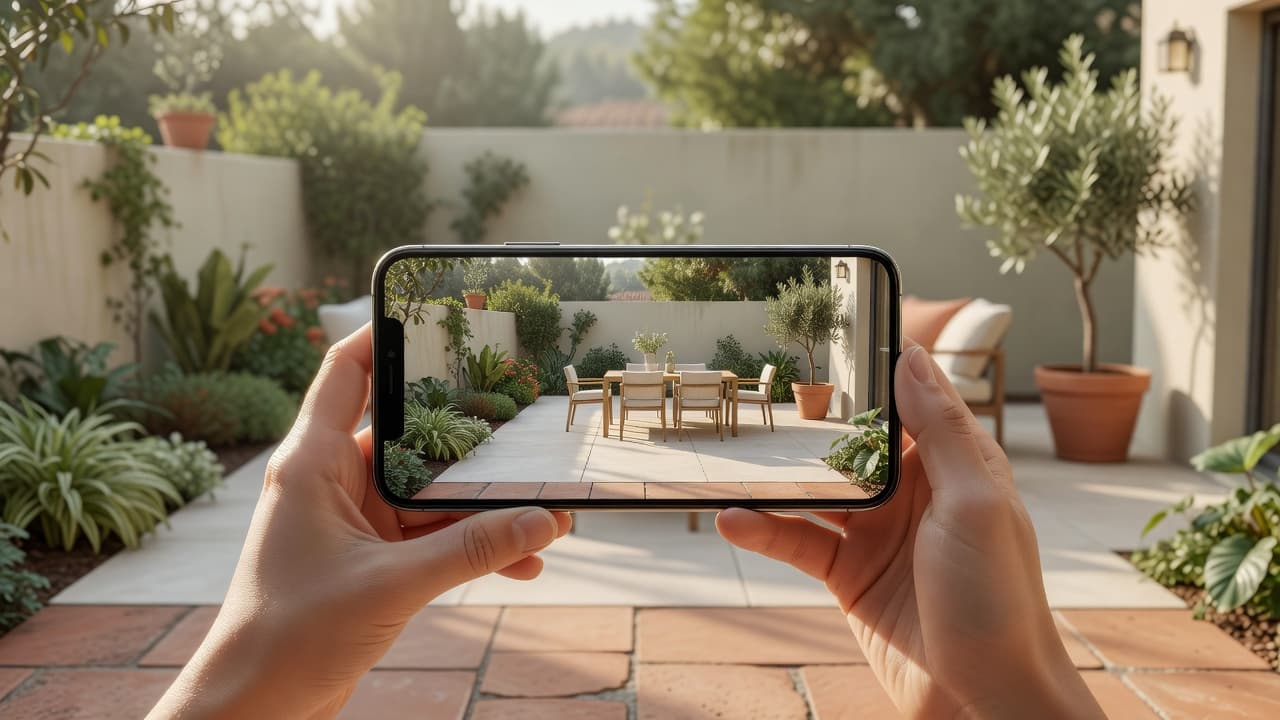
What an AI patio design app actually does
The idea is refreshingly simple. You open the app, take or pick one photo of your patio, choose a style, and a few seconds later you are looking at your own space transformed into a finished outdoor room. There is no CAD, no graph paper and no design training involved. If the whole concept is new to you, our plain-English explainer of AI garden design is the gentlest starting point, and the full AI garden design guide walks through a complete redesign with real before-and-after photos.
The word that matters is your. A weak app shows you a beautiful patio that belongs to someone else; a strong one shows you your patio, looking better, so the picture is genuinely useful when you start laying paving, buying pots or briefing a landscaper. FlorAI was built around exactly that, with a free tier, so you can see your own patio reimagined before deciding whether it is worth paying for.
Why design your patio before you build it
A patio is one of the most expensive square metres in the whole garden, and one of the hardest to undo once the paving is set. That is exactly why seeing the finished result first is worth so much. The outdoor room is also where the money comes back: a new patio is among the highest-return garden projects you can take on. A few reasons to settle the design on a photo before anyone picks up a trowel:
- It is costly to change. Once slabs are bedded on mortar, moving them means breaking them up — so a mistake in layout or material is expensive to fix.
- It returns its cost. Outdoor living areas can lift a home’s value by roughly 10–15%, and a well-built patio is among the most reliable garden improvements at resale.
- It is the heart of the garden. The patio is where you eat, sit and entertain, so getting its size, shape and flow right shapes how the whole space feels.
- It is easy to photograph. Most patios can be captured in one or two shots from a doorway or upstairs window — ideal raw material for an AI redesign.
- It sets the material palette. The paving you choose drives the colour of everything around it, so testing options on your own photo prevents a costly clash.
If your patio sits within a wider makeover, our guide to the AI backyard design app covers the whole space, while the 2026 garden design cost guide sets sensible expectations for where the budget goes.
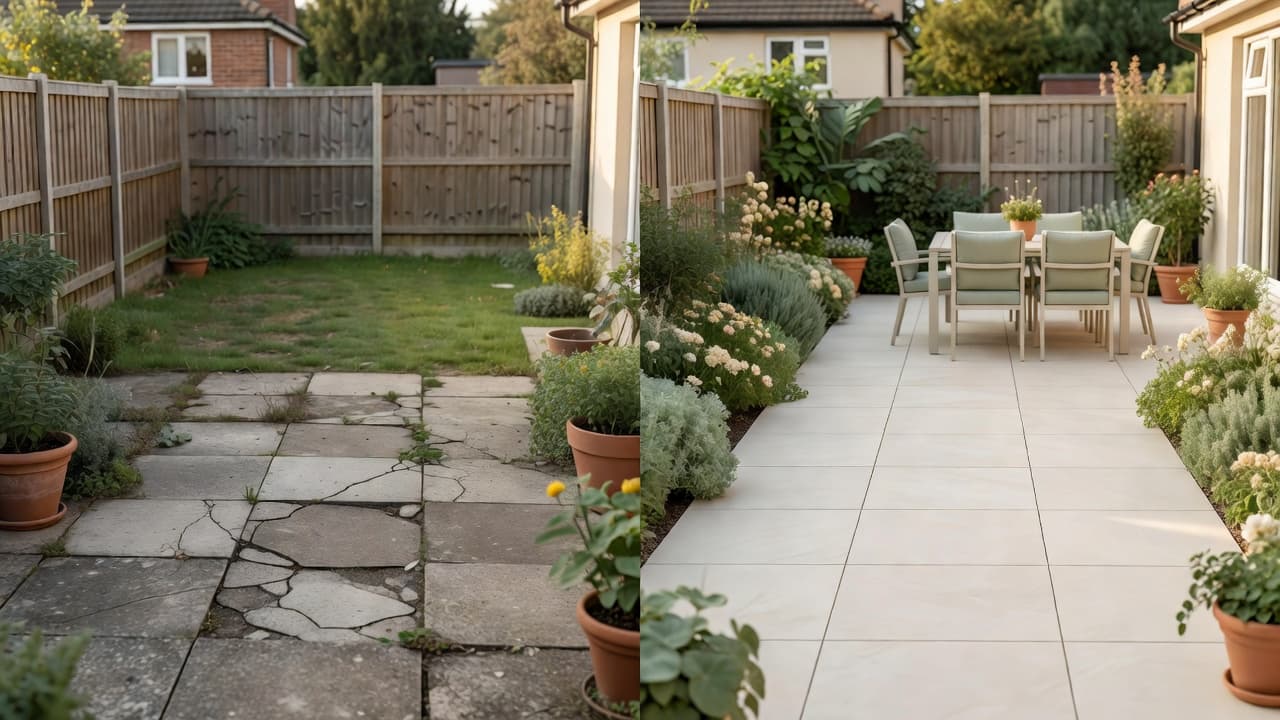
How to design your patio step by step
The first redesign takes about a minute. The process is the same whether you have a small courtyard, a long narrow side return or a wide rear terrace:
- Take or choose one photo. Stand in the doorway or at an upstairs window and capture the whole patio — paving, boundaries and the back of the house — in soft, even daylight.
- Pick a style. Modern porcelain, Mediterranean gravel-and-stone, cottage, Japandi or a low-maintenance scheme — choose the mood that suits your home, then try a second for contrast.
- Let the app redesign it. In a few seconds you will see your own patio re-paved, furnished and planted in that style, usually with the planting named.
- Refine and try variations. Ask for larger paving units, a built-in bench, a pergola overhead or more greenery around the edges, and compare the options side by side.
- Save and plan. Keep your favourites, line the before and after together, and decide what to build first — the paving, the planting or the furniture.
Because the app works from a photo rather than a blank plan, you are always editing your real patio — the actual walls, doors and boundaries — which is exactly why the output is something you can take to a builders’ merchant or a contractor. Our guide to designing from a photo versus from scratch explains why the photo route is almost always the better place to begin.
What to look for in an AI patio design app
Not every app earns a place on your home screen. Before you trust one with your patio, run through a few quick checks:
- Does it redesign your own photo? Your house wall, doors and boundaries should still be recognisable in the result. If it quietly swaps in a stock patio, the picture is useless.
- Does it suggest real materials? Look for paving you could actually order — porcelain, natural stone, sandstone, granite setts, gravel — not a vague grey blur.
- Does it name real plants? A good result names plants you could write on a shopping list — lavender, olive, ornamental grasses, climbing hydrangea — not just a green haze.
- Does it consider where you live? Climate-aware planting is the difference between a pretty picture and a scheme that survives your winters and summers in your hardiness zone.
- Is the free tier real? You should see clear, un-watermarked results and be able to try more than one style before any paywall.
An app that passes all five is worth keeping even if you never pay; one that fails two or three is worth deleting, however slick it looked. For a deeper version of this test, our checklist of what to look for in an AI garden design app turns it into a simple tick-box, and the 2026 buyer’s guide to AI garden design tools covers the features that separate a useful app from a gimmick.
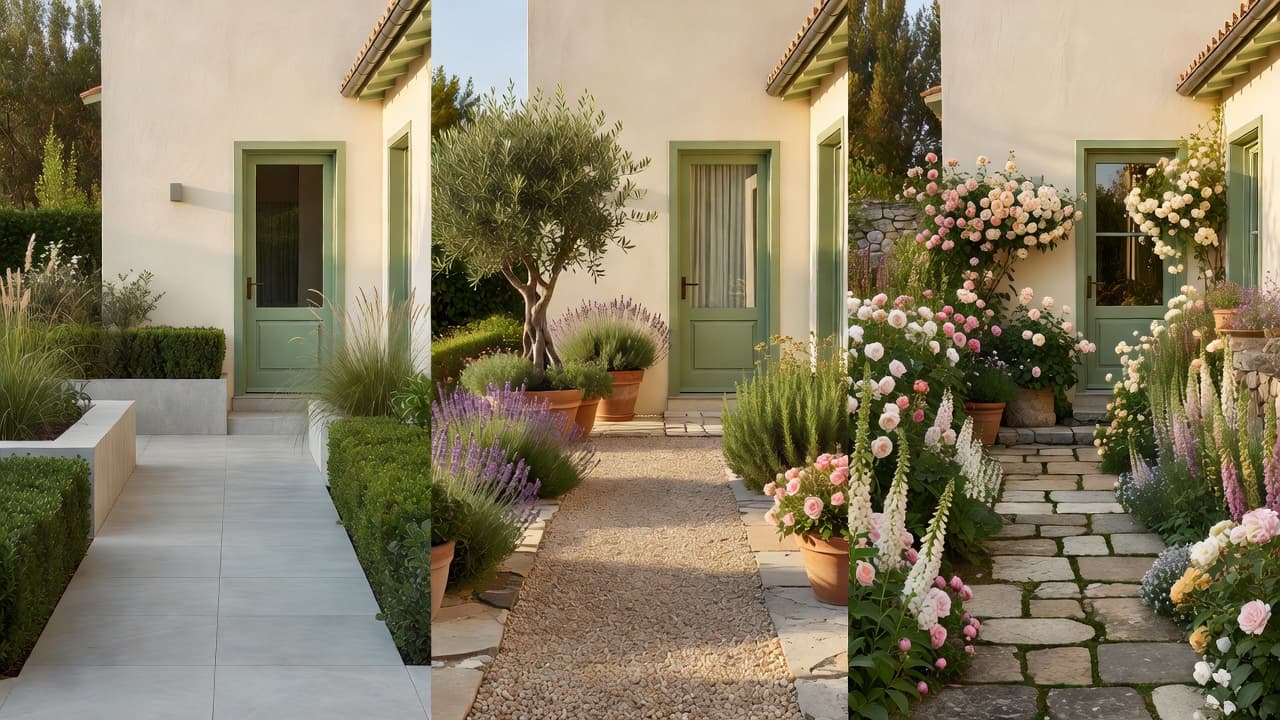
Patio materials and ideas to try in 2026
The real value of an AI patio design app is that it lets you test the year’s best ideas on your own space before committing. In 2026 patio design is all about the patio working as a true outdoor room — calm materials, blurred indoor-outdoor boundaries and low upkeep. Worth trying on your photo:
- Large-format porcelain paving. Oversized units of 60×60cm and above (24-inch and larger) are the defining look of 2026: fewer joints, a calm, contemporary surface, and a dense, low-maintenance material that resists stains and frost.
- Indoor-outdoor flow. Porcelain that mirrors your kitchen floor, run straight out through the doors with a flush threshold, makes the patio read as an extension of the living room — the strongest design move of the year.
- Mixed materials. Combining two surfaces — porcelain with gravel, stone with a darker border, paving with timber — adds texture and zones the space without walls.
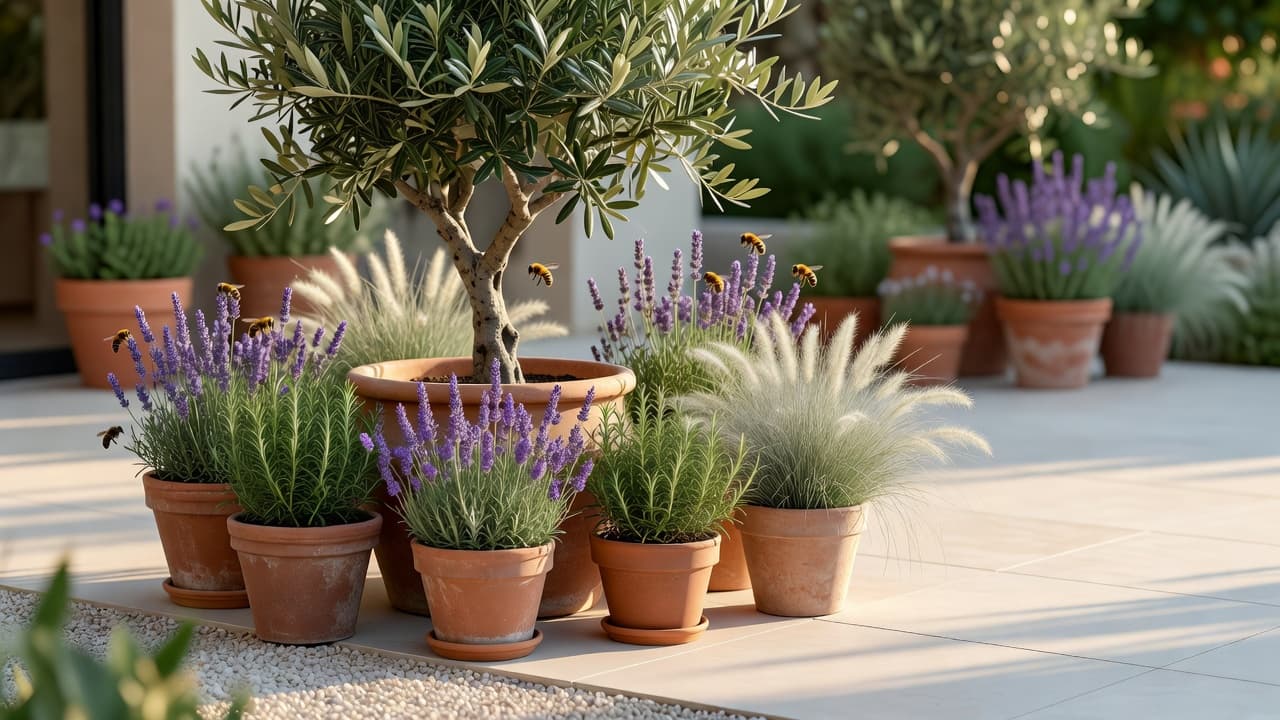
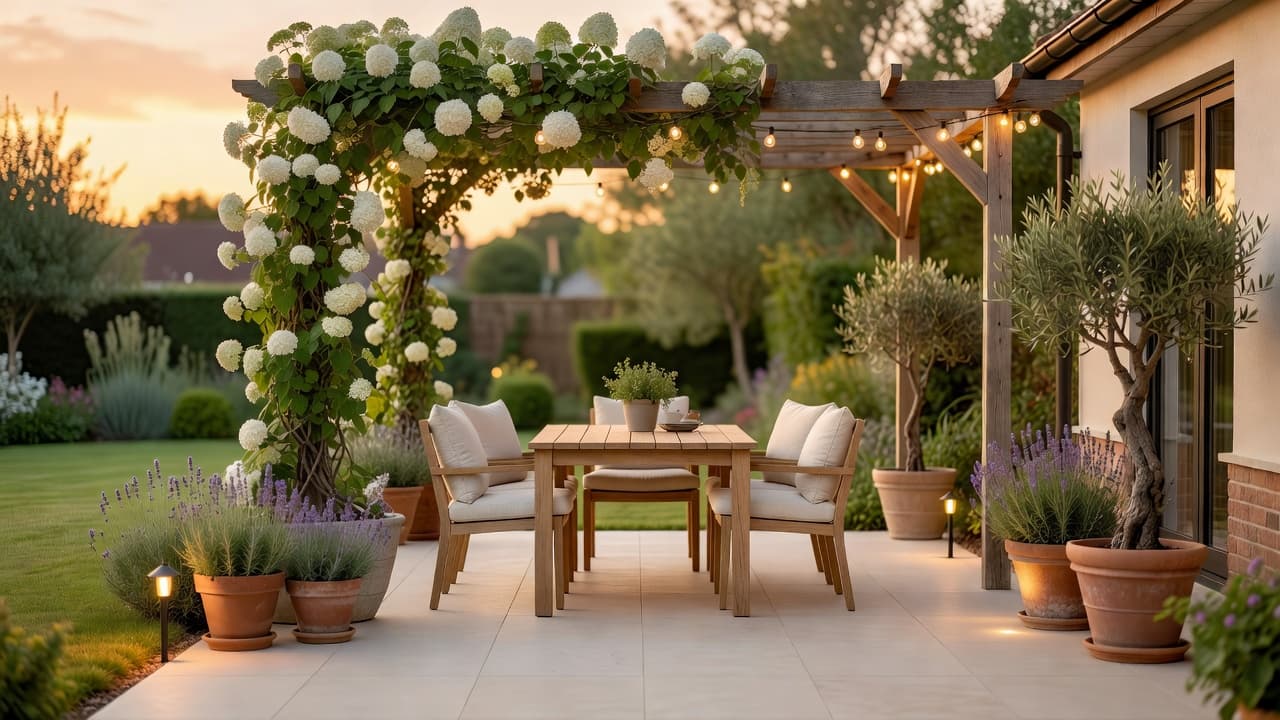
- Mediterranean planting in pots. A potted olive (the compact ‘Arbequina’ is ideal for containers), lavender, rosemary and ornamental grasses over gravel give an effortless, low-water, sun-loving patio.
- A pergola or overhead structure. A simple frame overhead — planted with a climbing hydrangea or wisteria — turns an exposed slab into a sheltered room you will actually use.
You do not have to pick one. Try each idea as a separate redesign of the same photo, then borrow the parts you like into a single plan. Drought-tolerant container planting matters more each year: as the climate warms, schemes built around lavender, olive and grasses stay handsome through a hot, dry summer with very little watering.
What a patio costs in 2026 — app vs the build
The app itself should cost little or nothing. Most good ones give you a real free tier — a set number of designs each month, enough to redesign your patio and try a few styles — with paid plans only if you want unlimited runs. That is usually plenty for a one-off project, and it is a tiny fraction of what the physical work costs.
The build is where the money goes. In the United States in 2026, a paver patio commonly runs about $12 to $30 per square foot installed, with simple poured concrete starting nearer $4–$6 and premium natural stone such as bluestone or travertine reaching $40–$50 per square foot fitted. Labour alone is typically $4–$11 per square foot, or $50–$80 an hour. Seeing the finished design first is exactly how you avoid paying twice for a change of mind — and a patio repays it: a new patio is consistently ranked among the highest-return outdoor projects at resale.
Climate awareness is the feature worth paying attention to, because it protects that spend. Pots and borders that cannot survive your winter are not a design but a disappointment waiting to happen — and the goalposts are moving. In November 2023 the USDA updated its Plant Hardiness Zone Map for the first time since 2012, using 1991–2020 data from 13,412 weather stations; the new map is about 2.5°F warmer on average, shifting roughly half of the United States into the next warmer half-zone. An app that weighs your location is doing real work, not decoration. The honest order is to explore for free first, settle the look on your own photo, and only then spend — the honest guide to free AI garden design apps explains how to tell a genuine free tier from a teaser.
Where the app stops and a landscaper begins
An honest guide names the limits. Even the best AI patio design app is a brilliant way to decide what you want, not a replacement for skilled hands when the ground gets complicated. Levels, falls for drainage, sub-bases, retaining walls, drainage runs and the laying itself still want a real landscaper. Treat the planting suggestions as a strong starting point and confirm anything unusual against your own climate — you can look up any unfamiliar plant on the RHS or Gardeners’ World, and read up on water-wise approaches at neutral references like xeriscaping before you buy.
Used that way, an AI patio design app is among the most reassuring tools you will reach for this year: it removes the guesswork, shows you the finished outdoor room in advance, and means the first slab goes down with confidence rather than hope.
Frequently asked questions
What is the best AI patio design app?
The best one redesigns your own photo (not a stock patio), suggests real paving materials, names real plants, considers your climate, and offers an honest free tier. FlorAI meets that bar with a free plan, so you can judge it on your own patio before paying.
Is there a free AI patio design app?
Yes. The honest ones offer a real free tier — a set number of designs each month, enough to redesign your patio and try a few styles. FlorAI has a free plan, with paid plans only if you want unlimited designs.
How does an AI patio design app work?
You take or upload one photo of your patio, choose a style, and the app returns a photorealistic redesign of that same space in a few seconds — new paving, furniture and planting — usually with the plants named so you can build from it.
How much does a new patio cost in 2026?
The app is usually free or low-cost. The physical build is the real expense: in the US in 2026 a paver patio commonly runs about $12–$30 per square foot installed, with concrete cheaper and premium natural stone reaching $40–$50, which is exactly why it pays to settle the design on a photo first.
Does a new patio add value to my home?
Generally yes. Outdoor living areas can raise a home’s value by roughly 10–15%, and a well-built patio is consistently among the highest-return garden improvements at resale, because buyers see it as usable extra living space.
Can an app replace a landscaper for my patio?
For the look, layout and planting it gets you most of the way and costs little or nothing. For levels, drainage, sub-bases and the laying itself you still want a professional — use the app to decide the design first, then hand your favourite over.
Last updated: June 2026. Written by the FlorAI garden team.