
Garden Styles · 2026
Japandi Garden Design: Ideas, Plants and Materials for a Calm Outdoor Space
Japandi garden design fuses the quiet asymmetry of a Japanese garden with the pared-back warmth of Scandinavian style, using natural stone, timber and a tightly restrained plant palette instead of ornament. The result is an outdoor space built around a handful of ideas: fewer plants used well, natural and weathered materials, and deliberate empty space that gives the eye somewhere to rest. This guide covers where the style comes from, the real plants and materials that define it, and how to apply it to a courtyard, balcony or full backyard — including how to preview the look on your own garden before changing anything.
AI Garden Design GuidesPublished July 11, 2026Updated July 11, 202611 min read
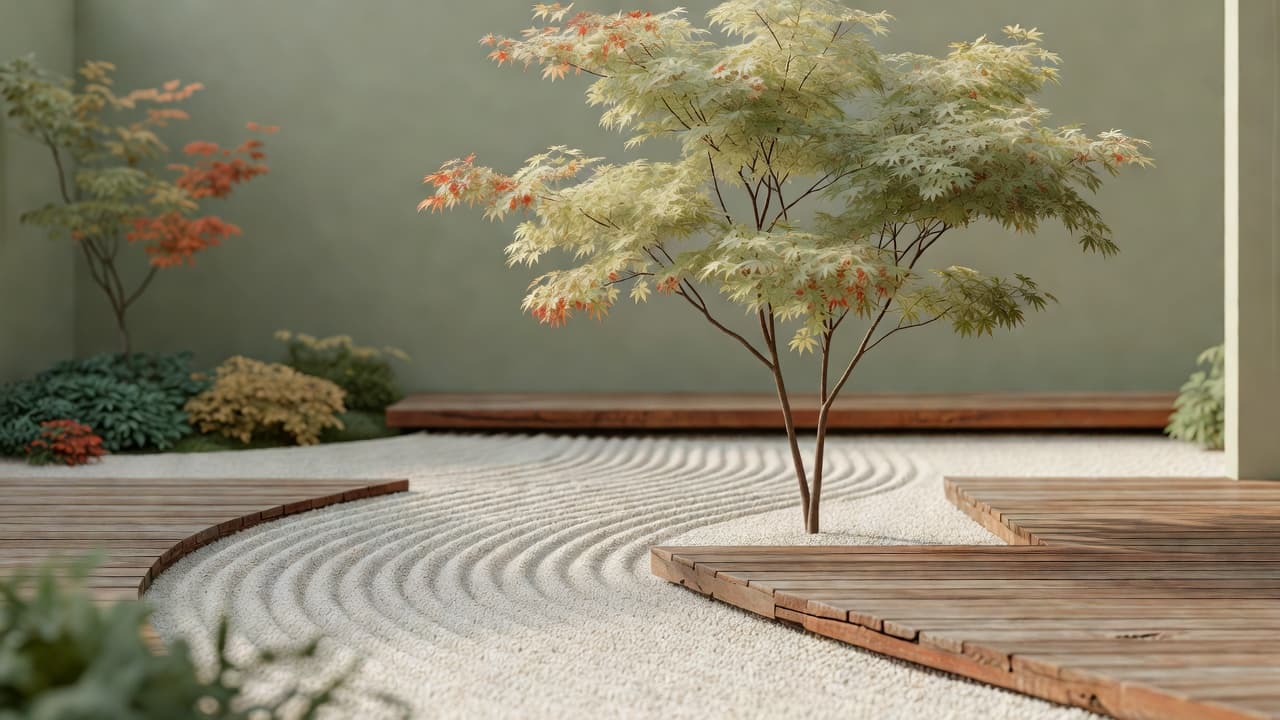
What is Japandi garden design?
The name is a portmanteau of "Japanese" and "Scandi" (Scandinavian), and it started as an interior-design trend before moving outdoors. Both traditions already share a lot: a preference for natural materials over synthetic ones, a dislike of clutter, and a belief that empty space is part of the design rather than a gap in it. Applied to a garden, that shared ground turns into a look that feels deliberate rather than decorated — closer to our wider guide on interior design principles for the garden than to a traditional cottage or ornamental planting scheme.
Where Japandi comes from: wabi-sabi meets hygge
Japanese design brings the concept of wabi-sabi — finding beauty in imperfection, age and natural wear, described in detail on Wikipedia's overview of wabi-sabi — along with the principles of a traditional Japanese garden: asymmetry, borrowed scenery, and framed views rather than a single dominant focal point. Scandinavian design contributes hygge-style cosiness, pale natural wood, and a strong bias toward function over decoration. Neither tradition is about minimalism for its own sake; both are about removing anything that does not earn its place, then making what remains feel warm and used rather than sterile.
In a garden, that translates into fewer hard landscaping materials used more carefully, fewer plant varieties repeated more often, and lighting and seating chosen for how they feel to sit in at dusk, not just how they look in a photograph.
The core principles of a Japandi garden
- Asymmetry over symmetry — plant and place things in odd-numbered, unevenly spaced groups rather than mirrored pairs either side of a path.
- Negative space (ma) — deliberately empty gravel, lawn or decking is not "unfinished"; it gives the eye somewhere to rest and makes the planting that is there feel more considered.
- Natural, honest materials — stone, timber, bamboo and rope instead of plastic, bright paint or heavily patterned tile.
- A restrained plant palette — three to six plant varieties repeated confidently, rather than a large mixed border.
- Texture over colour — bark, foliage shape and gravel do more visual work than flower colour, which is used sparingly.
- Function with warmth — every element, from a bench to a stepping-stone path, should be usable, not purely decorative.
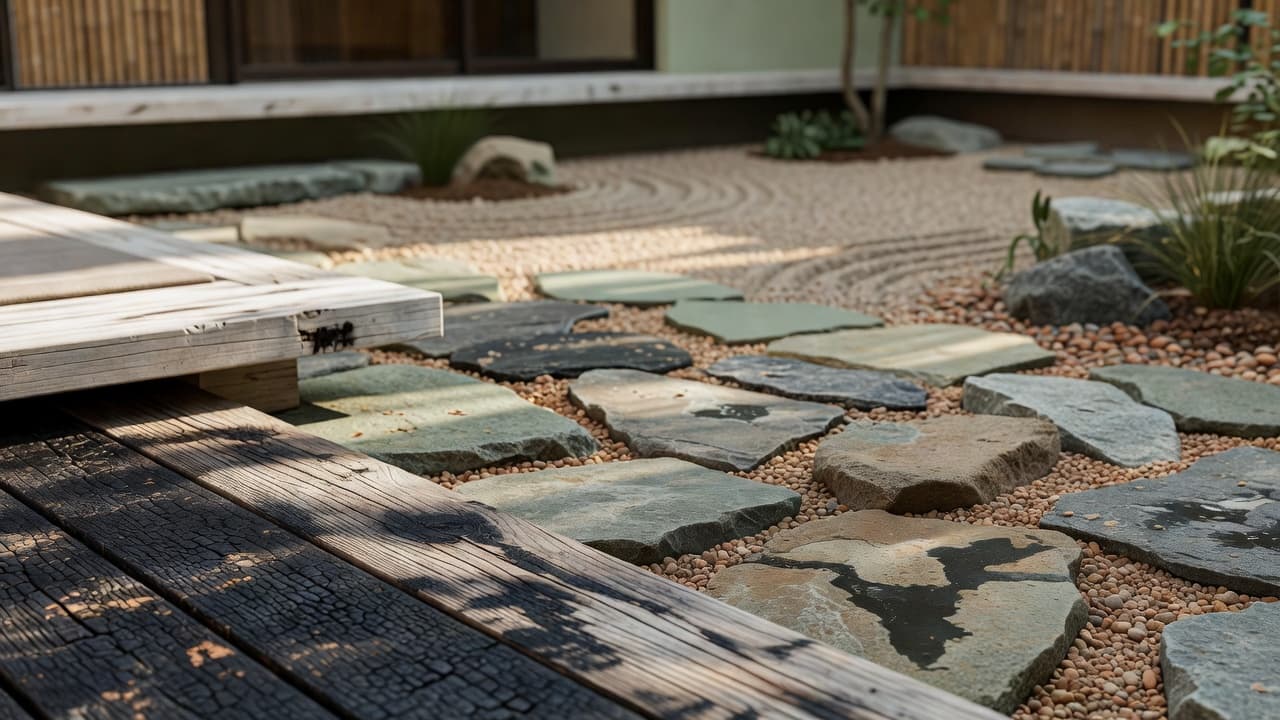
Materials: stone, charred timber and natural textures
The Japandi material palette is deliberately narrow: natural stone (real flagstone or granite setts rather than concrete pavers made to look like stone), gravel for paths and dry "streams", untreated or charred timber, and a little weathered metal such as corten steel edging that rusts to a warm, even brown.
One material worth knowing by name is yakisugi (also called shou sugi ban) — a traditional Japanese technique of charring the surface of timber cladding or fencing with fire, which chars off the softer wood fibres and leaves a durable, water-resistant, matte-black surface that needs no paint or stain. Wikipedia's entry on yakisugi traces the technique back centuries in Japan, and it has since turned up on show gardens at events such as the RHS Chelsea Flower Show, which is a reasonable sign it has moved from niche to mainstream in UK garden design.
- Paving — large, irregular natural stone slabs set with visible gaps, or raked fine gravel for a dry garden effect.
- Fencing and screens — charred (yakisugi) or simply weathered, untreated timber slats, left to silver naturally rather than stained.
- Edging — corten steel strips between gravel and planting beds, a detail borrowed from Scandinavian landscape design.
- Decking — pale, undyed timber such as thermally modified ash or larch, laid in simple straight runs rather than a herringbone pattern.
- Accents — a single hand-thrown ceramic pot, a stone water basin (tsukubai), or a coil of natural rope, used sparingly rather than repeated.
Plants for a Japandi garden (real species that work)
Plant choice in Japandi garden design favours structure and foliage over flowers, and a short list of species repeated confidently rather than a wide mixed border. For the growing conditions and care behind these species — light, soil, hardiness zone — see the RHS growing guide to Japanese maples, which notes they colour best in partial shade sheltered from strong wind and reach 4–8m at full size.
- Acer palmatum (Japanese maple) — the signature specimen tree of the style, valued for its layered branch structure in winter and fiery autumn colour; dwarf and dissectum cultivars suit a courtyard or large pot.
- Pinus species, cloud-pruned (niwaki) or left informal — evergreen structure that reads as considered rather than clipped-hedge formal.
- Phyllostachys (clumping or contained running bamboo) — height and gentle movement; always plant running types in a root barrier to stop them spreading.
- Ophiopogon planiscapus ‘Nigrescens’ (black mondo grass) — near-black, grass-like foliage used as a textural edging or gravel underplanting.
- Hakonechloa macra (Japanese forest grass) — soft, arching, lime-green foliage that softens hard paving edges.
- Moss or fine-leaved thyme — a living carpet between stepping stones in a shaded, damp courtyard, in place of grass.
- Betula (multi-stem silver birch) — a Scandinavian counterpoint to the Japanese maple, giving pale bark and dappled light.
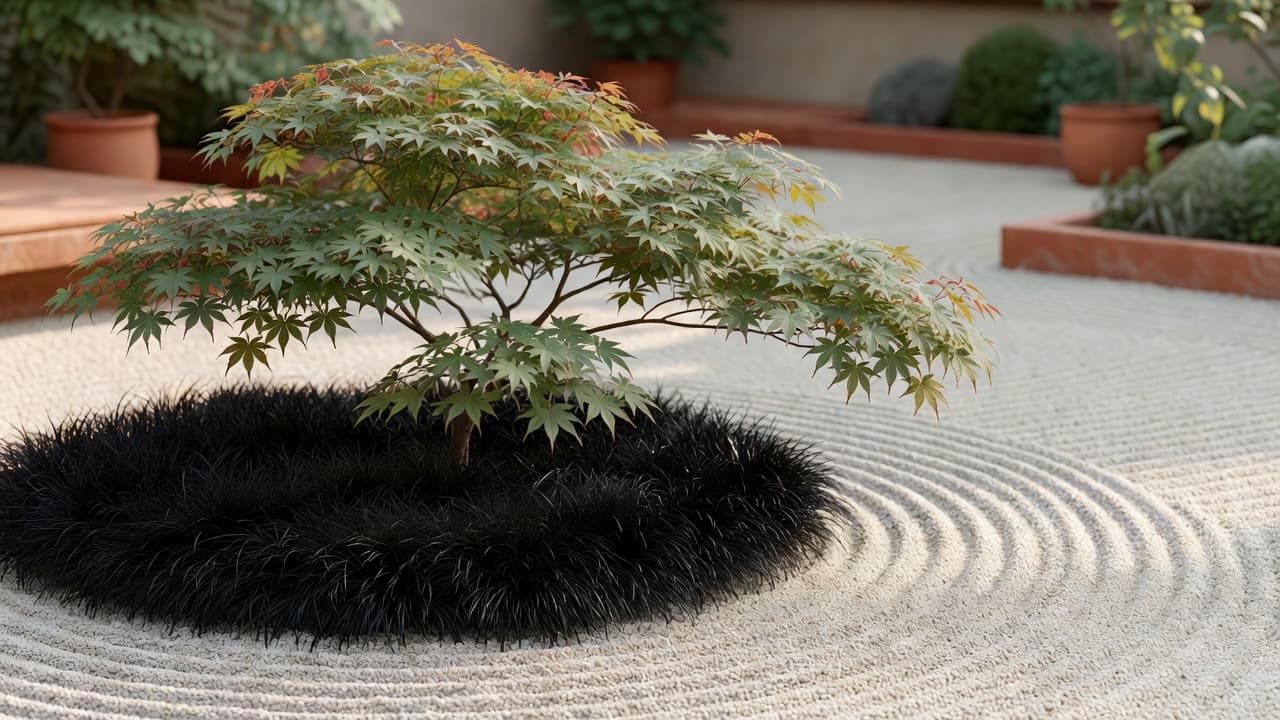
Colour palette and mood
The Japandi colour palette stays close to the materials themselves: stone grey, sand, charcoal black and warm timber brown, with deep evergreen and the occasional rust-red accent from Acer foliage in autumn. It is a close cousin of the monochromatic and analogous schemes covered in our guide to colour theory for garden design — pick two or three neutral tones and repeat them in hard landscaping, then let seasonal foliage provide the one or two accent colours that change through the year.
Avoid bright annual bedding, patterned tile, and painted fencing in saturated colours — all of it works against the calm, unified backdrop the style depends on. If a client or household wants more colour, it is better added through cushions, ceramics or a single flowering accent than through the hard landscaping itself.
Water, gravel and quiet focal points
A small water feature — a still stone basin, a simple bubbling urn, or a shallow rill — is one of the most efficient ways to add a Japandi focal point, because moving water brings sound and movement without adding visual clutter. Raked gravel, standing in for water in a traditional Japanese dry garden (karesansui), does something similar without any plumbing at all.
- Choose one focal point per sightline — a specimen tree, a water basin or a large stone — rather than several competing features.
- Set stepping stones with deliberately uneven spacing and slightly varied stone sizes; a perfectly even path reads as suburban rather than considered.
- Keep gravel to one consistent colour and grade throughout the space rather than mixing several decorative aggregates.
- Add low-level lighting — lanterns or uplighters at the base of a specimen tree — so the garden still reads calmly after dark.
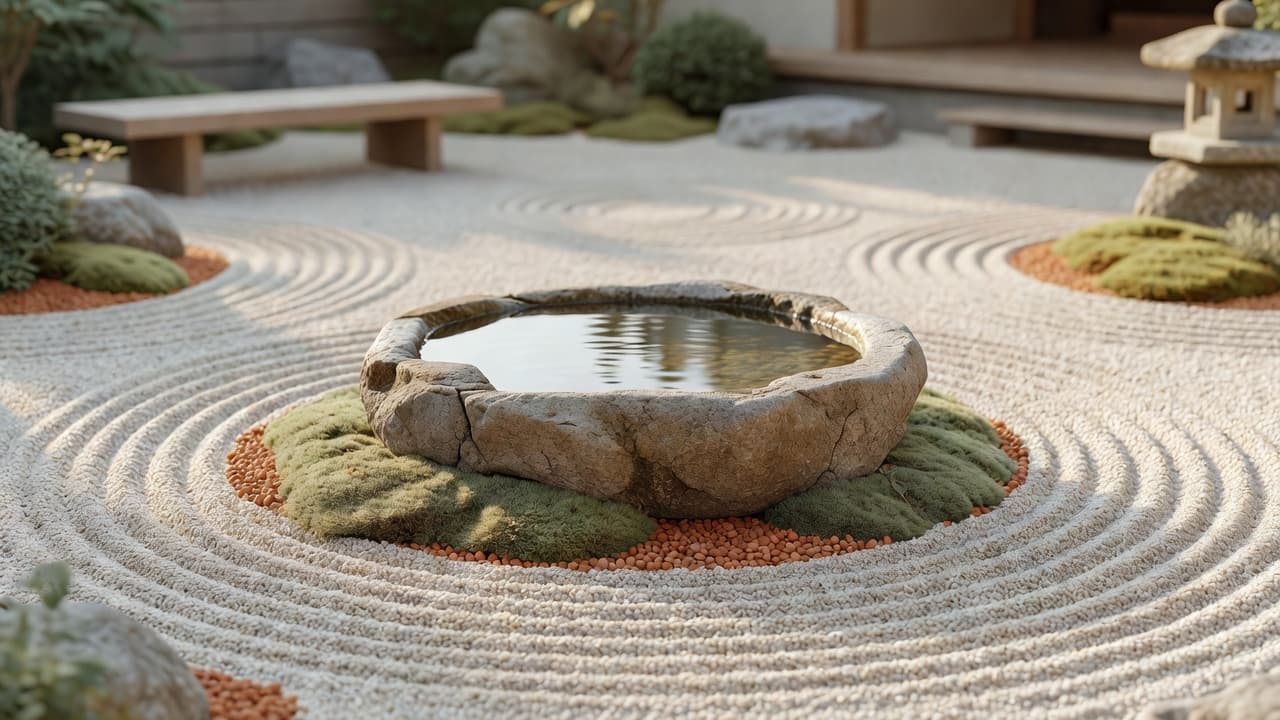
A Japandi garden by size: courtyard, balcony and full backyard
The style scales down unusually well, which is part of why it suits modern plots. A shaded courtyard can carry the whole look in miniature: gravel, one specimen tree in a large ceramic pot, and a moss-edged stepping-stone path. Our guide to small garden design covers the wider principles of designing a compact space; a Japandi approach is one of the easiest styles to apply to a tight plot because it deliberately uses fewer elements, not more.
On a balcony, the look comes down to containers: a dwarf Acer palmatum, a large glazed stoneware pot, black mondo grass trailing over the rim, and a simple timber or bamboo screen for privacy — see our balcony garden design guide for layout ideas that work in a confined footprint. A full backyard has room for a proper gravel dry garden or a raised timber deck as a distinct "room," bridging the Japandi look with a wider outdoor room layout. It is a distinct style from a traditional Japanese garden — for the classic version with koi ponds, torii gates and clipped karikomi, see our guide to Japanese garden design — Japandi is the pared-back, livable cousin built for a smaller Western plot and a lower maintenance budget.
Common Japandi garden mistakes to avoid
- Mixing too many materials — three natural materials (stone, timber, gravel) used well beats five used thinly.
- Planting too many species — a Japandi border with fifteen varieties stops reading as restrained and starts reading as a normal mixed border.
- Perfectly symmetrical layouts — mirrored planting either side of a path fights the deliberate asymmetry the style is built on.
- Skipping maintenance — bamboo left unmanaged, moss allowed to dry out, or an unpruned pine undoes the considered look within a season; the style needs light, regular upkeep, not none.
- Treating it as identical to a traditional Japanese garden — omitting Scandinavian warmth (timber, function, cosy seating) leaves a space that feels more like a show garden than somewhere to actually sit.

Frequently asked questions about Japandi garden design
What is Japandi garden design?
Japandi garden design combines Japanese garden principles — asymmetry, restraint, natural materials — with Scandinavian simplicity and function, producing a calm outdoor space built from stone, timber and a small, repeated set of plants rather than heavy ornament or a wide mixed border.
What plants work in a Japandi garden?
Japanese maple (Acer palmatum), clumping bamboo, black mondo grass, Japanese forest grass (Hakonechloa macra), moss and multi-stem birch are all common choices. The key is repeating three to six species confidently rather than using many different plants once each.
What materials are used in Japandi garden design?
Natural stone, gravel, untreated or charred (yakisugi) timber, and a little weathered metal such as corten steel edging. Bright paint, patterned tile and plastic finishes work against the natural, weathered look the style depends on.
Can a small garden or balcony be designed in Japandi style?
Yes — Japandi scales down well because it uses fewer elements rather than more. A balcony or courtyard can carry the look with one specimen tree in a large pot, gravel or timber decking, and a simple screen for privacy.
Is Japandi the same as a traditional Japanese garden?
No. A traditional Japanese garden follows centuries-old conventions such as koi ponds, torii gates and precisely clipped karikomi hedging. Japandi borrows Japanese restraint and asymmetry but blends it with Scandinavian warmth, function and a lower-maintenance plant list, making it more suited to a smaller Western garden.
Can an AI garden design app help plan a Japandi garden?
Yes. An app such as FlorAI can generate a photo-realistic Japandi redesign from a single photo of a real garden, courtyard or balcony, making it easy to test the gravel, timber and planting layout before any material is bought.
Last updated: July 2026. Written by the FlorAI garden team.