
Design ideas · 2026
Zen Garden Design Ideas: Philosophy, Layout and Plants for 2026
Good zen garden design is less about the objects you add and more about the space you leave alone. A calm karesansui-style garden rests on a handful of Japanese design principles — asymmetry, restraint, and roughly 70% open ground to 30% planted or built — arranged around one fixed viewing point. This guide walks through the philosophy, a practical step-by-step layout, and the plants and materials that turn a plain corner, courtyard or side return into a genuine meditation garden, without needing a whole garden to do it.
AI Garden Design GuidesPublished September 7, 2026Updated September 7, 202610 min read
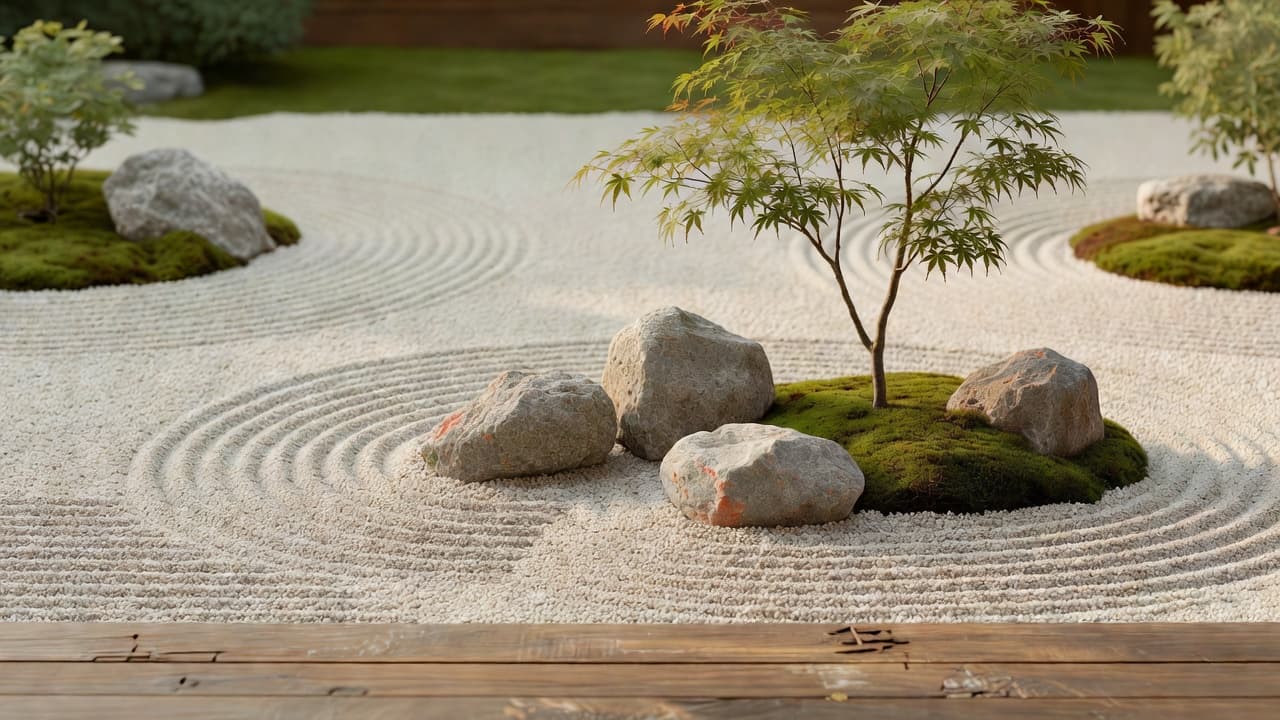
Zen garden design, in one sentence
That single idea — space as the main material — is what separates a genuine zen garden from a rockery with a Buddha statue dropped into it. The rest of this guide unpacks the philosophy behind it, a workable layout method for an ordinary backyard, and the plants that keep the look authentic rather than kitsch. If you would like to see your own garden turned into a finished zen design from a photo rather than build one from scratch, our Japanese garden design app guide covers the tool side of this in depth.
The philosophy behind a zen garden
The style traces back to karesansui — literally “dry mountain water” — dry-landscape gardens built by Zen Buddhist monks in medieval Japan as an aid to meditation, most famously at Kyoto’s Ryōan-ji. A handful of design ideas from that tradition still do all the work today:
- Fukinsei (asymmetry). Nothing is centred or paired. Stones are grouped in odd numbers — three, five, seven — because odd groupings read as natural rather than arranged.
- Kanso (simplicity). Say less. One good lantern beats five; one specimen tree beats a border full of them.
- Shizen (naturalness). Every material looks as though it arrived by nature, not by catalogue — a stone is placed to show its best natural face, never a slab cut to a neat square.
- Ma (meaningful emptiness). The gap between the stones matters as much as the stones. Open gravel and moss give the eye somewhere to rest.
- Shakkei (borrowed scenery). A neighbour’s tree, a distant roofline or the sky itself is framed into the view instead of screened out, so a small garden borrows a sense of scale from what lies beyond it.
You do not need to have read a word of Zen Buddhism to use these. They translate into two practical habits: decide what to leave out before you decide what to add, and place everything as if nature put it there. The Royal Horticultural Society’s overview of Japanese garden design is a good, neutral primer if you want the fuller history before you start.
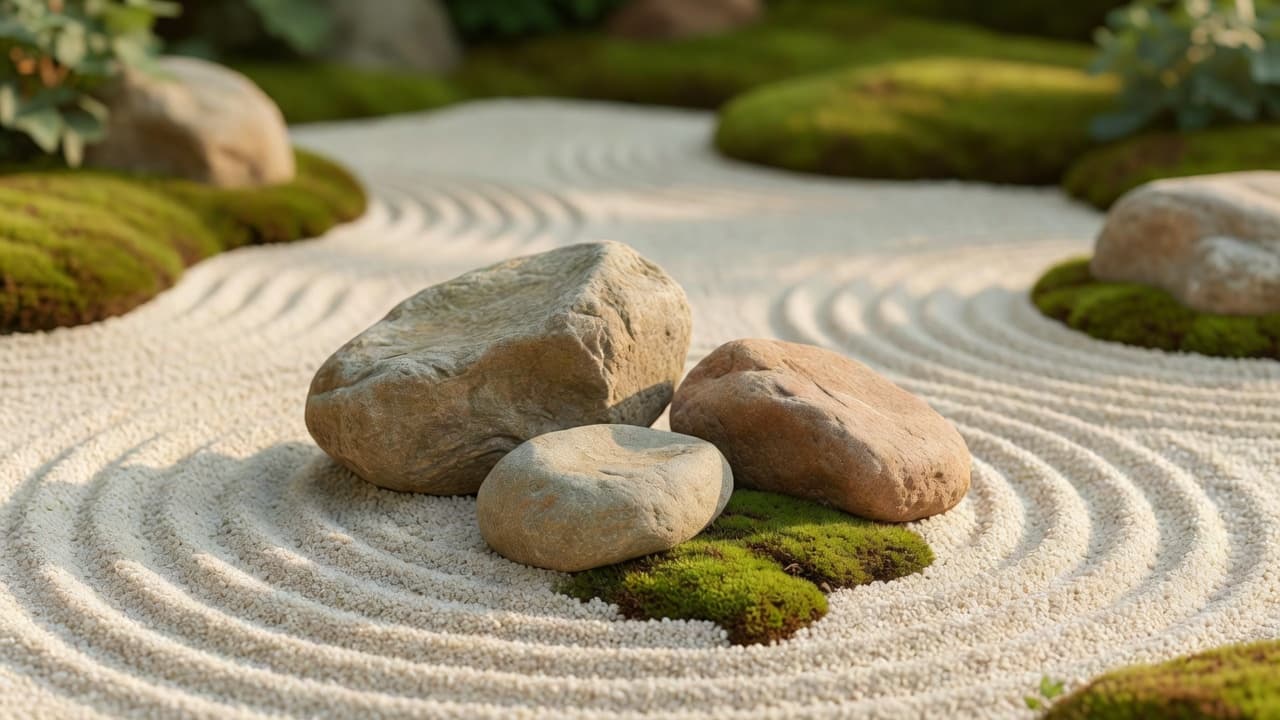
The 70/30 rule: how much space to leave empty
If you take away one number from this guide, make it this one: aim for roughly 70% open, unplanted ground — raked gravel, sand or moss — to 30% stone, planting or built features. It is the single most common mistake in Western attempts at the style: over-filling the space with lanterns, bridges, koi and colourful planting until the calm disappears entirely.
The 70/30 split is not a rigid formula so much as a discipline. Before adding another stone, another plant or another ornament, ask whether the garden still has room to breathe. A zen garden that looks slightly under-furnished is usually closer to correct than one that looks finished in the conventional sense.
Choosing your zen garden style
Most home zen gardens draw on one of a few traditional forms. Pick the one that matches your space and how you want to use it, rather than trying to fit all of them in:
- Karesansui (dry landscape). Raked gravel or sand stands in for water, with stone groupings for mountains or islands and almost no planting. The lowest-maintenance option, and the one that suits a small, enclosed or shaded courtyard best.
- Tsubo-en (courtyard garden). A small, walled or fenced garden — often no bigger than a light well or side return — built purely to be viewed, not walked through, from a window, deck or veranda.
- Roji (tea garden). A mossy path of stepping stones leading to a simple water basin and, traditionally, a tea house. Understated and deliberately unpolished (wabi-sabi) rather than pristine — see our wabi-sabi garden design ideas for more on that aesthetic.
- Tsukiyama (hill-and-water garden). A larger, more naturalistic composition with an artificial mound, stones and trees, meant to be strolled around a pond. This needs real space, and is closer to a Japanese-style landscape than a meditation corner.
For most suburban plots, karesansui or a tsubo-en courtyard is the realistic starting point — both scale down to a 3m × 4m corner without losing their meaning, because the principles are about proportion and restraint, not about square footage.
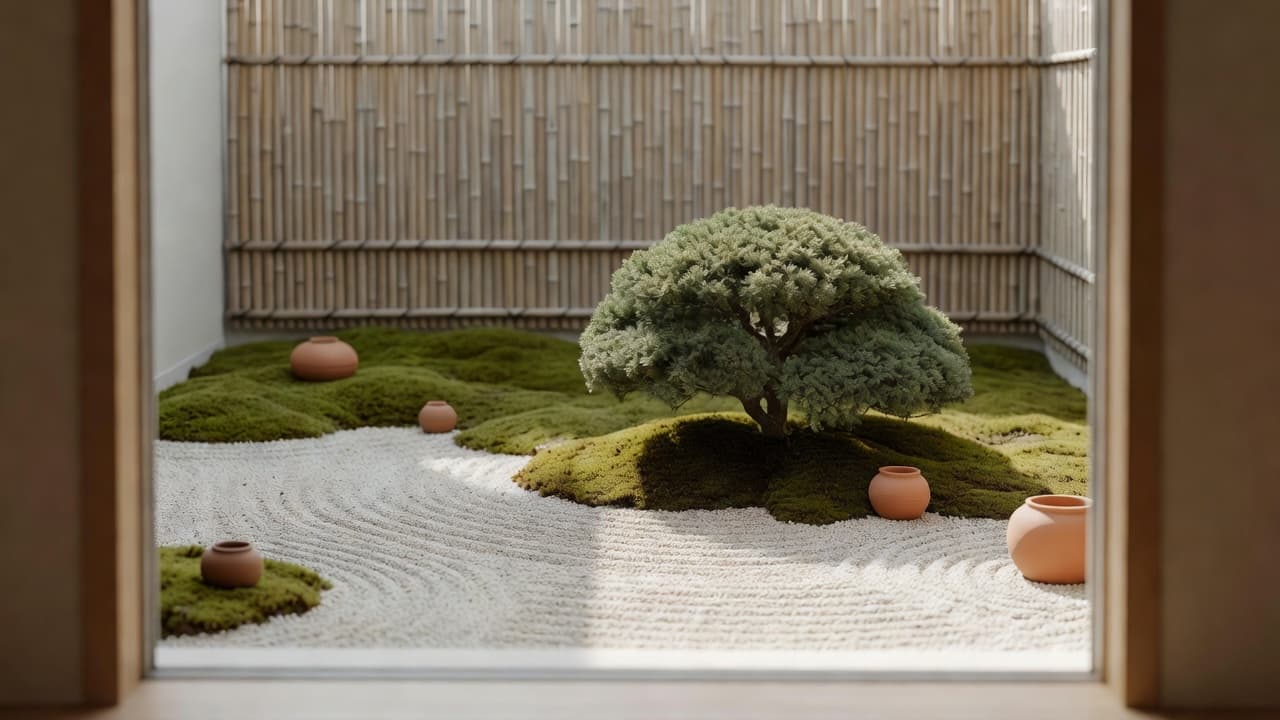
How to lay out a zen garden step by step
The layout sequence matters more than any single ingredient. Work in this order and the proportions tend to look after themselves:
- Fix your viewing point first. A zen garden is composed for a single vantage — a bench, a deck, a window — not for walking through. Decide where you will sit or stand before you place anything else.
- Define the boundary. A low wall, bamboo screen or hedge frames the space and gives the "borrowed scenery" beyond it something to be framed against.
- Place the stones first, in odd-numbered groups. Choose three, five or seven stones of varying size, set at irregular angles and depths — burying the base of each by roughly a third makes it look settled rather than dropped.
- Lay the gravel or sand around them. Pale granite gravel is the traditional choice; rake it in curved or straight lines that suggest ripples moving around the stones, leaving the 70% rule in mind as you go.
- Add a single path if the garden will be entered. A line of flat stepping stones set with soft, irregular gaps slows the pace naturally — see the next section for how spacing affects it.
- Introduce planting last, and sparingly. One tree, a low mound of moss or clipped evergreen, and perhaps a grass — resist the urge to fill every remaining gap.
- Stop before it feels finished. If in doubt, remove the last thing you added rather than add one more.
Because a zen garden is essentially a photograph-worthy composition, it is one of the easiest garden styles to test before you build it — lay stones out roughly with cardboard or buckets first, or preview the finished look on a photo of your own space with FlorAI, which shows an AI-generated zen-style redesign of your actual garden in seconds. Our broader AI garden design guide covers the same before-you-build approach for every style.
Stepping stones and paths: designing for a slower pace
A stepping-stone path in a zen or meditation garden is deliberately awkward to rush. Stones are set with a slightly uneven, irregular gap and gentle curve rather than in a straight, evenly spaced line, which forces a slower, more deliberate footstep — a small piece of walking meditation built into the layout.
- Use flat-topped natural stone at least 30–45cm across so each step feels secure underfoot.
- Bed each stone so roughly a third of its depth sits below grade — a stone that rocks or sits proud looks unfinished and is a trip hazard.
- Vary the gap slightly between stones rather than making it perfectly regular; a small irregularity is what makes the path feel natural rather than laid.
- Curve the path so the destination is not visible from the start — this is the "hide and reveal" principle (miegakure) that makes a small garden feel larger than it is.
If your zen corner includes a water basin (a tsukubai), position it near the path or entrance, since it was traditionally used for a moment of ritual hand-washing before continuing — a small pause that the whole garden is designed to encourage.
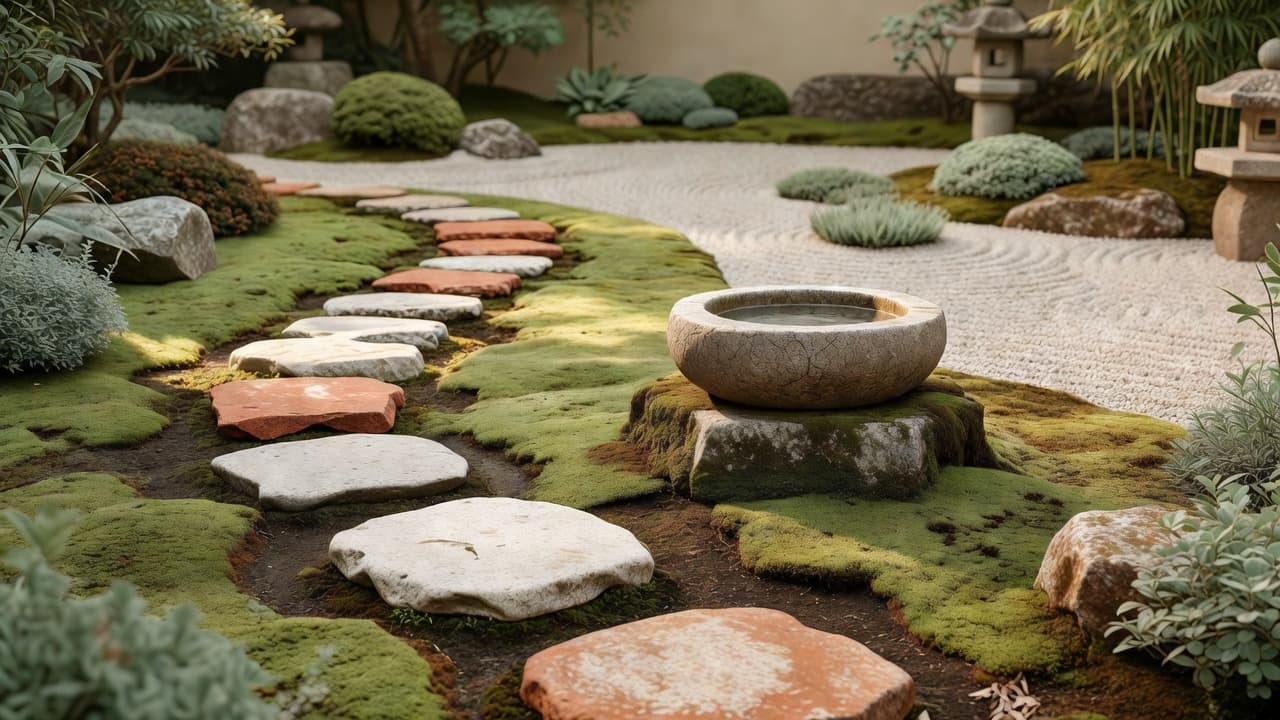
Plants and materials for a zen garden
The planting palette in zen garden design is intentionally small, mostly evergreen, and chosen for form and texture rather than flower colour:
- Japanese maple (Acer palmatum) as the single specimen tree, prized for its shape as much as its autumn colour; most cultivars suit USDA zones 5–8 with some shelter from harsh wind.
- Cloud-pruned pine or clipped evergreens — Japanese black pine, box or dwarf conifers — for year-round structure that does not change with the seasons.
- Moss, real where shade and humidity allow, or low Ophiopogon (mondo grass) as a practical substitute in drier or sunnier gardens.
- Clumping bamboo (choose a clumping Fargesia rather than a running variety) for screening and gentle movement without it taking over the bed.
- Pale granite gravel or sand for the "water" — light-coloured stone rakes more clearly and reads as water more convincingly than dark aggregate.
Confirm any plant against your own conditions before buying — the RHS plant finder and the USDA Plant Hardiness Zone Map are both free, reliable places to check. If gravel as a surface interests you beyond a zen corner, our gravel garden design ideas covers drought-tolerant planting through gravel more broadly, and if stone groupings are the part you find most appealing, garden design with rocks goes deeper on placing and sourcing them.
Common mistakes in zen garden design
Most zen gardens that feel wrong have fallen into one of a few avoidable traps:
- Too many ornaments. A red bridge, a stone lantern, a Buddha statue and a pagoda in the same small space reads as a garden centre display, not a meditation garden. Pick one.
- Even-numbered or centred stone groups. Pairs and centred arrangements read as formal and man-made; odd numbers and off-centre placement read as natural.
- Bright, mixed flower colour. Save colour for elsewhere in the garden — a zen corner works in green, grey and stone tones with at most one seasonal accent.
- No fixed viewing point. A zen garden designed to be seen from everywhere ends up composed for nowhere. Choose one seat or window and design to it.
- Skipping the empty space. If every part of the plan has something in it, the 70/30 balance has already been lost — go back and take something out.
Frequently asked questions
What is the difference between a zen garden and a Japanese garden?
A zen garden (karesansui) is one specific, dry-landscape style within the wider tradition of Japanese garden design, built for contemplation from a fixed viewpoint using stone, raked gravel and minimal planting. "Japanese garden" is the broader category, which also includes water-and-hill gardens (tsukiyama) and strolling gardens with ponds, paths and bridges.
How big does a zen garden need to be?
It can be genuinely tiny. Because the principles are about proportion and restraint rather than square footage, a 3m × 4m corner, a side return or even a large planter can hold a complete, convincing composition — a stone grouping, raked gravel and one specimen plant.
What is the 70/30 rule in zen garden design?
It is a practical guide to proportion: roughly 70% of the space should stay open and unplanted — gravel, sand or moss — with about 30% given to stone, planting or built features. It is the discipline that keeps a zen garden calm rather than cluttered.
What plants are used in a zen garden?
The palette is deliberately small: a Japanese maple as a specimen tree, clipped evergreens or cloud-pruned pine for structure, moss or mondo grass at ground level, and sometimes clumping bamboo for screening. Flower colour is minimal or seasonal rather than a main feature.
Can I build a zen garden in a shady courtyard?
Yes — a shaded, enclosed space suits the karesansui or tsubo-en styles particularly well, since moss, ferns and Japanese maples generally prefer some shade, and the dry-landscape style needs no direct sun to work.
Do I need real running water in a zen garden?
No. The whole point of karesansui, the dry-landscape style, is that raked gravel or sand represents water without needing a pond, pump or stream — a genuinely low-maintenance choice for a small garden.
Last updated: September 2026. Written by the FlorAI garden team.