
Garden Styling · 2026 guide
Garden Lighting Design: Layers, Colour Temperature and Placement for 2026
Garden lighting design is the practice of layering four kinds of light — path, ambient, accent and safety — so a garden works after dark instead of disappearing into it. Good garden lighting design starts with low-voltage or solar fixtures around 2700K, aimed down and shielded rather than glaring outward, placed to draw the eye through the space rather than to light every corner equally. This guide covers the light layers, the low-voltage-vs-solar decision, colour temperature, exact placement, and the mistakes that make a lit garden look flat instead of considered.
AI Garden Design GuidesPublished July 17, 2026Updated July 17, 202611 min read
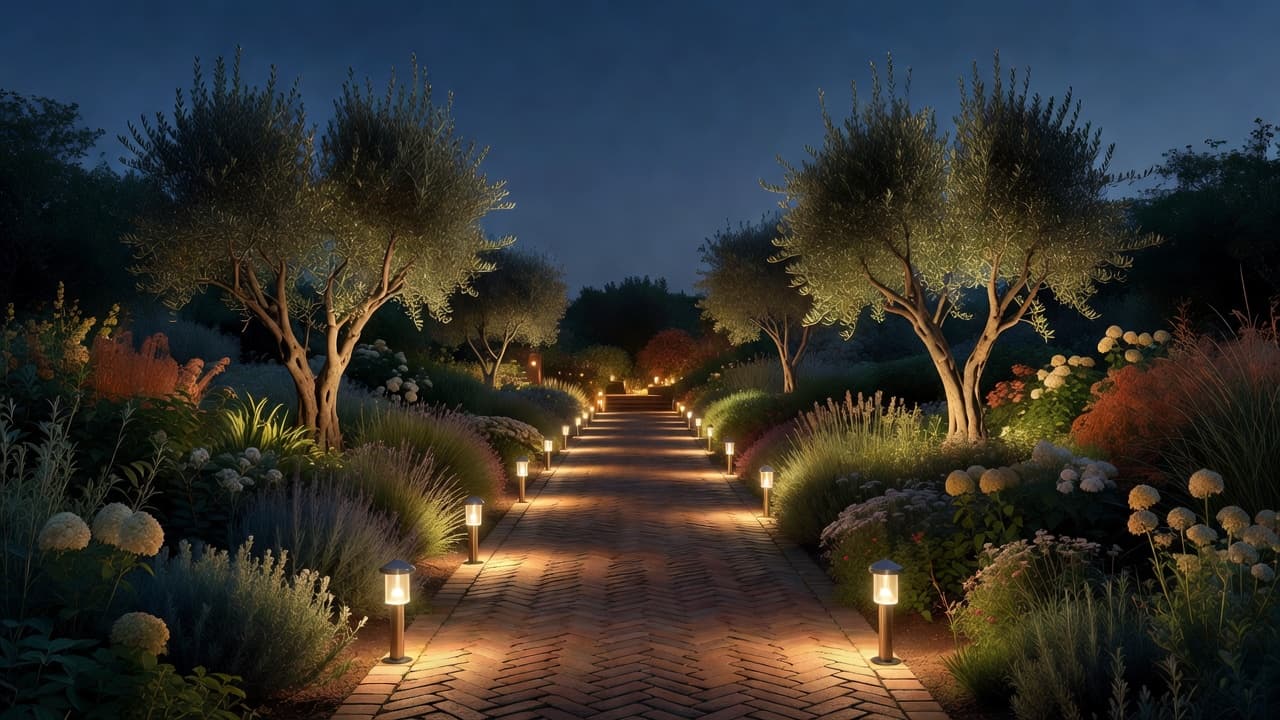
What is garden lighting design?
The goal is not to light the whole garden evenly — it is to create pools of light and shadow that draw the eye through the space, the same way a well-lit room uses a mix of ceiling, lamp and accent light rather than one bright overhead bulb. RHS guidance on lighting a garden makes the same point: use path lights to create lead-lines that draw people into the space, and favour warm white over cold white for a homely glow rather than a car-park feel.
Garden lighting design sits at the intersection of layout, planting and style, so it works best once the rest of the design is settled. If you have not yet planned the wider space, our AI garden design guide is a good place to start before adding lighting on top.
The four layers of garden lighting design
Almost every well-lit garden uses some combination of four layers, added roughly in this order:
- Path and step lighting. Low-level fixtures that mark a safe route and stop trips on steps, thresholds and changes in level — the first layer to install, not the last.
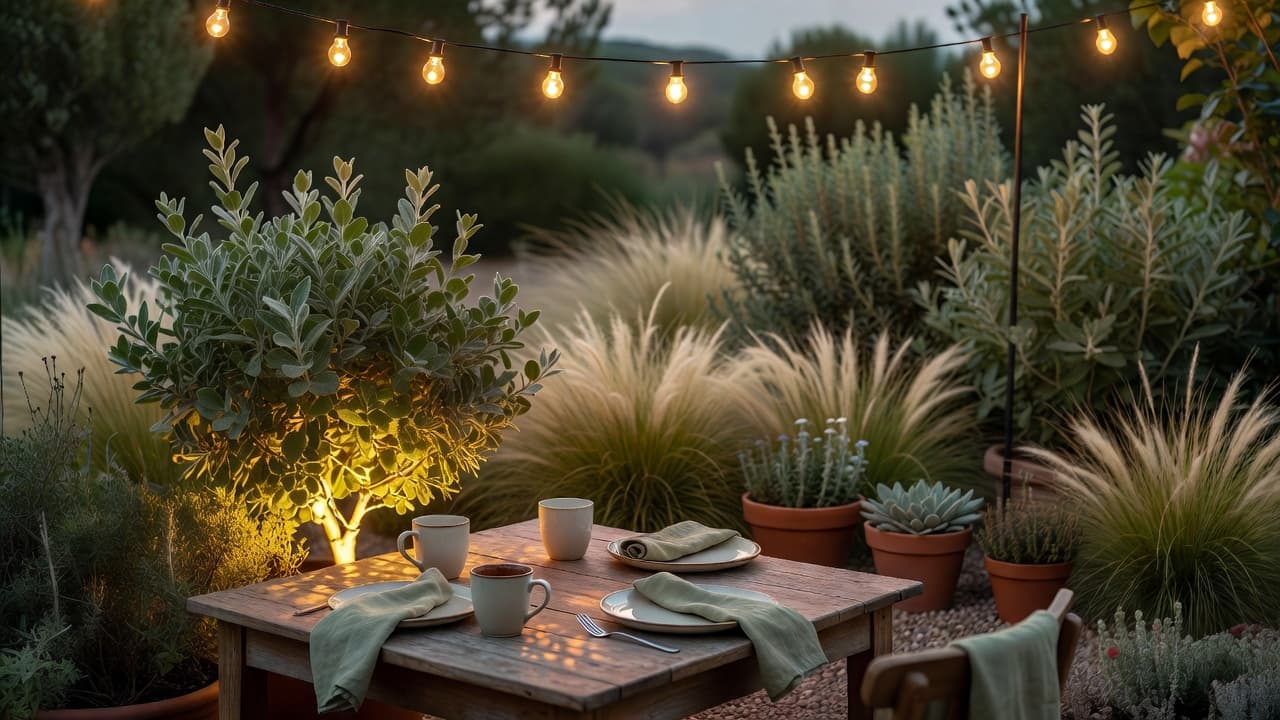
- Ambient or general light. Softer, wider light around seating and dining areas — string lights, lanterns or wall-mounted fixtures — that lets people actually use the space after dark.
- Accent or feature lighting. Uplights on a specimen tree, spotlights on a sculpture, or backlighting through ornamental grasses to pick out texture and movement — Gardeners' World notes that spotlights are the most versatile fixture for uplighting shrubs, trees and foliage.
- Safety and security lighting. Motion-triggered floodlights near entrances and gates, kept separate from the decorative layers so they only come on when needed.
A garden does not need all four layers at once. Most small or starter gardens do well with just path and accent lighting; ambient and security layers tend to get added later as the space and budget grow.
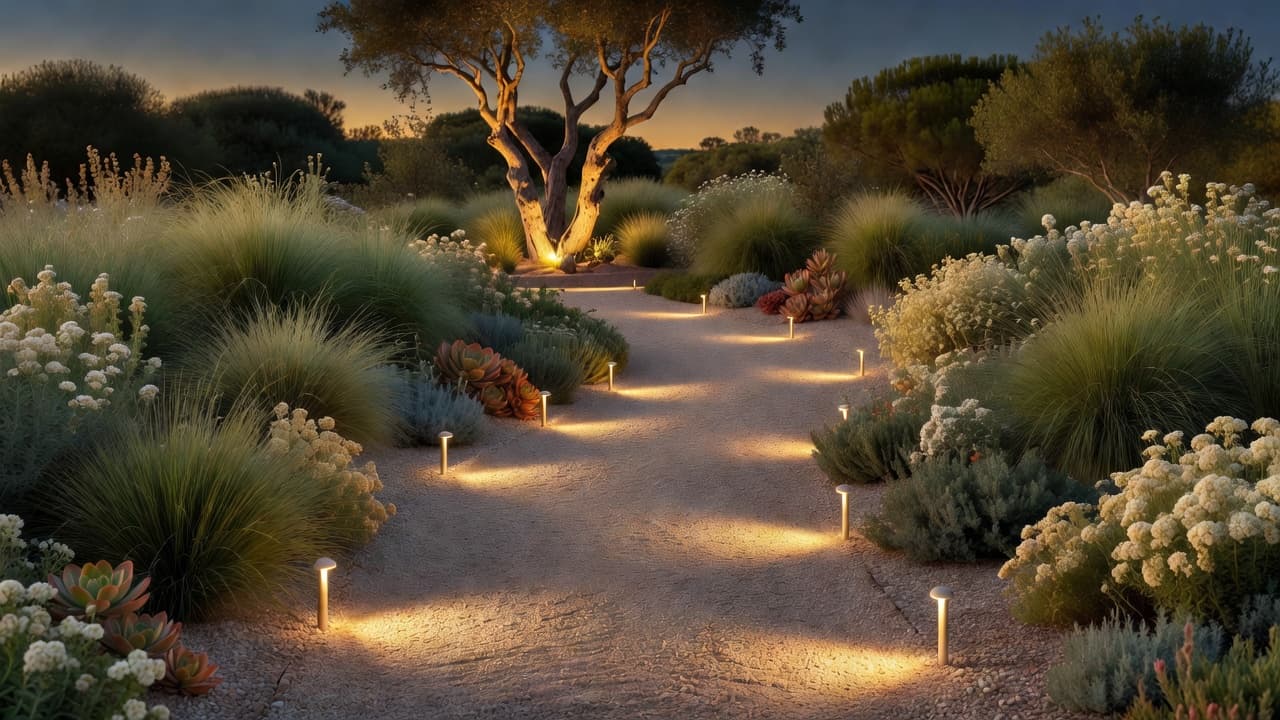
Low-voltage, solar or mains: which garden lighting to choose
Most residential garden lighting design in 2026 comes down to a choice between low-voltage (12V) wired systems and solar fixtures, with mains-voltage lighting reserved for permanent architectural features that need an electrician.
- Low-voltage (12V) wired lighting. A transformer near the house steps mains power down to 12V, feeding a run of cable to individual fixtures. It is safe to install without an electrician for most DIY runs, reliable regardless of weather, and dimmable or schedulable through the transformer or a smart controller. The trade-off is a cable run to plan and, on longer runs, voltage drop — a good rule of thumb is no more than around 100 watts of fixtures per cable run, splitting long runs into two shorter ones from the transformer rather than one long daisy chain.
- Solar lighting. No cabling and near-zero running cost, which makes it the easiest layer to add to an existing garden. Modern solar fixtures for 2026 use higher-efficiency panels and lithium-phosphate batteries that hold charge for roughly 10–12 hours on a good day, addressing the dim, unreliable light older solar units were known for — though performance still drops in a run of cloudy days or deep shade, so solar suits path and accent lighting better than anything relied on for safety.
- Mains-voltage (240V/230V) lighting. Needed for permanent architectural lighting, anything wired into the house circuit, or high-output security floodlights. This work needs a qualified electrician and, in most areas, must meet outdoor electrical safety regulations — budget accordingly and treat it as the exception rather than the default.
For most gardens, a mix works best: low-voltage for the permanent path and accent layers, solar for anything moved seasonally like planter uplights, and mains reserved for security lighting near entrances.
Choosing colour temperature and avoiding light pollution
Colour temperature, measured in Kelvin, has more effect on how a garden feels at night than almost any other lighting decision. Lower numbers mean warmer, more amber light; higher numbers mean cooler, bluer light closer to daylight.
- Stick to warm white — around 2700K to 3000K — for almost every fixture in a residential garden. It reads as homely rather than clinical, and it is the range DarkSky International recommends for reducing the impact of outdoor lighting on the night sky and nocturnal wildlife.
- Use fully shielded, downward-facing fixtures rather than exposed bulbs. This keeps light on the ground and planting where it is useful, rather than spilling upward or into neighbouring gardens and windows.
- Avoid cold white or daylight-balanced (4000K+) fixtures outdoors — they are common on cheap security floodlights but make a garden feel like a car park rather than an extension of the house.
- Keep wildlife in mind. RHS research on garden lighting and wildlife found that artificial light at night can disrupt moths, bats and other nocturnal species, so limiting lighting to the hours it is actually used, on a timer or smart schedule, is worth doing even in a small garden.

Where to place garden lights
Placement matters more than fixture count. A handful of lights in the right spots reads as considered; a dozen in the wrong spots reads as cluttered.
- Light the route first. Mark paths, steps and any change in level with low, offset fixtures spaced roughly 2–3 metres apart — close enough to guide the eye without creating an airport runway.
- Backlight or uplight one or two specimen plants. A single well-placed uplight on a multi-stem tree or a backlit stand of ornamental grass does more than even lighting across an entire border — movement and texture read especially well after dark.
- Frame the seating or dining area with ambient light. String lights overhead, a lantern on the table, or wall-mounted fixtures at a lower level bring people into the space rather than lighting it from a distance.
- Use water and reflective surfaces sparingly. A single submersible light in a pond or water feature, or a fixture angled to catch a glass or metal surface, adds movement without extra fixtures.
- Keep security lighting separate and motion-triggered. Position it near entrances and gates only, on its own circuit or timer, so it does not compete with the decorative layers.
For a small garden, patio or balcony, this whole placement plan can shrink to two or three fixtures — see our small garden design guide for the wider layout principles that garden lighting design should follow, and our outdoor room design ideas guide for how lighting fits alongside shelter and furniture in an outdoor living space.
Smart and app-controlled garden lighting in 2026
Smart control has become the default rather than the upgrade for low-voltage systems in 2026. A transformer with a Wi-Fi or Bluetooth controller lets a household set schedules, dim fixtures for different occasions, and group lights into zones — path lighting on a strict dusk-to-11pm schedule, say, with accent lighting on a separate, later timer for evenings when the garden is actually in use. Some systems also offer colour-changing LEDs for occasional use, though for everyday garden lighting design a fixed warm white still reads as more considered than shifting colour.
The planning stage benefits from the same kind of visual testing as any other part of a redesign. FlorAI can generate a photo-realistic preview of how path, accent and ambient lighting would actually look in your own garden from a single daytime photo, which makes it far easier to agree on fixture placement with a partner or a landscaper before anything is bought or installed.
Garden lighting design mistakes to avoid
- Overlighting. Trying to evenly light an entire garden removes the shadow that makes the lit areas feel intentional — pools of light and dark do more work than uniform brightness.
- Mixing colour temperatures. A warm 2700K path light next to a cold 5000K solar spike looks unplanned; keep every fixture in the same warm-white range.
- Ignoring voltage drop. On a long low-voltage run, fixtures at the far end can visibly dim — split long runs into two shorter cable runs from the transformer instead of one continuous chain.
- Skipping the wildlife check. Lighting left on all night near hedges, ponds or dense planting can disturb moths, bats and hedgehogs — a timer or smart schedule limits lighting to the hours the garden is actually used.
- Buying budget solar first. Cheap solar stake lights with small panels are the most common disappointment in garden lighting — spend the budget on one or two better-quality solar or low-voltage fixtures rather than a dozen weak ones.
Frequently asked questions about garden lighting design
What is the best colour temperature for garden lighting?
Warm white, roughly 2700K to 3000K, suits almost every residential garden. It reads as calm and homely, and it is the range recommended by dark-sky organisations for reducing the impact of outdoor lighting on wildlife and the night sky.
Should I choose low-voltage or solar garden lighting?
Low-voltage (12V) wired lighting is more reliable and works regardless of weather, making it the better choice for path and safety lighting. Solar suits accent lighting or fixtures that get moved seasonally, since modern solar units with lithium-phosphate batteries perform far better than older versions but still dim in extended cloudy weather.
How many garden lights do I actually need?
Fewer than most people expect. A small garden or patio often needs only two or three well-placed fixtures — one to mark the route, one to accent a specimen plant or seating area — rather than lighting every corner evenly.
Does garden lighting disturb wildlife?
It can. Research from the RHS has found that artificial light at night affects moths, bats and other nocturnal species, so using warm colour temperatures, shielded fixtures aimed downward, and a timer or schedule rather than dusk-to-dawn lighting all help reduce the impact.
What is voltage drop and why does it matter?
Voltage drop is the loss of brightness in fixtures placed far from a low-voltage transformer, worse the longer the cable run and the more fixtures on it. Splitting a long run into two shorter runs from the transformer, rather than one continuous chain, keeps fixtures at both ends similarly bright.
Can AI help plan garden lighting design?
Yes. An AI garden design app like FlorAI can turn a single daytime photo of a garden into a photo-realistic preview showing where path, accent and ambient lighting would sit, which makes it easier to agree on fixture placement before buying anything.
Last updated: July 2026. Written by the FlorAI garden team.