
Garden Styles · 2026 guide
Coastal Garden Design: Plants, Windbreaks and Ideas for a Seaside Garden (2026)
Coastal garden design solves three problems at once: salt carried on the wind, the wind itself, and sandy, fast-draining soil. The trick is not toughness for its own sake — it is choosing plants and materials that already cope with spray and gusts, then arranging them so the garden actually feels sheltered rather than beaten back by the weather. This guide covers the real salt-tolerant plants, windbreak strategy and hardscaping materials behind good coastal garden design in 2026, plus how to scale the look from a sheltered courtyard to a fully exposed backyard.
AI Garden Design GuidesPublished August 5, 2026Updated August 5, 202610 min read
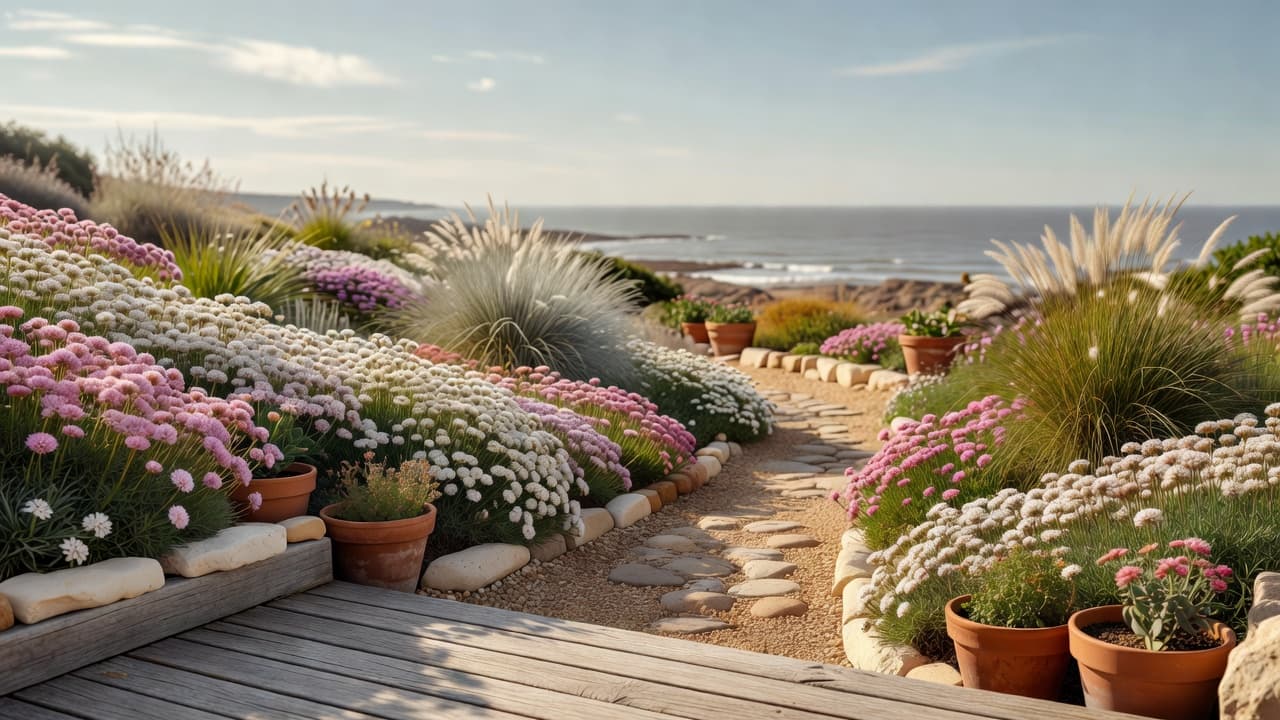
What is coastal garden design?
That is the underlying logic. The rest of this guide gets specific: the real plants proven to survive salt spray, how to build a windbreak that softens wind instead of fighting it, the materials that hold up to sea air, and how the look scales from a sheltered courtyard to a fully exposed backyard. For the wider picture of planning any outdoor space, see our AI garden design guide.
A coastal garden is not simply a Mediterranean or drought-tolerant garden moved to the beach, even though the plant lists overlap. Lavender, rosemary, santolina and cistus — all staples of Mediterranean garden design and drought-tolerant, xeriscape planting — cope well with wind and poor soil, but not every one of them tolerates direct salt spray at the shoreline, so it is worth checking each species individually before planting it right at the boundary.
The three challenges of a coastal garden: salt, wind and sandy soil
Every coastal garden design decision, from plant choice to fence style, is really a response to three overlapping pressures:
- Salt spray — carried on the wind from breaking waves, it settles on foliage and scorches leaf tissue, especially on the side of a plant facing the sea. Broad, soft leaves suffer the most; small, tough or waxy leaves cope far better.
- Wind — a near-constant presence close to open water, it dries out soil and plants faster than an inland garden of the same size, and strong gusts can physically snap soft new growth before it has a chance to toughen up.
- Sandy, free-draining soil — water and nutrients wash through quickly, so ordinary bedding plants often struggle even where wind and salt are not the limiting factor.
None of these are reasons to avoid a coastal garden — they are simply the starting brief. Work with them and a coastal plot can be some of the lowest-maintenance, most distinctive planting anywhere, precisely because the conditions rule out anything fussy.
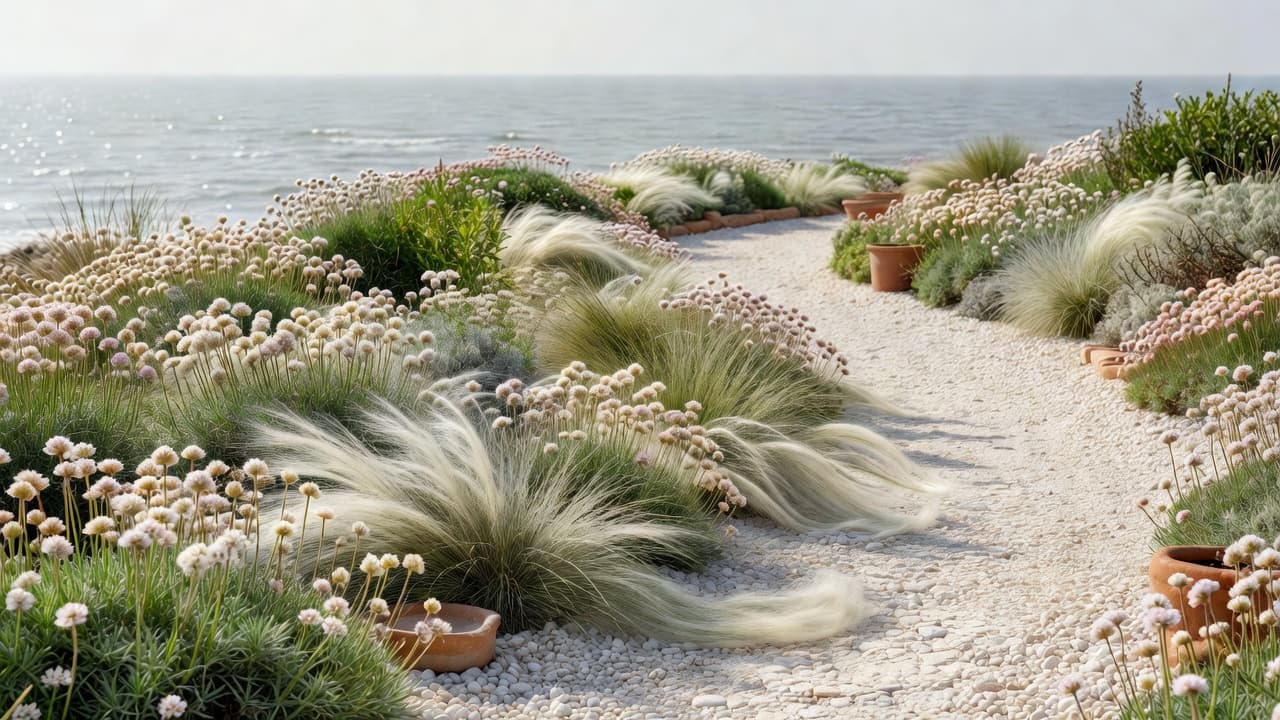
Plants that survive salt spray and coastal wind
The RHS guide to plants for coastal areas and its advice on coastal foliage and flower planting are both good starting points for choosing species by how exposed a site actually is. As a rough rule, plants such as escallonia, griselinia, hebe, tamarisk and sea thrift are tolerant enough to grow within around 50 metres of open shoreline, while more tender species are usually planted further back, in the shelter of a windbreak.
- Armeria maritima (sea thrift) — one of the most recognisable coastal plants in the UK and Ireland: compact, grassy foliage topped with rounded pink or white flowerheads, happy in poor soil right at the shoreline.
- Eryngium maritimum (sea holly) — metallic-blue stems and spiny, architectural foliage, thriving in sunny, free-draining, sandy sites.
- Crambe maritima (sea kale) — thick, waxy, blue-grey leaves built to shrug off salt spray; a genuinely native coastal species in the UK.
- Escallonia — a glossy-leaved evergreen shrub commonly used as a salt-tolerant hedge close to the shore.
- Griselinia littoralis — thick, waxy leaves and a dense habit make it one of the most reliable coastal hedging shrubs.
- Hebe — compact evergreen shrubs, many with small, leathery leaves that resist wind and salt damage well.
- Tamarix (tamarisk) — feathery foliage and a naturally wind-sculpted habit; one of the toughest small trees for an exposed coastal boundary.
- Phormium (New Zealand flax) — bold, strap-like, waxy leaves that barely flinch in salt-laden wind, useful as a structural anchor plant.
- Rosa rugosa — a tough, disease-resistant wild rose that copes with sandy soil and salt spray far better than most garden roses.
- Limonium (sea lavender) — papery, long-lasting purple-blue flowerheads over low, salt-tolerant foliage, good at the front of a border.
- Ammophila arenaria (marram grass) — the classic dune grass, with deep, fibrous roots that stabilise loose sand and cope with almost constant wind.
Once a windbreak is established, the shelter behind it can support a wider palette — the same lavender, rosemary and santolina used in Mediterranean garden design often do well a little further from the spray line, along with ornamental grasses that move naturally in the wind instead of resisting it.
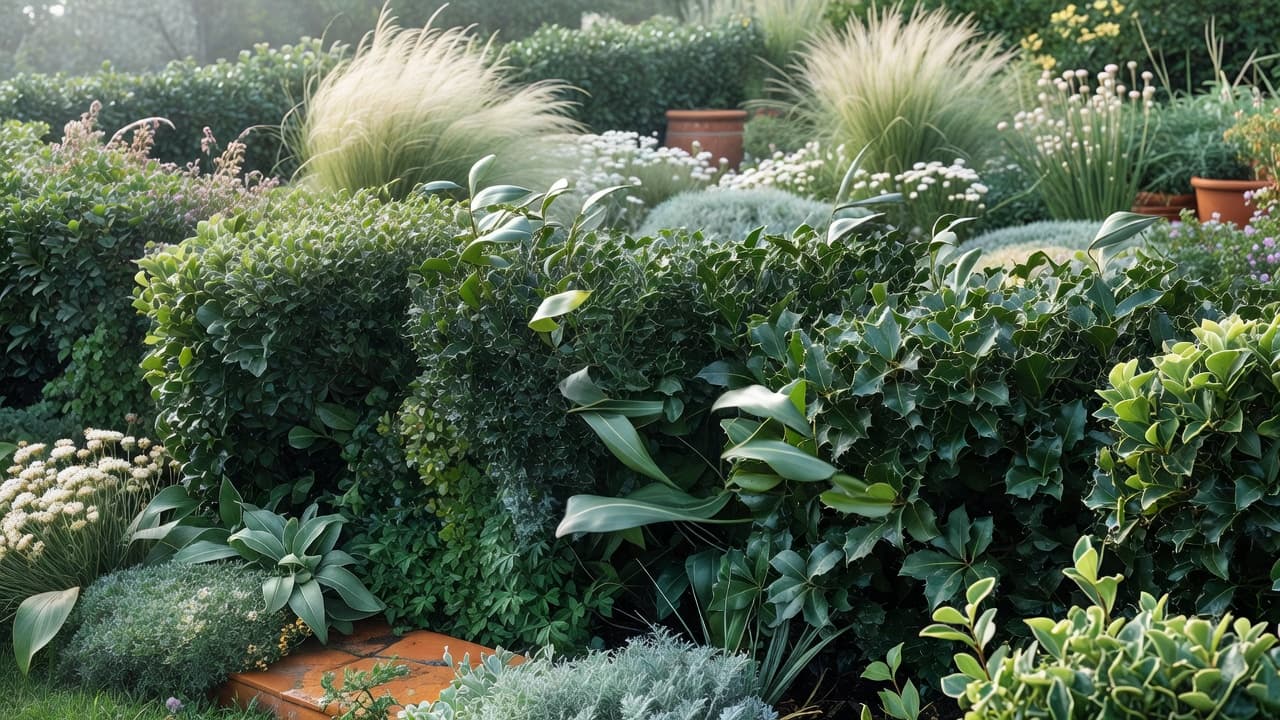
How to build a windbreak that actually works
A windbreak is the single most useful thing a coastal garden design can include, but the instinct to put up a solid wall or fence is usually the wrong one. A solid barrier blocks wind directly in front of it but creates turbulence on the leeward side, which can buffet plants harder than the open wind would. A permeable barrier — a hedge, or a slatted screen with gaps — filters the wind and slows it gradually over a much longer distance, which is exactly what the RHS recommends when it advises forming a windbreak or shelter belt from a wind-filtering screen of trees or shrubs rather than a solid one.
- Choose a permeable barrier first — a mixed hedge or a slatted fence, not a solid wall or close-boarded panel, so wind is filtered rather than deflected into turbulence.
- Plant the toughest species on the seaward side — escallonia, griselinia or tamarisk absorb the worst of the salt and wind before it reaches anything more delicate behind them.
- Layer the planting behind the windbreak, with hardier plants at the front and more tender species further into the shelter it creates.
- Stake and protect new windbreak plants for their first season or two — young roots have not yet anchored the plant, which is when wind damage is most likely.
Give a windbreak two or three growing seasons to establish before judging how sheltered the garden behind it has become; a young hedge does far less filtering than a mature one.
Materials and hardscaping for a seaside garden
Planting is only half of coastal garden design — the hard landscaping has to survive salt air too, which behaves differently from an ordinary inland garden.
- Decking and timber — naturally durable hardwood or pressure-treated softwood, oiled regularly; expect faster silvering and greying from salt air and UV than an inland deck would show.
- Fixings — stainless steel or marine-grade fittings resist the corrosion that ordinary galvanised screws and brackets suffer within a season or two near the sea.
- Paving — local stone or textured porcelain that stays grippy when damp from spray or rain; glossy, highly polished finishes become slippery underfoot near the coast.
- Boundaries — a permeable hedge or slatted screen rather than a solid wall, for the windbreak reasons above.
- Mulch — gravel or shell mulch instead of loose bark, which blows away in constant wind.
- Furniture — powder-coated aluminium or teak rather than untreated mild steel, which rusts quickly in salt-laden air.
The colour palette tends to follow the materials: driftwood grey, sea-glass green, sand and chalky white, lifted by one saturated accent such as a painted blue door or gate — a similar principle to the limited, repeated palettes covered in our guide to colour theory for garden design.
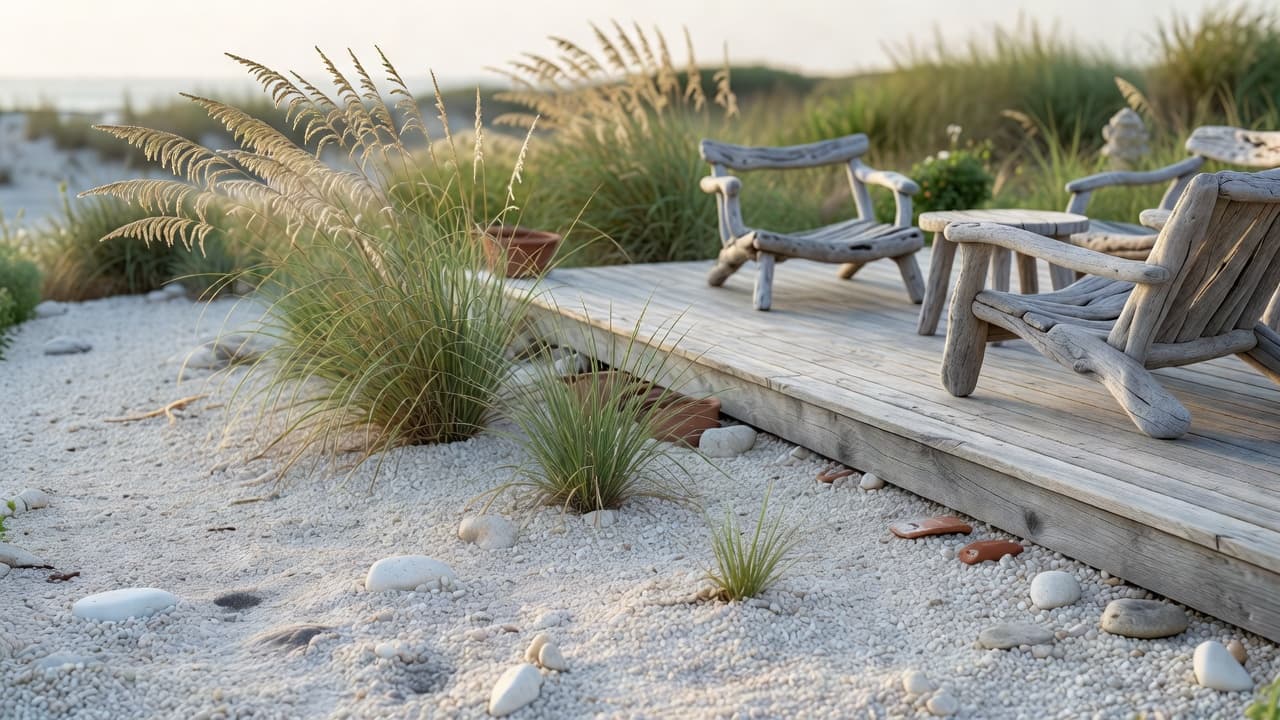
Coastal garden design by space: courtyard, balcony and full garden
A sheltered courtyard close to the coast often needs less windbreak work than an open backyard, since surrounding walls already do some of the filtering — the same compact layouts covered in our small garden design guide translate well here, with sea thrift, sea holly and a single wind-sculpted tamarisk doing most of the work in a tight footprint. A coastal balcony is more exposed, since it usually sits above the shelter of surrounding buildings; container planting of hebe, armeria and low grasses, plus a slatted windbreak screen rather than solid glass panels, suits the constant wind — see our balcony garden design guide for layout ideas suited to a small, wind-exposed space. A full, open backyard has room for a proper hedge windbreak, a dune-style planting of marram grass and sea holly on the seaward side, and a sheltered dining area treated as a distinct outdoor room once the windbreak has had a season or two to establish.
Common coastal garden design mistakes to avoid
- Planting tender specimens right at the boundary before a windbreak has had time to establish — give the hedge or screen a head start first.
- Relying on a solid wall or fence as the only windbreak, which creates turbulence rather than shelter on the leeward side.
- Using bark mulch, which blows away in constant wind — gravel or shell mulch stays put and suits the palette better.
- Ignoring the soil — sandy, free-draining ground still benefits from organic matter dug in before planting anything beyond the most drought-tolerant species.
- Choosing untreated mild steel furniture or fixings, which can rust within a single season of salt-laden air.

Frequently asked questions about coastal garden design
What is coastal garden design?
Coastal garden design plans a garden around salt spray, wind exposure and free-draining sandy soil, using naturally tolerant plants, a permeable windbreak and salt-safe materials so the space feels sheltered and lush rather than beaten back by the weather.
Which plants tolerate salt spray best?
Sea thrift (Armeria maritima), sea holly (Eryngium maritimum), sea kale (Crambe maritima), escallonia, griselinia, hebe, tamarisk and Rosa rugosa are all reliable choices, according to RHS guidance on coastal planting. Most share small, tough or waxy leaves that resist scorching from salt-laden wind.
How do I build a windbreak for a coastal garden?
Use a permeable barrier — a hedge or slatted screen — rather than a solid wall or fence. A solid barrier blocks wind but creates turbulence behind it, while a permeable one filters and slows the wind gradually, sheltering a much larger area over time.
Is sandy coastal soil bad for planting?
It is free-draining and low in nutrients rather than unworkable. Many coastal specialists such as sea holly and marram grass actively prefer it, and digging in organic matter helps ordinary planting establish alongside them.
Can a small courtyard or balcony use coastal garden design?
Yes. The style scales down well — a courtyard with surrounding walls already filters some wind, and a balcony can carry the look with container-grown hebe, sea thrift and low grasses behind a slatted windbreak screen.
Can an AI garden design app help plan a coastal garden?
Yes. An app such as FlorAI can generate a photo-realistic coastal redesign from a single photo of a real garden, courtyard or balcony, making it easy to test windbreak planting and materials before buying anything.
Last updated: August 2026. Written by the FlorAI garden team.