
Garden Styles · 2026
Mediterranean Garden Design: Ideas, Plants and Materials for a Sun-Loving Garden
Mediterranean garden design borrows the planting and materials of southern Europe — olive trees, lavender, rosemary, terracotta and gravel — to build a sun-loving outdoor space that copes with very little water. The style suits any garden with a warm, sheltered spot, from a courtyard to a full backyard, and it is becoming more relevant everywhere as summers get hotter and drier. This guide covers where the look comes from, the real plants and materials that define it, and how to bring it to a garden of any size — including how to preview the look on your own space before buying anything.
AI Garden Design GuidesPublished July 15, 2026Updated July 15, 202610 min read
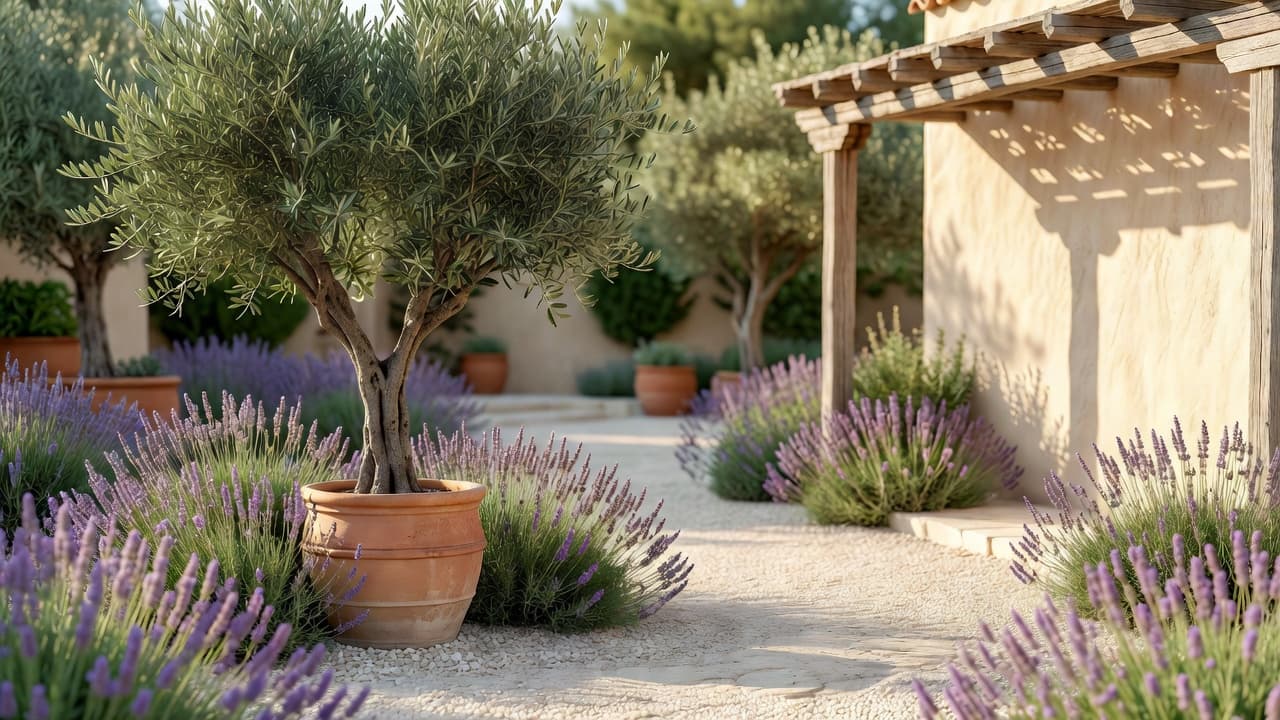
What is Mediterranean garden design?
The style takes its name from the Mediterranean climate — hot, dry summers and mild, wet winters — found around the coasts of southern Europe and beyond. Gardens there evolved around one hard constraint: very little rain falls between May and September, so both the planting and the hard landscaping had to work with drought rather than against it. Applied to a garden anywhere with a warm, sheltered spot, that same discipline produces a look that reads as relaxed and sun-worn rather than fussy — a looser, warmer cousin of the ideas in our AI garden design guide.
Unlike a formal garden built around symmetry and clipped lines, a Mediterranean garden is deliberately informal. Paths wander slightly rather than running dead straight, pots are grouped in odd numbers rather than matched pairs, and plants are left to spill a little over the edges of paving. That relaxed, sun-worn quality is as much a part of the style as any single plant or material — it is a garden that looks as though it has always been there, rather than one that was installed last week.
Materials: terracotta, limestone and gravel
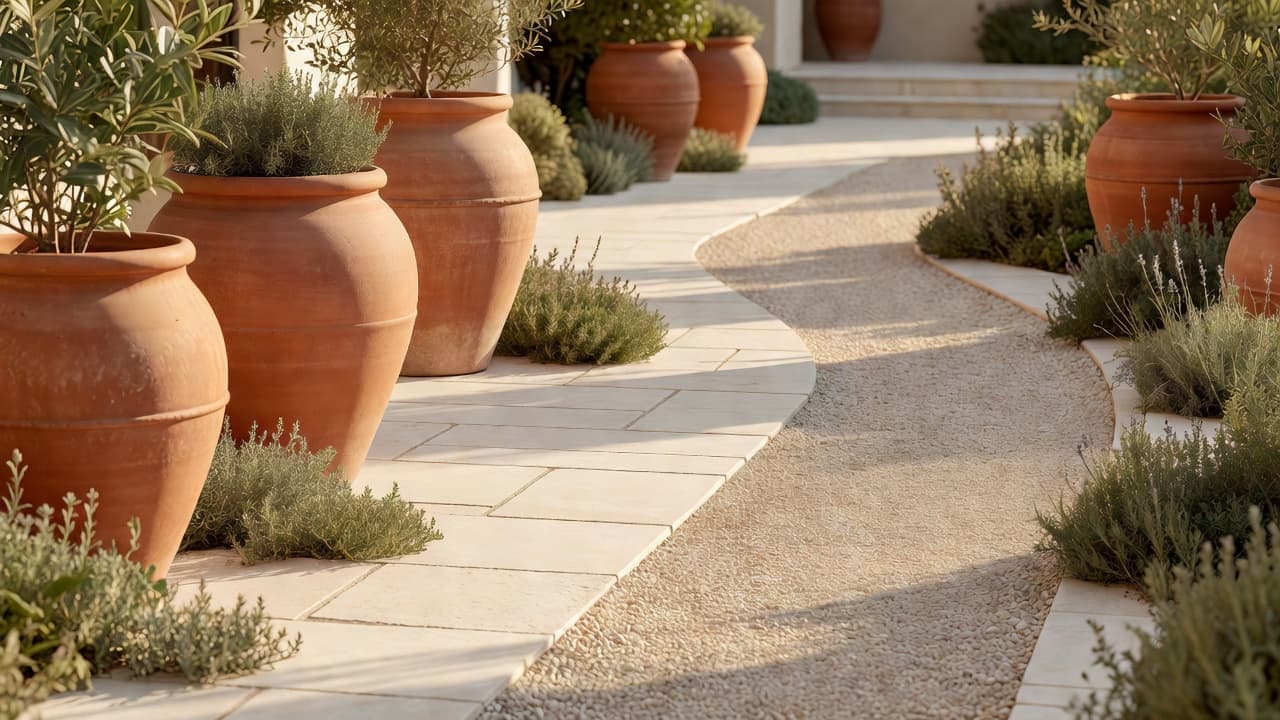
The material palette stays close to what the ground itself provides in Provence, Andalusia or Tuscany: pale stone, terracotta, lime-washed render and gravel, laid loosely rather than to a rigid geometric plan. Because so much of a Mediterranean garden is hard landscaping rather than lawn, the choice of paving and walling does as much visual work as the planting — a reason the style suits gardens where a large area is already paved or gravelled.
- Paving — limestone, sandstone or reclaimed terracotta tile, laid with visible joints rather than tight modern pointing.
- Paths — gravel or decomposed granite, laid 5–7.5cm deep over a compacted base, which drains fast and stays cool underfoot.
- Walls and boundaries — rendered or lime-washed masonry in warm sand or ochre tones, sometimes with exposed natural stone at the base.
- Pots — oversized terracotta urns and jars, used as bold, sculptural focal points rather than scattered in matching sets.
- Shade — a pergola in timber or wrought iron, planted with a grapevine or wisteria for dappled summer shade.
- Water — a small tiled or rendered rill, trough or still basin, more about sound and coolness than a feature pond.
Plants for a Mediterranean garden (real species that work)
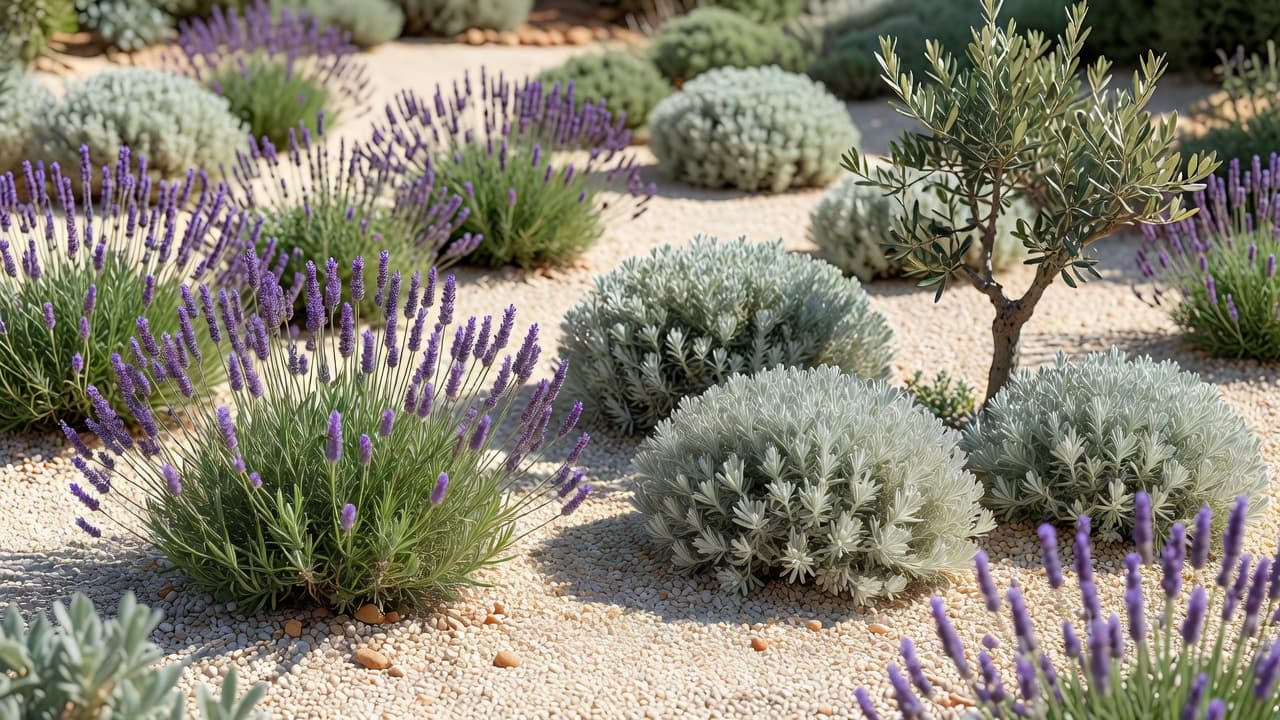
Mediterranean garden planting favours silver, grey-green and evergreen foliage that copes with strong sun and long dry spells, in place of the thirsty greens of a traditional lawn-and-border garden. For the growing conditions behind these species — light, soil, hardiness — the RHS’s guide to Mediterranean garden plants and its advice on drought-resistant gardening are both good starting points.
- Olea europaea (olive) — the signature specimen tree; rated H4 by the RHS (hardy to roughly -10°C to -5°C) and reliable through most of the UK once established, though young trees and container-grown olives need frost protection in a hard winter. Suits USDA zones 8–10 outdoors.
- Lavandula (lavender) — thrives in poor, free-draining soil in full sun; extremely drought-tolerant once established and one of the best plants for pollinators.
- Rosmarinus officinalis (rosemary) — evergreen and fragrant, useful as loose informal hedging as well as a kitchen herb; flowers blue between April and June.
- Cupressus sempervirens (Italian cypress) — the tall, narrow accent tree of a classic Mediterranean garden; Cupressus macrocarpa ‘Goldcrest’ is a smaller, golden-leaved alternative for a compact plot.
- Santolina chamaecyparissus (cotton lavender) — low, silver foliage, clipped into loose domes for structure without formality.
- Phlomis fruticosa (Jerusalem sage) — soft grey-green leaves and whorled yellow flowers, very drought-tolerant once established.
- Agapanthus — bold, strappy foliage and blue or white flower heads from midsummer, good in a pot or gravel bed.
- Thymus (thyme) and Cistus (rock rose) — low, aromatic groundcover for the edge of a path or gravel garden.
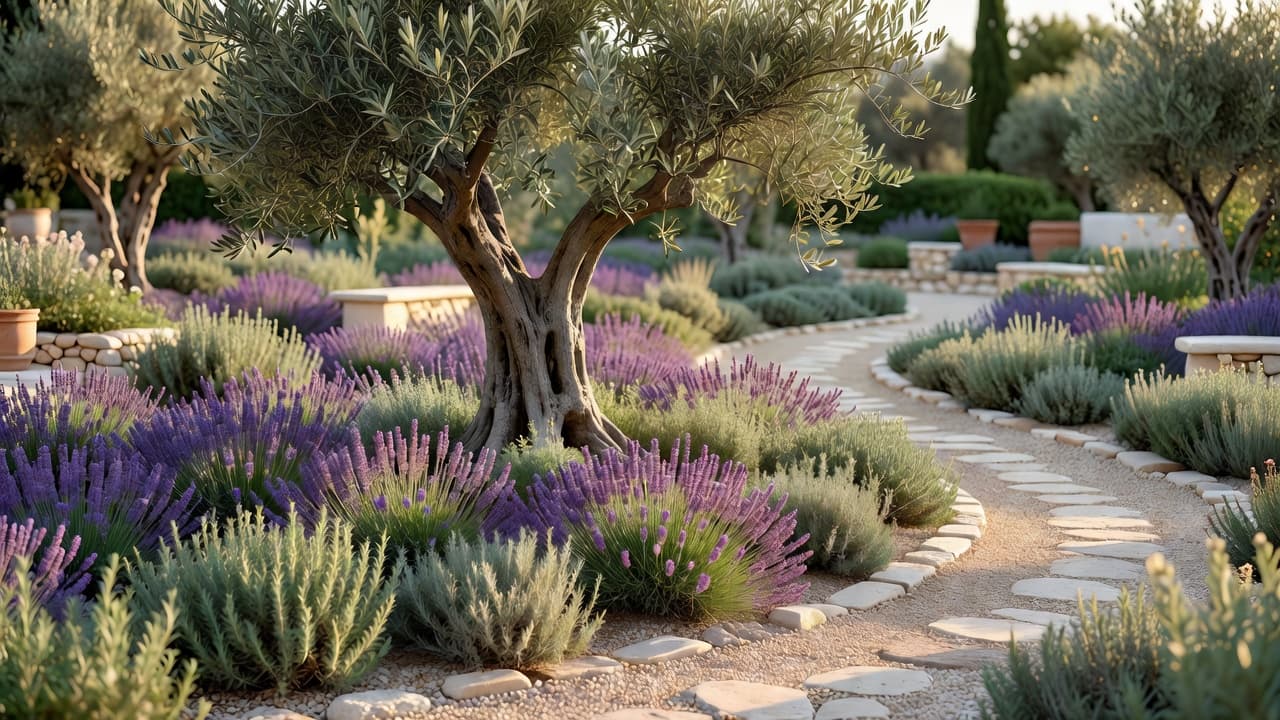
Colour palette and mood
The palette leans on sun-bleached neutrals — sand, cream, warm stone and olive-green — lifted by one saturated accent, most often the blue of a painted door, shutter or glazed pot. It is a close cousin of the limited, repeated palettes covered in our guide to colour theory for garden design: pick two or three warm neutrals for the hard landscaping, then let silver foliage and a single accent colour do the rest of the work. Bright, saturated bedding plants and cool blue-toned paving both fight the sun-warmed feel the style depends on, so they are best avoided.
Water-wise by design: why it matters beyond looks
Mediterranean garden design is not only a look — in a warming climate it is also a practical response to hotter, drier summers and tighter water restrictions becoming more common across much of Europe and North America. The RHS’s advice on drought-resistant gardening recommends proven, low-water plants such as lavender, rosemary, rockrose, santolina, germander, thyme, sage, phlomis and oregano, mulched with 5–7.5cm of gravel to cut evaporation and suppress weeds — essentially the plant list and material a Mediterranean garden already uses. For more on building a garden around drought tolerance specifically, see our xeriscape and drought-tolerant garden design guide.
- Improve drainage first — dig grit or coarse sand into heavy clay before planting; most Mediterranean plants fail from wet roots in winter, not from cold.
- Mulch with 5–7.5cm of gravel rather than bark, which holds moisture against the crown of drought-tolerant plants and encourages rot.
- Group plants by thirst, not just by look, so nothing gets over- or under-watered while it establishes.
- Water deeply but rarely in the first year to encourage deep roots, then largely stop once plants are established.
A Mediterranean garden by size: courtyard, small backyard and full garden
The style scales down well because it was never really about scale. A shaded courtyard can carry a whole Mediterranean garden in miniature: gravel underfoot, one olive tree in a large terracotta pot, and a pair of lavender either side of the door — a similar approach to the compact layouts in our small garden design guide. On a balcony, container planting does all the work: a dwarf olive, trailing rosemary, a glazed pot of agapanthus and a folding table for eating outside — see our balcony garden design guide for layout ideas suited to a tight footprint. A full backyard has room for a proper gravel garden, a pergola-shaded dining area treated as a distinct outdoor room, and a cypress or two as vertical accents. It is worth comparing the mood to a cottage garden before committing — cottage planting is soft, mixed and thirsty, where Mediterranean planting is structural, silver-toned and built to go without a hose for weeks.
Whatever the size of the plot, it helps to sketch a rough zoning plan before buying anything: one area for sitting and eating in shade, one sunny gravel bed for the silver-leaved planting, and a single specimen tree or large pot as the anchor the eye returns to. Gardens that try to fit every element from this guide into a small space usually end up feeling cluttered rather than relaxed — restraint is as much a part of Mediterranean garden design as the plant list itself.
Common Mediterranean garden design mistakes to avoid
- Planting into wet, heavy clay without improving drainage first — Mediterranean plants dislike winter wet far more than they dislike cold.
- Using bark mulch instead of gravel, which keeps moisture against the crown of drought-tolerant plants and encourages rot.
- Mixing too many pot styles and colours — a handful of oversized terracotta urns beats a dozen small mismatched pots.
- Leaving young trees and pots unprotected through their first hard frost, before the root system has had time to establish.
- Treating it as a no-maintenance style — lavender and santolina both need an annual trim to keep the tight, structural shape that makes the look work.
Frequently asked questions about Mediterranean garden design
What is Mediterranean garden design?
Mediterranean garden design uses the drought-tolerant plants, warm natural materials and relaxed layout of southern Europe — olive, lavender, rosemary, terracotta and gravel — to build an outdoor space that copes with heat and dry soil while still feeling lush and lived-in.
What plants work in a Mediterranean garden?
Olive, lavender, rosemary, Italian cypress, santolina, Jerusalem sage, agapanthus and thyme are all reliable choices. Most share silver or grey-green foliage and thrive in poor, free-draining soil and full sun.
Is a Mediterranean garden low-maintenance?
Once established, yes, relative to a thirsty lawn-and-border garden — but it is not zero-maintenance. Lavender and santolina need an annual trim to keep their shape, and potted olives need occasional feeding and watering.
Can an olive tree survive a UK or northern climate?
Yes, in most of the UK. The RHS rates the common olive H4, hardy to roughly -10°C to -5°C once established, though young trees and container-grown olives benefit from winter protection or being moved somewhere frost-free.
Can a small garden or balcony be designed in Mediterranean style?
Yes. The style scales down well because it relies on a small number of bold elements rather than many. A balcony or courtyard can carry the look with one olive tree in a large pot, gravel or terracotta paving, and repeated lavender.
Can an AI garden design app help plan a Mediterranean garden?
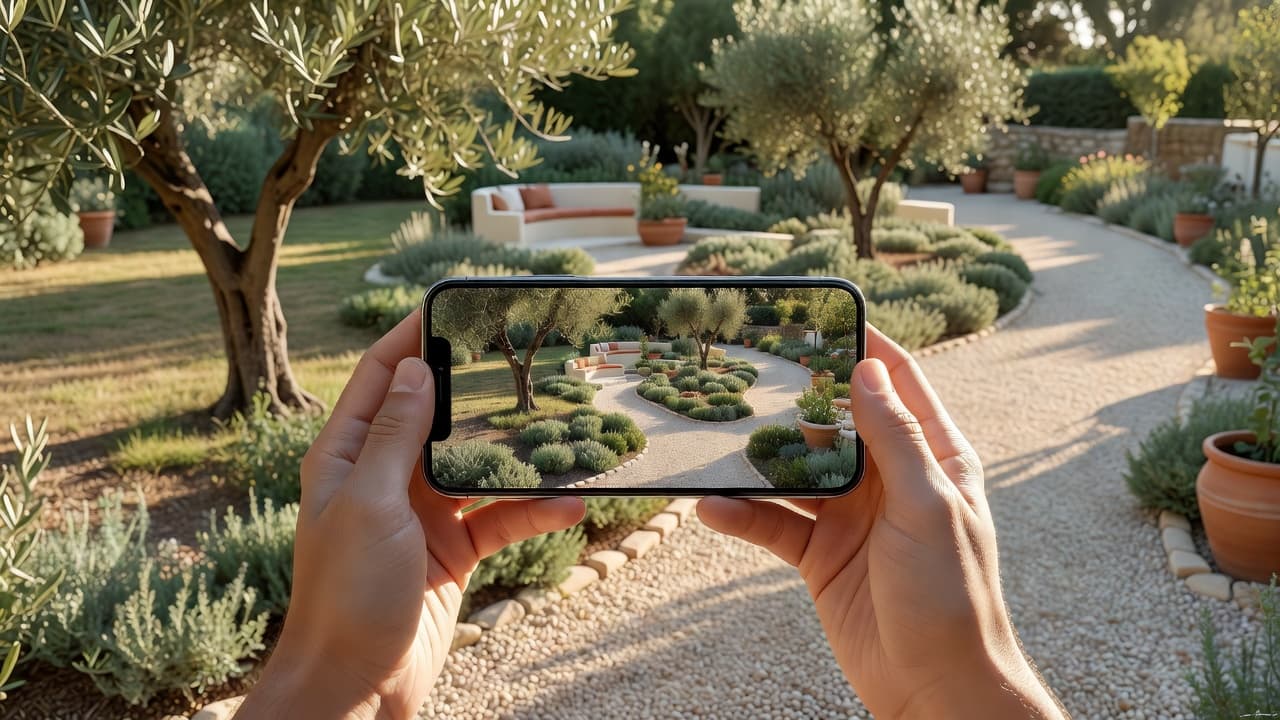
Yes. An app such as FlorAI can generate a photo-realistic Mediterranean redesign from a single photo of a real garden, courtyard or balcony, making it easy to test the planting and materials before buying anything.
Last updated: July 2026. Written by the FlorAI garden team.