
Small Gardens · 2026 guide
Courtyard Garden Design Ideas That Actually Work in 2026
Good courtyard garden design solves for light before it solves for size: pale, large-format paving and walls to bounce daylight around an enclosed space, a short list of genuinely shade-tolerant plants, and climbers trained up the boundaries instead of laid out across the ground. A courtyard is usually shaded on at least one side for most of the day, so the plants and materials that work in an open small garden often fail here — this guide covers what actually holds up, with real plant names, materials and 2026 costs.
AI Garden Design GuidesPublished August 4, 2026Updated August 4, 202610 min read
What is courtyard garden design?
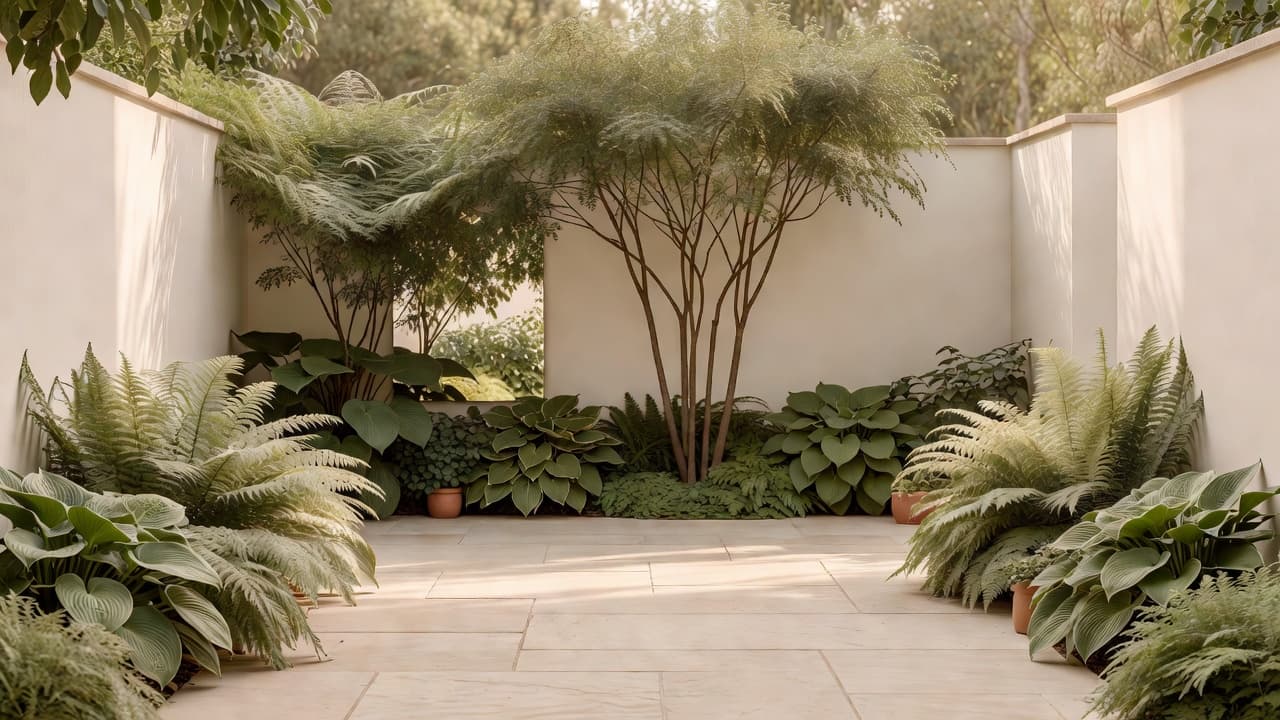
A courtyard is a different design problem to an open small garden. High walls or close neighbouring buildings usually mean direct sun for only part of the day, if at all, and the enclosed shape traps damp and shade in the corners. The RHS notes that with very high walls, the right approach is to plant strategically and lean on shade-tolerant species — and if a courtyard is entirely paved or bricked over already, a container garden built around a few large, well-chosen pots often works better than trying to break up hard surfacing. See our AI garden design guide for the broader principles; everything below is the courtyard-specific version of that thinking.
Light paving and pale walls: the fastest way to lift a shaded courtyard
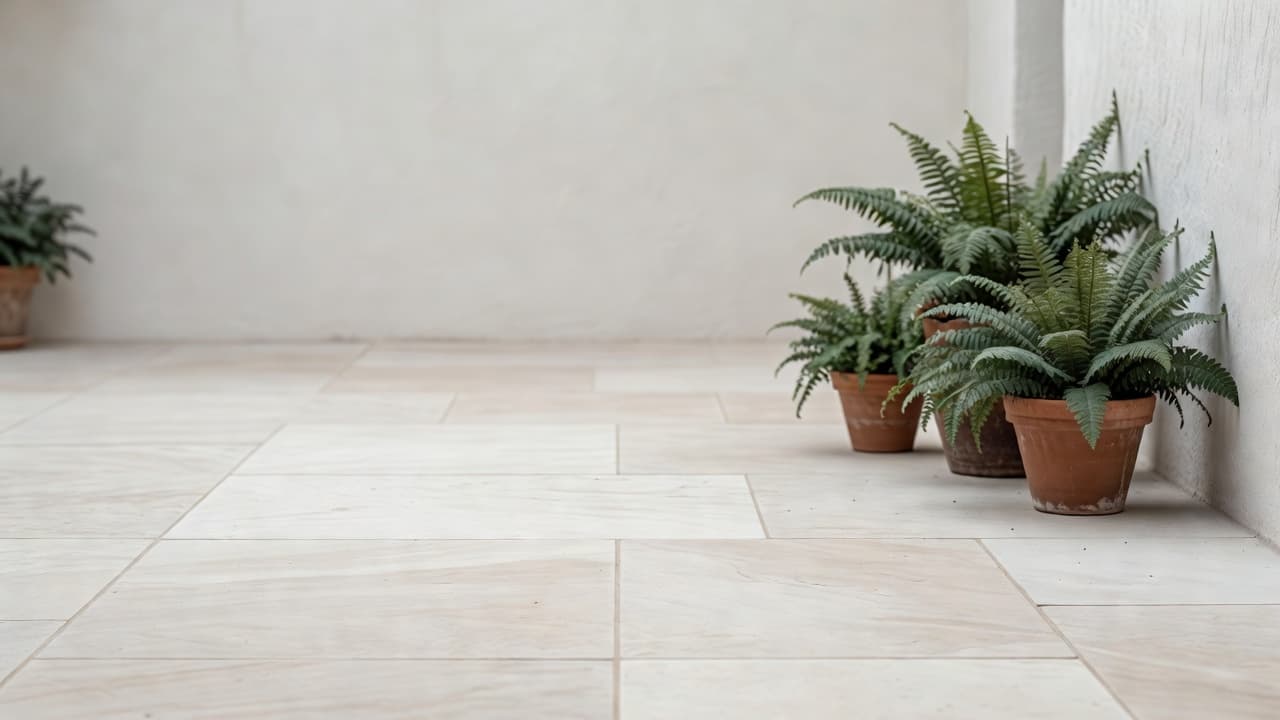
In an open small garden, smaller paving units and more joints make the space read as larger. A courtyard has a different constraint — the limiting factor is usually light, not a sense of distance — so large-format, pale paving with fewer joints actually performs better here, because it reflects more of the little daylight the space receives back upward and around instead of breaking it up into shadowed grout lines.
- Choose large-format pale sandstone or porcelain slabs over small dark pavers — fewer joints mean more continuous reflective surface.
- Paint or lime-wash boundary walls and fences in a warm white or pale putty tone; light-coloured walls lift a shaded courtyard more than almost any single planting change.
- Keep hard landscaping tonally consistent — paving, walls and any raised beds in the same pale family read as one considered space rather than several competing surfaces.
- Save dark charcoal or black paving for a genuinely sunny courtyard — in a shaded one it absorbs light the space cannot spare.
The best plants for a shady, enclosed courtyard
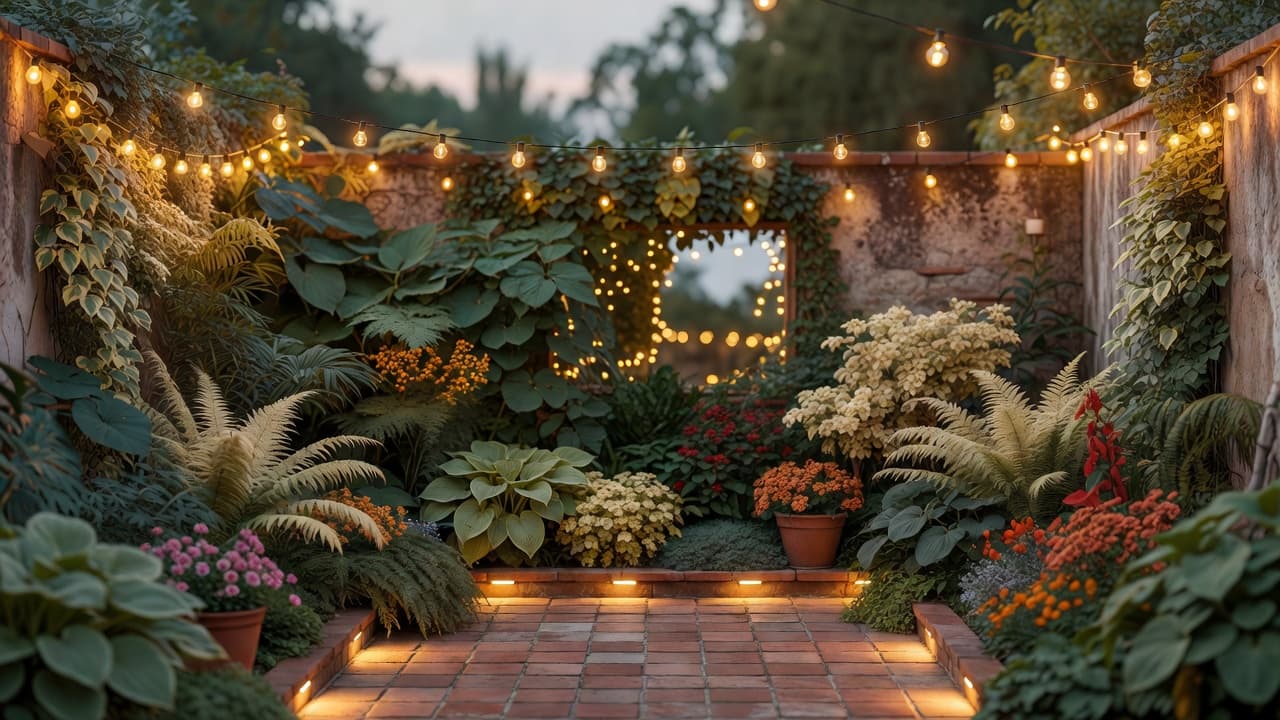
Shade-tolerant plants tend to have the most interesting foliage, and a courtyard is exactly where that pays off — a scheme mixing lush fern fronds among large-leaved Bergenia and delicately flowered Epimedium reads as calm and considered rather than sparse. The RHS shade gardening advice and Gardeners’ World’s shady courtyard plant picks both point to a similar core list for enclosed, low-light spaces:
- Hosta varieties — broad, architectural foliage that thrives in the damp, low-light conditions a courtyard traps in its corners.
- Tree fern (Dicksonia antarctica) — a genuine structural specimen for deep shade, tolerant of the still, humid air an enclosed courtyard often holds.
- Foxgloves (Digitalis) — reliable vertical flower spikes for a partly shaded bed, self-seeding readily once established.
- Tiarella and Brunnera macrophylla ‘Jack Frost’ — low, silver-foliaged groundcover that leads the eye down and helps a shaded courtyard feel wider at ground level.
- Ferns generally, mixed with large-leaved Bergenia and delicate Epimedium, for the layered-foliage look that shade gardens do better than sunny ones.
Favour pale flowers and foliage — cool blues, whites and silvers show up far better in a shaded courtyard than dark reds or purples, which simply disappear into the low light. Our guide to layering in planting design covers how to combine foliage shapes like this in more depth.
Grow vertically: climbers and wall shrubs for empty walls
A courtyard’s real growing area is rarely the ground — it is the walls. Once paving, a path and a bed or two are fixed, most of a courtyard’s surface area is vertical, and shade-tolerant climbers soften brick or render without costing any floor space at all.
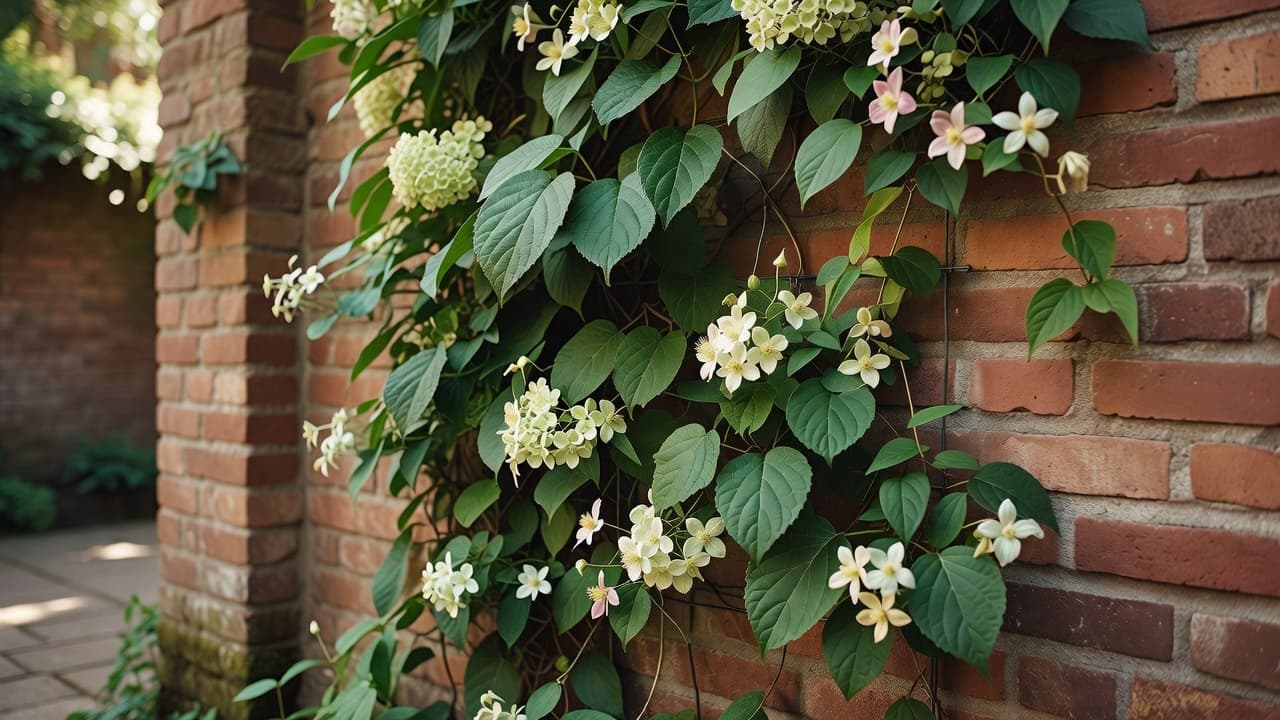
- Climbing hydrangea (Hydrangea anomala subsp. petiolaris) — self-clinging and one of the few reliable flowering climbers for a north-facing wall.
- Shade-tolerant Clematis varieties trained up a discreet wire or trellis system, which spreads their weight evenly across a wall without damaging pointing.
- Virginia creeper (Parthenocissus quinquefolia) for a wall that gets any afternoon sun — reliable, low-maintenance, and gives a courtyard genuine autumn colour that most shade planting cannot.
- Jasmine on the warmest, most sheltered wall — a small courtyard traps and holds scent far more effectively than an open garden, so one well-placed scented climber goes a long way.
Zone the space: one dining spot, one seating spot
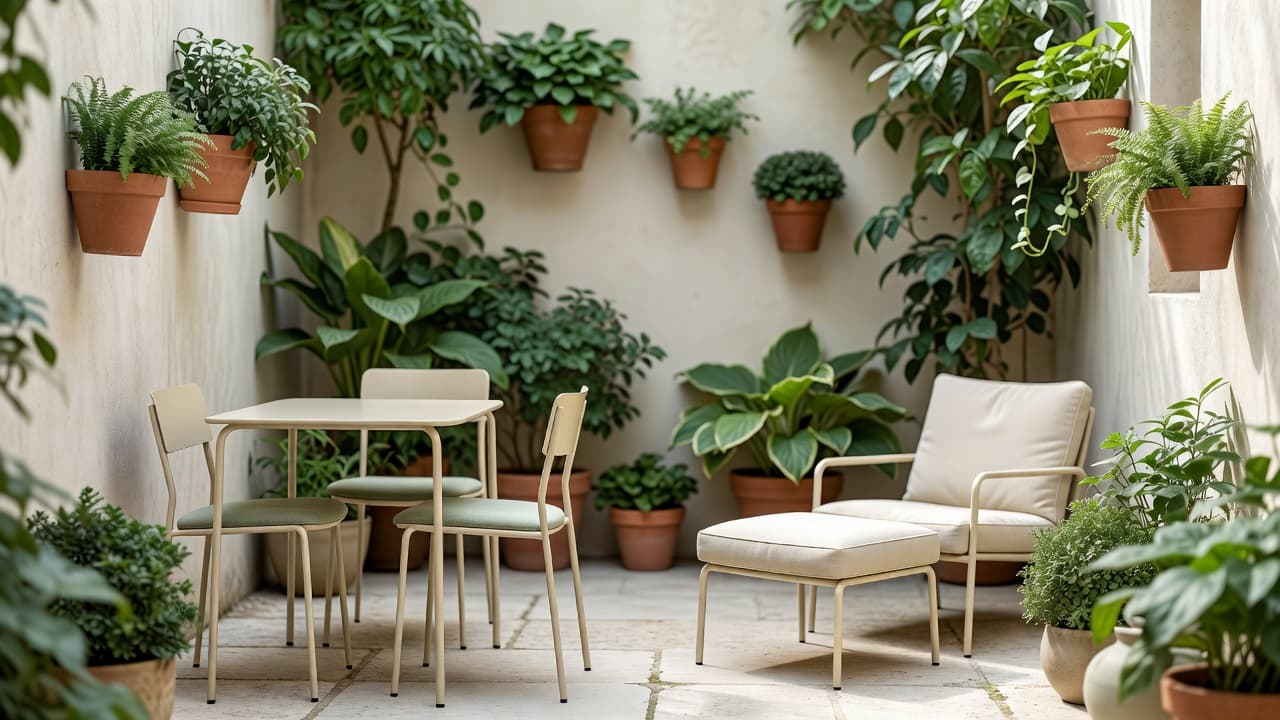
A courtyard rarely has room for more than two distinct uses, so decide on them early rather than letting furniture drift into a single blurred area. Our outdoor room design ideas guide covers this zoning principle for outdoor spaces generally; in a courtyard, with walls already defining the room on every side, it matters even more than in an open garden.
- Pick one corner for dining and one, if there is room, for lounging — resist the urge to fit in a third zone in a space this size.
- Choose slim-profile furniture; a bulky outdoor sofa or a full-size dining set makes an enclosed courtyard feel smaller by comparison, the same way oversized furniture crowds a small room indoors.
- Lift pots off the ground onto shelving, plant stands or wall-mounted brackets wherever possible — floor space is the scarcest resource in a courtyard, and container gardens rely on it most.
- Leave one clear sightline from the main window or door through to the far wall — an unbroken view through the space reads as more generous than a courtyard packed edge to edge.
Mirrors, lighting and other space-tricks for a small courtyard
A courtyard is used after dark as much as in daylight, since it usually sits right off the kitchen or living room, so lighting deserves as much planning as planting. Our garden lighting design ideas guide covers layering options in full; the courtyard-specific wins are a weatherproof mirror and a considered light plan.
- Hang a weatherproof mirror on a boundary wall, positioned opposite a planting bed or an architectural feature so it reflects greenery rather than a blank wall or the back of the house.
- Partly obscure the mirror’s edges with planting so it reads as a window through to more garden, not an obvious mirror — the illusion holds better at a glance.
- Layer three light types rather than one: a wall-mounted uplight to graze textured brick or planting, warm festoon or string lighting overhead for ambience, and low path or step lights for safety underfoot.
- Keep every fitting warm white (around 2700K) — cool white light flattens a courtyard’s planting and paving tones instead of complementing them.
What does a courtyard garden redesign cost in 2026?
A courtyard’s small footprint keeps a redesign well within reach of most budgets, since there is simply less ground to cover than a full garden rebuild. Our garden design on a budget guide breaks the general principles down further; the courtyard-specific figures for 2026 are:
- Professional courtyard redesign (roughly 15–30 m²): around £1,200 – £15,000 in the UK depending on paving material, drainage work and planting scope.
- UK landscaping, installed: typically £80 – £250 per m² for a professionally finished space, with basic gravel or planting at the lower end and porcelain paving or retaining work pushing costs higher.
- Paving material only, supply and lay: porcelain runs roughly £90 – £280 per m²; Indian sandstone roughly £75 – £240 per m².
- US comparison: a balanced softscape-plus-hardscape courtyard project averages $8 – $12 per square foot installed, with hardscape-heavy work (paving, walls) running $15 – $30 per square foot.
- DIY route: planning the layout with an AI garden design app costs nothing, and a courtyard’s impact comes mostly from paving colour, planting and lighting rather than major structural work — our low maintenance garden design guide covers plant choices that also keep ongoing costs down.
See your courtyard design before you build
A courtyard is a space you look at every day, often through a kitchen or living-room window, so a paving colour or a wall treatment that does not work is hard to ignore once it is built. FlorAI can generate a photo-realistic redesign of your actual courtyard from a single photo, keeping your real walls, windows and boundary in place, so you can see how pale paving, a specific climber or a mirror placement would genuinely look before committing to any of it.
That matters more in a courtyard than in a large open garden, because there is nowhere for a layout mistake to hide — every surface is close, visible and enclosed. Seeing the finished look first, in a photo of your own space, removes most of that risk.
Frequently asked questions about courtyard garden design
What is courtyard garden design?
Courtyard garden design is planning a small, walled or fenced outdoor space around light rather than size — using pale, large-format paving and walls to bounce daylight, shade-tolerant planting, and climbers trained up the boundaries instead of spread across limited floor space.
What are the best plants for a shady courtyard?
Hostas, tree ferns, foxgloves, Tiarella and Brunnera macrophylla ‘Jack Frost’ all tolerate the low light and trapped damp typical of an enclosed courtyard, along with Bergenia and Epimedium for layered foliage interest.
How do I make a small courtyard feel bigger and brighter?
Use large-format pale paving and light-coloured walls to reflect the limited daylight, add a weatherproof mirror positioned to reflect planting, and keep pots lifted off the ground on shelving so floor space stays open.
What climbers work on a shaded courtyard wall?
Climbing hydrangea (Hydrangea anomala subsp. petiolaris) is one of the few reliable flowering climbers for a north-facing wall, alongside shade-tolerant Clematis varieties trained on a discreet trellis.
How much does a courtyard garden redesign cost in 2026?
A professional courtyard redesign of roughly 15–30 m² typically costs £1,200 – £15,000 in the UK in 2026, depending on paving material and the amount of drainage or wall work involved.
Can an AI garden design app help plan a courtyard?
Yes. FlorAI can generate a photo-realistic redesign of a courtyard from a single photo, keeping the real walls and boundary in place, which is especially useful in an enclosed space where every surface is visible and a layout mistake is hard to hide.
Last updated: August 2026. Written by the FlorAI garden team.