
Permaculture · 2026 guide
Permaculture Garden Design: A Practical 2026 Guide
Permaculture garden design lays out a plot in zones based on how often each part needs attention, then fills those zones with layered, self-supporting plant communities — a mini food forest, a fruit-tree guild, a herb spiral — so the garden needs less water, less digging and fewer inputs over time. It is a design method, not a planting style: any size of garden, from a balcony to an acre, can use the same zone-and-layer logic. This guide covers Bill Mollison and David Holmgren's founding principles, the five permaculture zones, how to build a small food forest, and layouts that work in an ordinary back garden rather than a homestead.
AI Garden Design GuidesPublished September 9, 2026Updated September 9, 202611 min read
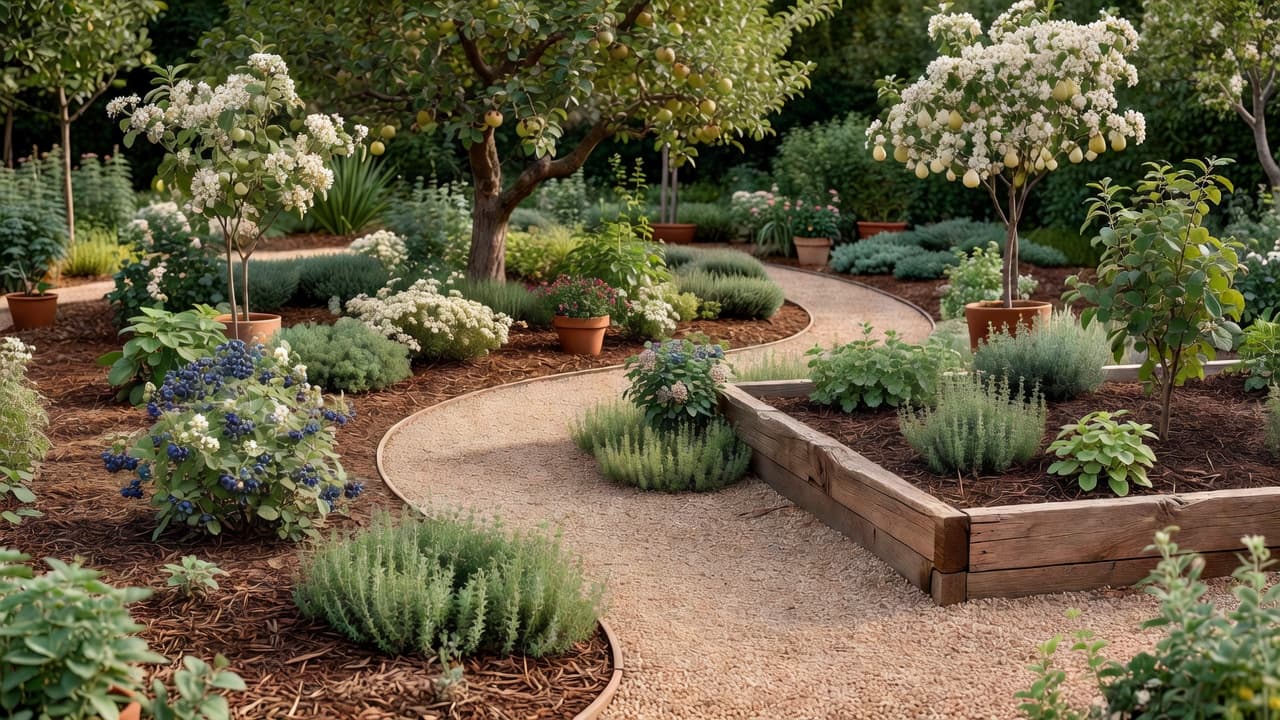
What is permaculture garden design?
The term was coined in 1978 by Bill Mollison and David Holmgren as a contraction of "permanent agriculture," later broadened to "permanent culture" once it became clear the same design thinking applied to how people live, not just how they grow food, according to Wikipedia's entry on permaculture. At home-garden scale, permaculture garden design mostly means two practical things: grouping plants and features by how much attention they need (the zone system, below), and building small plant communities that support each other instead of relying on a single crop, a single bed and a single feeding schedule. Our AI garden design guide covers layout and style choices more broadly; this guide focuses on the permaculture layer specifically.
- It is a design method, not a look. A permaculture garden can be tidy and formal or loose and naturalistic — the zones and guilds work either way.
- It front-loads effort. Most of the work happens once, at planting; a mature permaculture garden needs comparatively little ongoing input.
- It borrows from ecology. Every element is chosen to serve more than one function — a fruit tree that also fixes nitrogen for its neighbours, a hedge that also blocks wind and feeds pollinators.
The 12 permaculture principles, in plain English
David Holmgren set out twelve permaculture design principles in his book Permaculture: Principles and Pathways Beyond Sustainability. They read as philosophy, but each one has a direct, practical translation for a home garden.
- Observe and interact — watch sun, shade, wind and water on the actual plot for a season before moving anything.
- Catch and store energy — a water butt off the downpipe, a compost heap, a sunny wall that stores heat for tender plants.
- Obtain a yield — every bed should produce something usable: food, cut flowers, mulch material or habitat.
- Apply self-regulation and respond to feedback — if a bed keeps failing, the design is wrong, not the plant.
- Use and value renewable resources — leaf mould, saved seed and homemade compost instead of bagged fertiliser.
- Produce no waste — prunings become mulch, kitchen scraps become compost, fallen leaves become leaf mould.
- Design from patterns to details — decide the zones and the overall shape first, choose individual plants last.
- Integrate rather than segregate — mix vegetables, herbs, flowers and fruit instead of separating them into single-use beds.
- Use small and slow solutions — expand a food forest or a new bed one section at a time rather than digging the whole plot at once.
- Use and value diversity — many species and varieties spread risk against pests, disease and a single bad season.
- Use edges and value the marginal — the border between lawn and bed, pond and path, is usually the most productive strip in the garden.
- Creatively use and respond to change — let a garden evolve with a young tree's growing shade rather than fighting it.
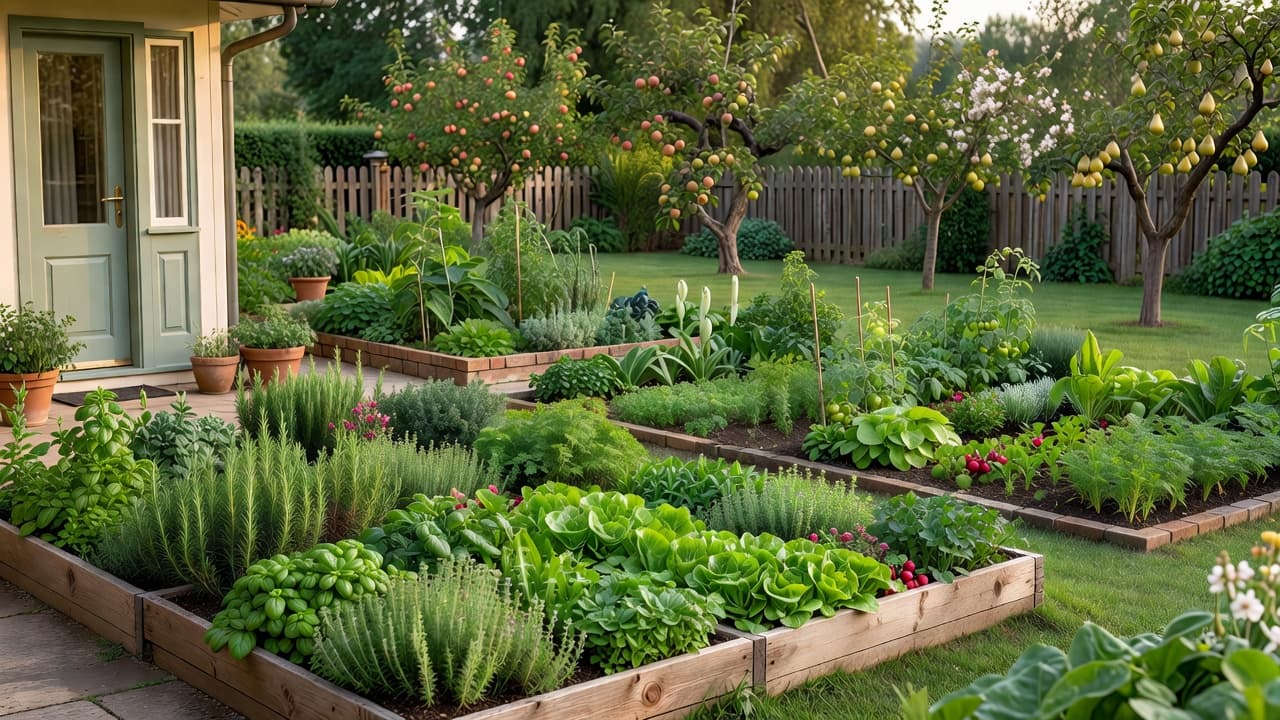
How do permaculture zones work in a home garden?
Permaculture zoning places each part of a garden according to how often it needs a visit, with zone 0 at the centre and zone 5 at the furthest edge. Most home gardens only ever use zones 0 through 3, but understanding the full scale makes the logic clear.
- Zone 0 — the house. Where design decisions start: doors, windows and paths dictate how the rest of the garden gets used.
- Zone 1 — daily-visit beds. Herbs, salad leaves and cut flowers right outside the kitchen door, visited most days.
- Zone 2 — regular beds. Vegetable beds, a greenhouse or a chicken run, visited every few days.
- Zone 3 — the orchard or main crop area. Fruit trees and larger vegetable plots that need attention weekly rather than daily.
- Zone 4 — semi-managed edges. A mixed hedge, a small woodland edge or a foraging strip, visited occasionally.
- Zone 5 — left wild. An unmanaged corner for wildlife and self-seeding; most gardens under about 500m² compress this into a single hedge base or log pile rather than a full zone.
In an average suburban plot, this usually collapses to three practical rings: a herb-and-salad bed by the back door (zone 1), a vegetable and soft-fruit area a little further out (zone 2), and one or two fruit trees or a wildlife corner at the boundary (zones 3–5 combined). Our raised bed design guide covers the zone-1 layer in more depth, since raised beds are the standard way to build a high-attention bed close to the house.
Design a mini food forest in an ordinary garden
A food forest — also called a forest garden — mimics the structure of a natural woodland edge using edible and useful plants instead of wild ones. RHS Resilient Garden designer Tom Massey has noted that forest gardens suit small plots particularly well, because the layering lets a garden be productive from ground level up to head height in the same square metre, according to reporting picked up from RHS-affiliated coverage of resilient garden design. The classic model uses seven layers, developed from Robert Hart's original forest garden work in the 1980s:
- Canopy — one or two full-size or semi-dwarf fruit or nut trees, such as an apple on a semi-vigorous rootstock.
- Understorey — smaller trees that tolerate part shade, like a fan-trained plum or a mulberry.
- Shrub layer — currants, gooseberries or blueberries beneath the trees.
- Herbaceous layer — perennial herbs such as comfrey, chives and lovage, cut back each year rather than replanted.
- Rhizosphere — root crops like Jerusalem artichoke or perennial alliums, grown at ground level.
- Ground cover — low, spreading edibles such as strawberries or nasturtium, which also suppress weeds.
- Vertical layer — climbers like a grapevine or a kiwi trained up the canopy tree or a fence.
A single fruit tree with two or three shrubs, a ring of herbs and a strawberry ground cover underneath is already a working, miniature food forest — it does not require woodland-sized space. For the vegetable-bed side of the same garden, see our vegetable garden planner guide.
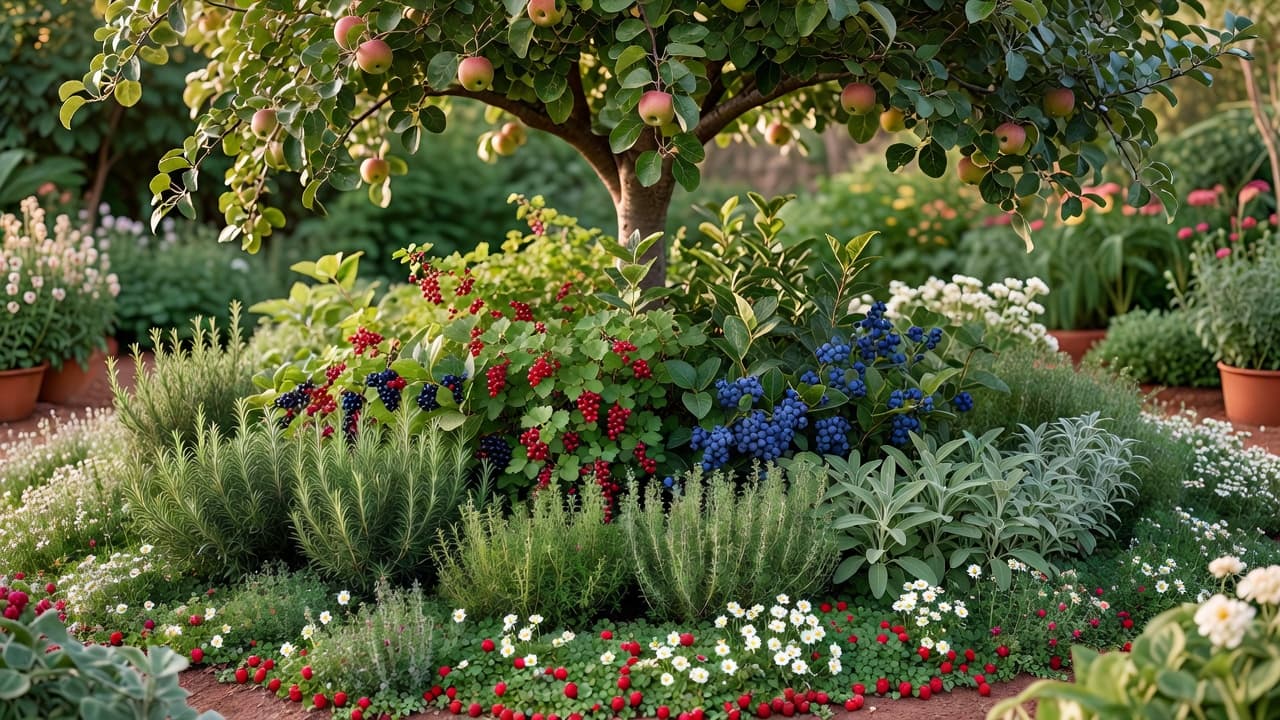
What is a permaculture guild?
A guild is a small group of plants placed together because each one performs a different job for the others — the permaculture version of companion planting. The best-known example is the fruit-tree guild built around an apple or plum:
- A nitrogen fixer, such as a clover ground cover or a small nitrogen-fixing shrub, feeds the tree without added fertiliser.
- A dynamic accumulator like comfrey sends deep roots down to pull up minerals, which return to the soil surface when its leaves are cut and left as mulch.
- Pollinator-attracting flowers, such as borage or a single-flowered Salvia, bring in bees to pollinate the fruit — see our wildlife garden design guide for plant choices the RHS Plants for Pollinators list supports.
- Pest-confusing herbs such as chives or garlic planted at the base mask the tree's scent from some flying pests.
- Ground cover, like strawberries, keeps the soil surface shaded and moist, cutting down on watering.
One planted guild takes an afternoon and roughly the space of a large flowerbed; a garden does not need more than two or three guilds to feel meaningfully different from a lawn-and-border layout.
Permaculture layouts that fit a normal-sized plot
Most permaculture writing assumes a smallholding, but the same principles scale down cleanly. Three layouts cover the majority of UK, US and European garden sizes:
- The keyhole bed. A curved bed shaped like a keyhole so every plant can be reached from a central path without stepping on the soil — an efficient use of the "edge" principle in a bed as small as 3–4m across.
- The herb spiral. A raised, spiralling mound of soil and stone that creates a range of microclimates — dry and sunny at the top, damp and shaded at the base — in about a 1.5–2m diameter footprint, enough for a dozen different herbs.
- The suburban food forest strip. One fruit tree, its guild, and a herb-and-salad zone-1 bed by the door, connected by a mulched path — realistic for almost any garden over about 40m².
For the general layout thinking behind zoning and repeat planting that makes any of these read as designed rather than random, see our guide to layering in planting design.
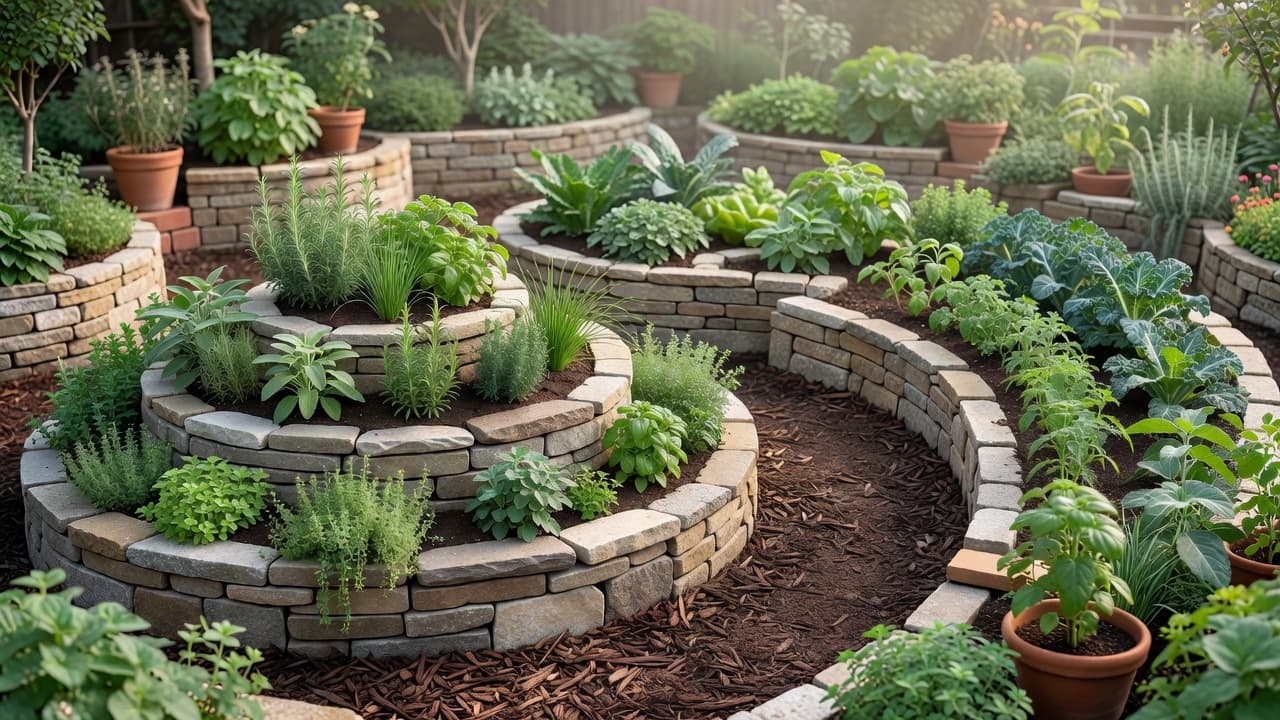
See your permaculture garden design before you dig
A permaculture layout is genuinely hard to picture from a plan alone, because its whole value is in how zones, guilds and layers sit together over several seasons rather than in a single neat bed. FlorAI can generate a photo-realistic redesign of your actual garden from one photo, so you can see roughly how a fruit-tree guild, a herb spiral or a zone-1 bed by the door would sit in your own space before any digging starts.
This matters most for the biggest permaculture decision — where the canopy tree goes — since a badly placed tree is the hardest and most expensive mistake to undo years later. Seeing a mature-height tree in a photo of your own garden, rather than guessing from a tape measure, makes that decision far easier to get right the first time.
Common mistakes in permaculture garden design
- Planting the whole plot in one season. Holmgren's "small and slow solutions" principle exists because an entire garden converted at once is also entirely likely to be neglected at once.
- Skipping zone 1. A food forest at the back of the garden gets visited far less than herbs by the kitchen door — put the highest-value, most-used plants closest to the house first.
- Choosing a canopy tree without checking its mature spread. A full-size apple can reach 6–8m across; most home food forests need a tree on a dwarfing or semi-dwarfing rootstock instead.
- Treating guilds as decoration. Each plant in a guild needs an actual job — nitrogen fixing, pest confusion, pollinator support or ground cover — or it is just companion planting by another name.
- Ignoring the soil. Permaculture's emphasis on mulch and compost exists because most of the "self-maintaining" benefit comes from soil biology, not from the plant choices alone.
Frequently asked questions about permaculture garden design
Is permaculture garden design the same as organic gardening?
No. Organic gardening is mainly about avoiding synthetic chemicals; permaculture garden design is a whole-system approach to layout, zoning and plant relationships that usually happens to be organic as a side effect, not its main goal.
How much space do you need for a permaculture garden?
There is no minimum. A single fruit-tree guild fits in a space roughly 3m across, and a herb spiral fits in about 1.5–2m diameter, so the zone-and-guild approach works in an average suburban garden as easily as on a smallholding.
What is the difference between a permaculture guild and companion planting?
Companion planting usually pairs two plants for one shared benefit, such as pest deterrence. A permaculture guild groups several plants around a central tree or crop, each contributing a different function — nitrogen fixing, mulch, pollinator support and ground cover together.
Do permaculture gardens need less watering?
Usually, once established. Ground-cover layers shade the soil surface, mulch from cut-and-drop herbs like comfrey retains moisture, and layered planting reduces the bare soil that dries out fastest — but new plantings still need regular watering in their first one to two seasons.
Can permaculture principles work in a small or rented garden?
Yes. Zone 1 thinking (the highest-value plants closest to daily use) and a single guild in a large container both apply at balcony or courtyard scale; the same logic used for the full zone 0–5 system.
Can an AI garden design app help plan a permaculture garden?
Yes. FlorAI can generate a photo-realistic permaculture-style redesign of an existing garden from a single photo, which helps with the hardest decision in the whole layout — where to place the canopy tree — before any digging starts.
Last updated: September 2026. Written by the FlorAI garden team.