
Design fundamentals · 2026
Garden Design Principles: The 8 Rules Behind Every Garden That Feels Right
Garden design principles are the small set of rules — unity, balance, proportion, rhythm, focal point, line, form and texture — that professional designers use to make an outdoor space feel calm and finished rather than just planted. You do not need training to use them: once you can see them, you can check any garden, including your own, against them. This guide walks through each principle in plain English, with a way to test it in your own garden before you spend anything.
AI Garden Design GuidesPublished September 12, 2026Updated September 12, 202611 min read
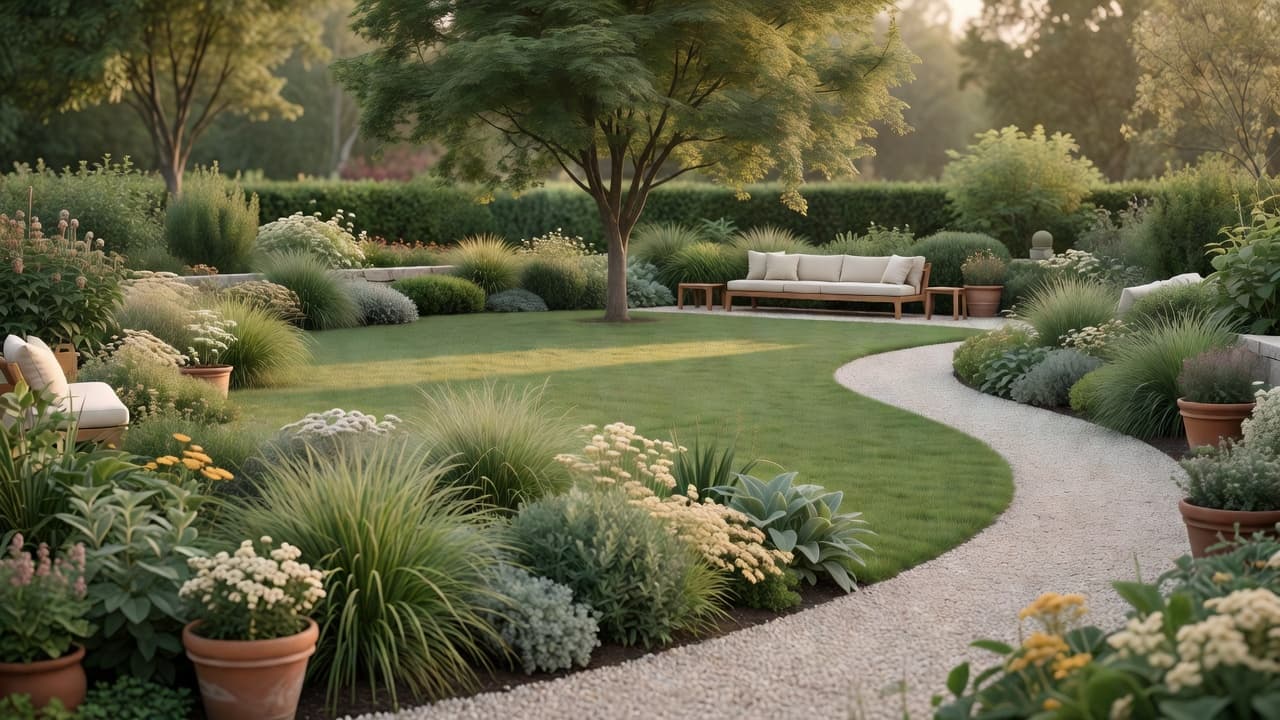
The one-line answer
You will see these words again and again in landscaping courses and design books. This guide translates each one into something you can actually check by standing in your own garden.
What are garden design principles, and why do they matter?
Garden design principles are not rules about which plants to buy. They are rules about how the whole space reads to the eye — whether it feels like one considered place or a row of separate decisions. Two gardens can contain almost identical plants and hardscaping and still feel completely different, because one applies these principles and the other does not.
The Royal Horticultural Society (RHS) teaches the same core set to its garden design students: unity, balance, proportion, rhythm, focal point, and the visual qualities of line, form and texture. They apply whether the finished garden is a formal parterre, a wild pollinator patch or a minimalist courtyard — the style changes, the underlying structure does not. If you would rather see the principles applied across real styles before you dig into the theory, our AI garden design guide shows cottage, modern, Mediterranean and Japanese layouts side by side on the same real garden.
Unity: making everything feel like one garden
Unity is the principle that ties a garden together. It comes from repeating the same handful of materials, plant shapes, or colours throughout the space, rather than treating each bed, border or corner as its own separate project.
- Repeat the same paving or edging material in more than one area, instead of mixing three different stones.
- Choose a small palette of 5–8 plant varieties and repeat them in drifts, rather than one of everything.
- Carry a single accent colour — a terracotta pot, a rust-coloured grass — through at least two or three parts of the garden.
A garden with no unity looks busy even when every individual plant is beautiful. A garden with strong unity can look calm even with a fairly wild planting style, because the eye recognises the repeated pattern and relaxes into it.
Balance: symmetrical, asymmetrical, and why it matters
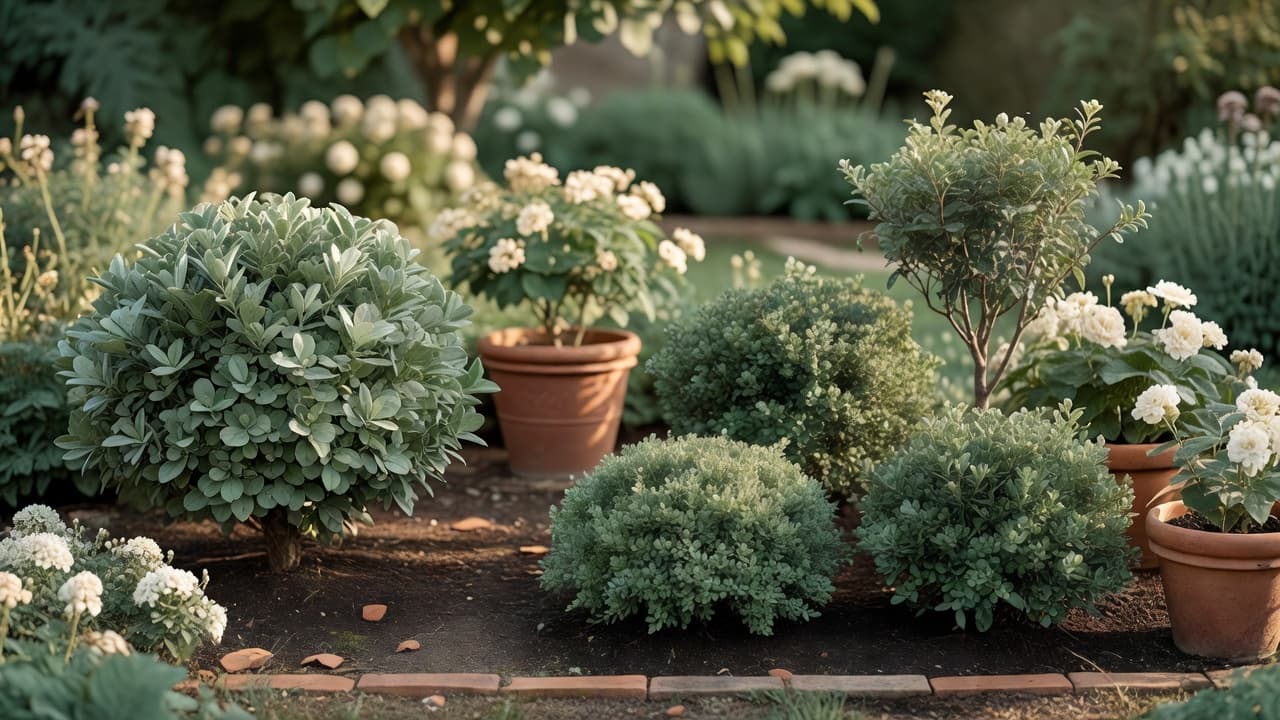
Balance is about visual weight, not literal size. A garden can be balanced in two ways: symmetrical balance, where matching elements sit on either side of a central line (a pair of matching topiary either side of a front door), or asymmetrical balance, where a large feature on one side is offset by several smaller features on the other, so the two sides feel equally "full" without mirroring each other.
Most everyday gardens — an irregular back garden shape, a corner plot, a sloped front yard — suit asymmetrical balance far better than strict symmetry, because they are rarely symmetrical to begin with. A single large specimen tree on one side of the lawn can be balanced by a grouped planting of three or four medium shrubs on the other, rather than by trying to force a matching tree into a spot that does not have room for one.
Proportion and scale: sizing everything correctly
Proportion is the relationship between the sizes of things in the garden — a bench that is too small for its patio, a pond that swallows a small lawn, a pergola that dwarfs a cottage. Scale is closely related: it is how the size of the garden relates to the size of the house and the people using it.
- A small garden usually needs fewer, larger-leaved plants and one clear focal point, not many small features competing for attention.
- Furniture, pots and structures should feel proportionate to both the space and the house behind them — an oversized pergola against a single-storey cottage looks out of place however well it is built.
- Paths should be wide enough for two people to walk comfortably (roughly 90–120 cm), which reads as generous even in a small garden.
Getting proportion wrong is one of the most common reasons a DIY garden redesign feels "off" even when every individual choice was reasonable. This is exactly the kind of mistake it helps to catch before buying anything — our small garden design guide covers proportion specifically for compact plots.
Rhythm and repetition: the pattern that guides the eye
Rhythm is what unity feels like in motion — the way the eye is guided through a garden by a repeated pattern of planting, colour or shape, the same way a repeated chorus creates rhythm in music. A border planted with the same three grasses repeating every metre or so has rhythm; a border with one of everything, in whatever order it was bought, does not.
Rhythm is especially useful along a path, a driveway or a boundary, where it turns a long, plain stretch into something that feels intentional rather than empty. It does not need to be rigid — a "loose" rhythm, where the same plant reappears at slightly different intervals, often looks more natural than a perfectly even spacing.
Focal points: giving the eye somewhere to rest
A focal point is the one thing in a view that the eye lands on first and returns to — a specimen tree, a sculpture, a bench, a water feature, or simply a striking plant in a prominent spot. Every well-designed garden view has one, and most poorly composed views have none, or worse, two or three competing with each other.
- Place a focal point at the end of a path, at the far end of a lawn, or directly opposite a window you look through often.
- Keep the area immediately around the focal point calmer — simpler planting, fewer competing colours — so it stands out rather than blending in.
- One strong focal point per view beats three modest ones; if everything is trying to be the star, nothing reads as one.
Line, form and texture: the shapes that hold a garden together
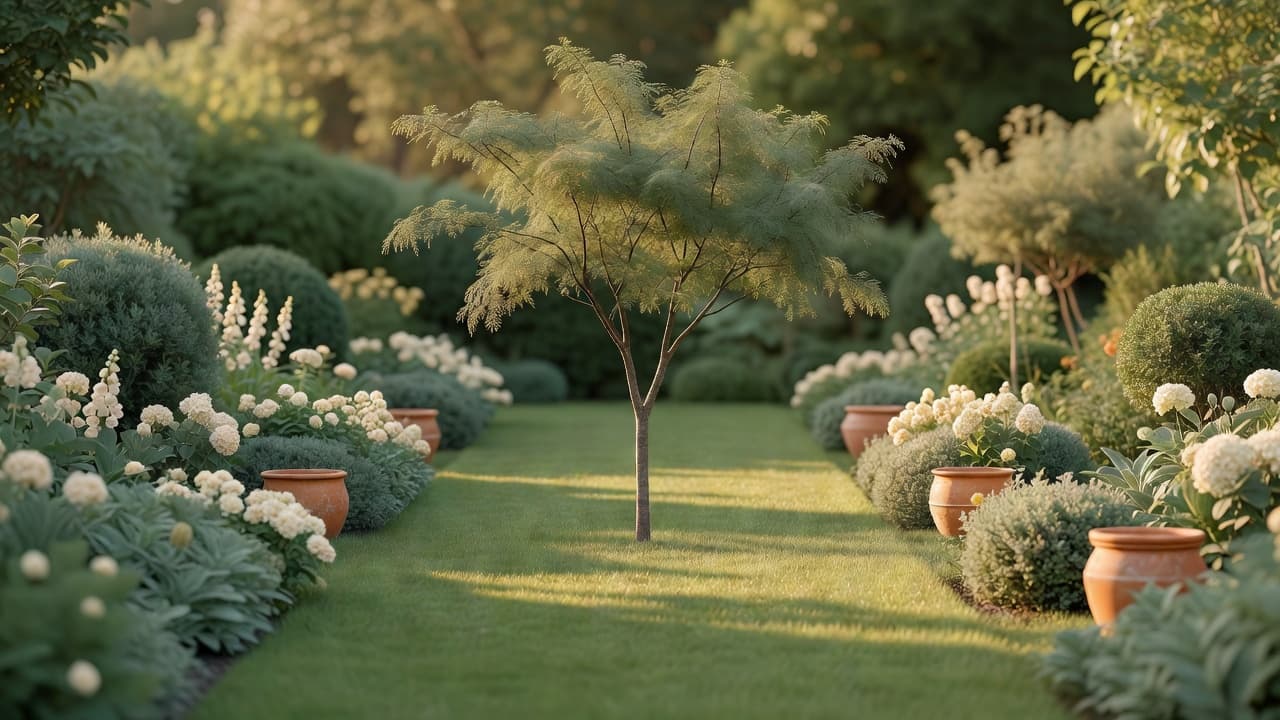
Three quieter principles do a lot of the work in a finished-looking garden. Line is the path your eye — and your feet — follow: a curved path feels relaxed and slows you down, a straight path feels formal and purposeful. Form is the overall shape of a plant or feature — rounded, spiky, spreading, upright — and a garden with a mix of forms reads as more interesting than one with plants of a single silhouette. Texture is the contrast between fine and bold foliage, smooth and rough surfaces, which keeps a planting scheme from feeling flat even within a narrow colour palette.
Colour is the principle most people reach for first, and it deserves its own guide — our colour theory for garden design article covers palettes in depth, and layering texture in planting design goes further into combining fine and bold foliage. Both work alongside the structural principles above, not instead of them.
How to apply these principles in your own garden
You do not need a design qualification to use these principles — you need a slow walk around your own garden and an honest eye. A practical order to check them in:
- Stand at your main viewpoint — the kitchen window, the back door, the spot you sit in most — and note the first thing your eye lands on. If it is nothing in particular, you are missing a focal point.
- Count your materials. If you can count more than three different paving, edging or fencing materials, unity is probably the fix.
- Look for lopsided weight. If one side of the view feels heavier than the other, that is a balance problem, not necessarily a symmetry one — you can fix it by adding mass to the lighter side rather than removing from the heavier one.
- Check proportion against the house, not just the garden. A feature that looks fine on its own can still look wrong against your specific house and boundary size.
- Look for a repeating pattern. If every plant is different from its neighbour, that is a rhythm gap — pick three or four "repeater" plants and use them again.
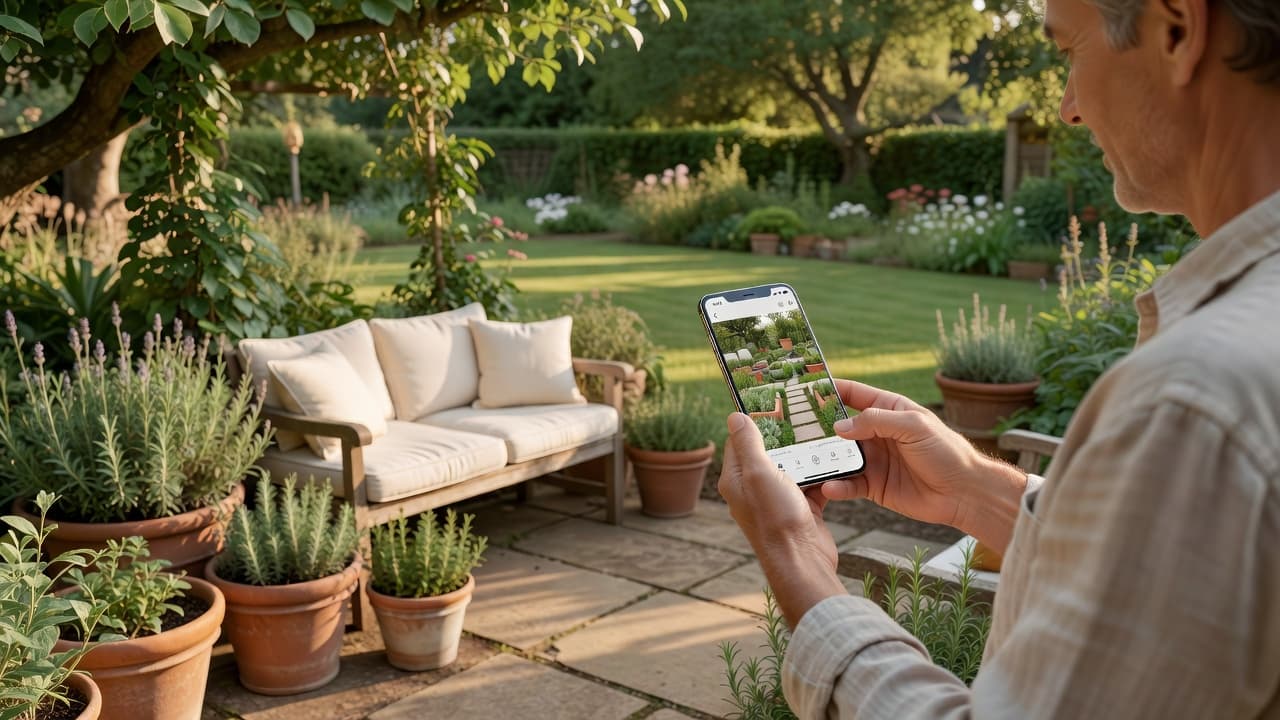
This is also where it helps to test changes before committing to them. An AI garden design app like FlorAI can apply a proposed change — a new focal tree, a repeated hedge line, a wider path — to a photo of your actual garden, so you can judge balance and proportion against the real space rather than imagining it.
Common mistakes these principles fix
- Too many focal points. A gazing ball, a large urn and a bright tree in the same view compete rather than complement.
- No repetition. Buying one of everything at the garden centre gives variety but no rhythm or unity.
- Oversized features. A large water feature or pergola bought for its own sake, without checking it against the size of the plot.
- Ignoring the view from indoors. Most gardens are seen from a kitchen or living room window far more than they are walked through — design for that view first.
Frequently asked questions about garden design principles
What are the main principles of garden design?
The core garden design principles taught by organisations like the RHS are unity, balance, proportion, rhythm and focal point, alongside the visual qualities of line, form and texture. Colour theory is often taught alongside them as a related, but separate, principle.
What is the most important garden design principle?
Most designers treat unity as the foundation, because a garden with strong unity still reads as calm and considered even if other principles like proportion are slightly off. Without unity, even a technically correct layout can feel disjointed.
What is the difference between balance and symmetry in garden design?
Symmetry is one type of balance, where matching elements mirror each other on either side of a line. Asymmetrical balance achieves the same equal "visual weight" using different elements of different sizes — a large shrub balanced by several smaller ones, for example — and suits irregular garden shapes better than strict symmetry.
How do I find a focal point for my garden?
Stand at the window or door you use most to look at the garden and notice the far end of that view — that spot, or the end of a path, is usually the strongest place for a focal point such as a specimen tree, sculpture or bench.
Can AI garden design apps apply these principles automatically?
Yes. An AI garden design app such as FlorAI is trained on real, professionally designed gardens, so a generated redesign will typically already reflect unity, balance and a clear focal point. It is still worth checking the result against the principles in this guide, especially proportion against your own house.
Do these principles apply to small gardens too?
Yes, arguably more so. Small gardens have less room to hide a mistake, so unity, proportion and a single strong focal point matter even more than in a large garden where a lopsided corner is easier to overlook.
Last updated: September 2026. Written by the FlorAI garden team.