
Sloped Gardens · 2026 guide
Sloped Garden Design: A Practical 2026 Guide
Sloped garden design works best when the gradient is measured honestly and handled with terracing, retaining walls or simple grading, rather than disguised with a lawn that is neither safe nor realistic to mow. A gentle slope of around 1 metre of height change over 10 metres of run (a 1:10 gradient) can often be managed with generous planting and a few level changes, while anything steeper usually needs proper terracing, retaining walls and a qualified builder. Get the drainage right behind every wall and choose plants bred to grip a bank, and even a genuinely steep garden becomes one of the most dramatic, usable spaces on the plot. This guide covers how to measure a slope, the terracing and retaining wall options and their 2026 costs, the drainage detail most projects get wrong, and the plants that actually hold a slope together.
AI Garden Design GuidesPublished August 26, 2026Updated August 26, 202611 min read
What is sloped garden design?
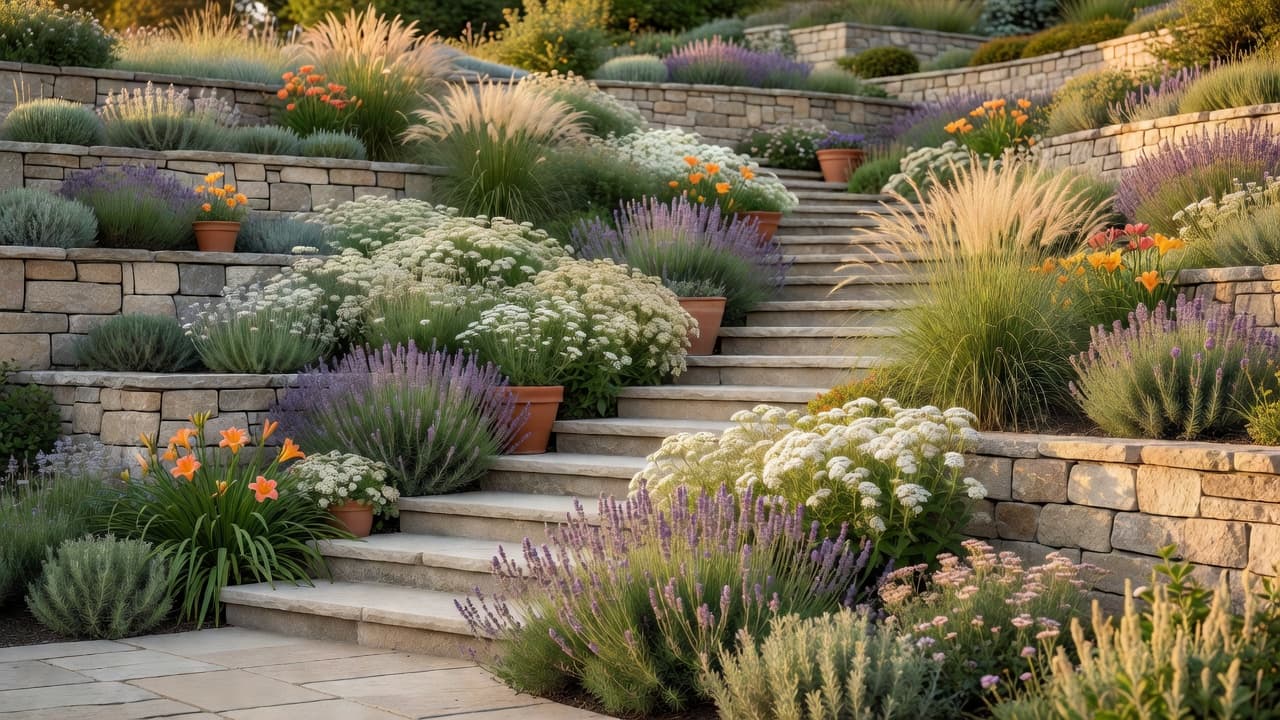
Every garden with a meaningful change in level between its highest and lowest point counts as a sloped garden, whether that is a gentle grassy bank at the back of a new-build plot or a steep hillside drop behind an older house. The instinct to level the whole site is usually the wrong one: full levelling is expensive, can undermine a neighbouring boundary, and throws away a genuine design opportunity, since a slope naturally creates distinct zones, framed views down (or up) the garden, and drama that a flat plot never offers. Good garden design treats the gradient as the starting point for the layout, not a problem to solve away.
How steep is your slope, really?
Before choosing terracing, steps or planting, it helps to measure the gradient properly rather than guess by eye, which almost always underestimates a slope. A simple method: hammer in a stake at the top and bottom of the run, stretch a string level between them, and measure the height of the string above the ground at the lower stake against the horizontal distance between the two points. A one-metre rise over a ten-metre run is described as a 1:10 gradient, and is generally gentle enough to manage with planting and a few subtle level changes rather than full terracing.
- Gentle slope — roughly 1:10 or shallower. Often workable with contoured planting beds, a meandering path and one or two shallow level changes, no retaining structure required.
- Moderate slope — somewhere between 1:10 and 1:4. This is where most gardens benefit from at least one or two terraces held by a low retaining wall, plus proper steps.
- Steep slope — steeper than roughly 1:4. The RHS notes that sites this steep often need retaining walls, and recommends bringing in a qualified builder or landscape contractor rather than attempting structural retaining work as a DIY project.
It is also worth noting that a lawn is rarely the right answer once a slope gets past gentle: the RHS points out that close-mown grass is neither realistic nor safe to maintain on a steep bank, which is one reason most sloped garden designs lean on planting, gravel or hard landscaping instead of turf on the steepest sections.
Terracing and retaining walls: the two ways to handle a real gradient
Once a slope is past "gentle," there are really only two structural approaches, and most gardens end up combining them: terracing the site into a series of level platforms held by retaining walls, or grading a single continuous slope more gently with cut-and-fill earthworks and letting planting do the stabilising work between wider, shallower changes in level.
- Survey and mark out the levels you want, working out how many terraces the drop needs so each one is deep enough to actually use rather than a token step.
- Cut and fill — dig out soil to level the uppermost terrace, then use that same soil to build up and level the terrace below it, repeating down the slope so material is reused rather than trucked away.
- Build the retaining structure for each terrace edge before finishing the surface, sized and engineered appropriately for its height.
- Finish each level with paving, gravel, lawn or planting only once drainage behind the wall (see below) is in place.
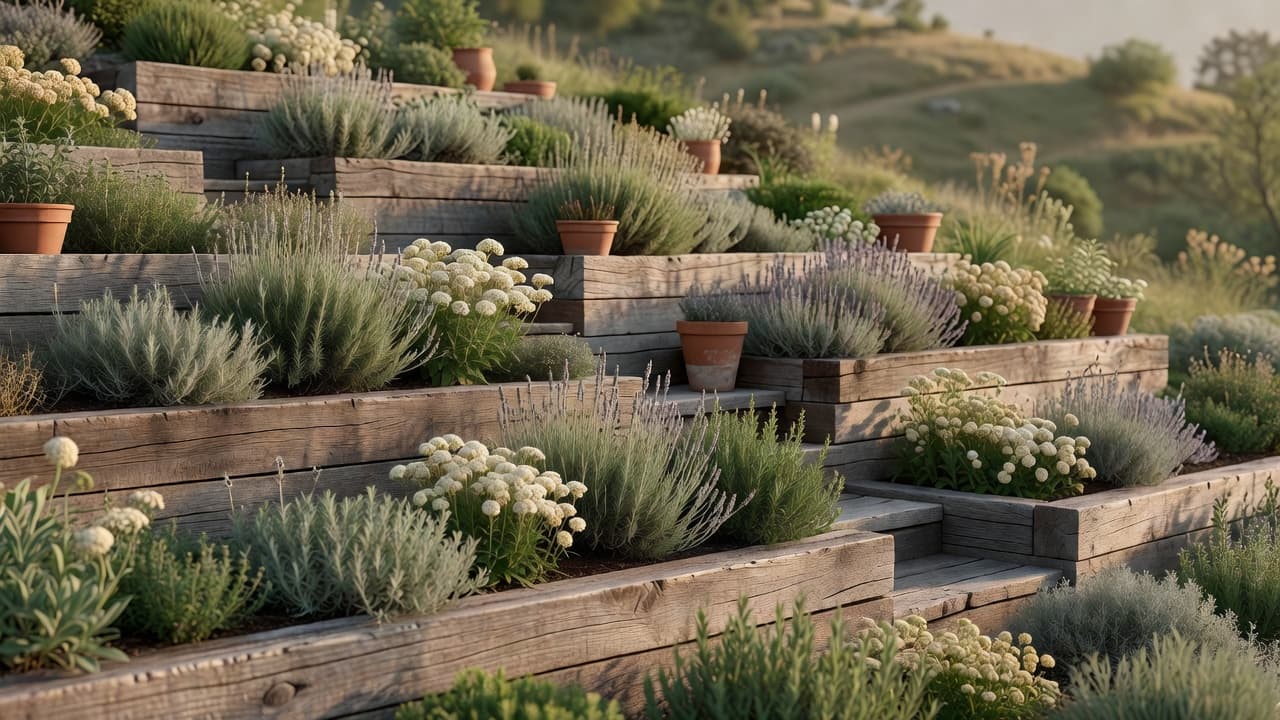
- Timber sleepers — a popular, relatively affordable choice for low walls up to roughly waist height, giving a natural look, though they have a limited lifespan and are not suited to tall or structural retaining.
- Natural stone or brick — more expensive but durable and often the best match for an older property.
- Concrete block — strong, consistent, and can be rendered or clad to suit the garden's style.
- Never use plain wooden planks as a retaining structure — gardening authorities are consistent that untreated planking rots and fails far sooner than sleepers, stone or block.
Why drainage matters more than the wall itself
A retaining wall's most common failure is not the material cracking, it is water pressure building up behind it. Backfilling a retaining wall with plain soil traps rainwater, and the resulting hydrostatic pressure can push even a well-built wall out of position over a few wet seasons. The standard fix is a perforated drainage pipe laid along the base of the wall, wrapped in roughly 30cm (12in) of clean gravel, separated from the soil above with a permeable filter fabric, with the pipe running to a safe outfall rather than dead-ending behind the wall.
- Perforated pipe at the base of every retaining wall, sloped gently to a proper outfall.
- Clean gravel backfill immediately behind the wall face, not the excavated soil.
- Filter fabric between the gravel and the retained soil, so fines do not clog the drainage layer over time.
- A planned outfall — a soakaway, ditch or storm connection, never a pipe that simply stops underground.
This detail is invisible once the garden is finished, which is exactly why it gets skipped on a tight budget and exactly why skipping it is the single most expensive mistake in sloped garden design — a failed wall usually costs more to rebuild than it would have cost to drain properly the first time.
Steps, paths and safe movement on a slope
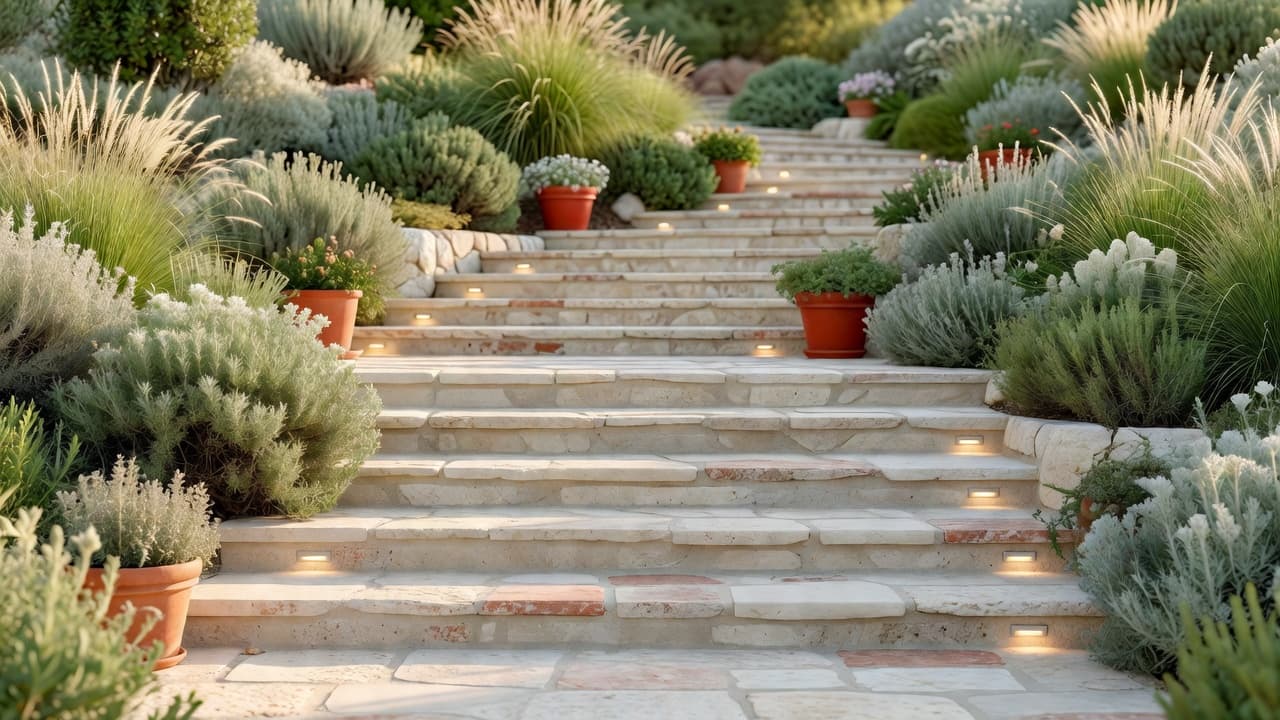
Once the levels and walls are set, how people actually move between them matters as much as how the terraces look from a window. Wide, shallow steps feel safer and more inviting than a narrow, steep run, and matching or complementing the step material to the retaining wall material gives the whole slope a sense of continuity rather than a patchwork of different fixes.
- Keep individual risers shallow — a run of gentle steps is safer and more comfortable than fewer, steeper ones, especially for anyone visiting with limited mobility.
- Use a non-slip surface on every tread, particularly stone or timber that gets damp or shaded through the day.
- Add a handrail on any run steeper or longer than a few steps.
- Consider a gently graded ramp alongside steps where the garden needs to stay accessible for a wheelbarrow, pushchair or wheelchair.
- Light every step, not just the terrace it leads to — our garden lighting design guide covers low-level step lighting in more detail.
The best plants for a sloped garden in 2026
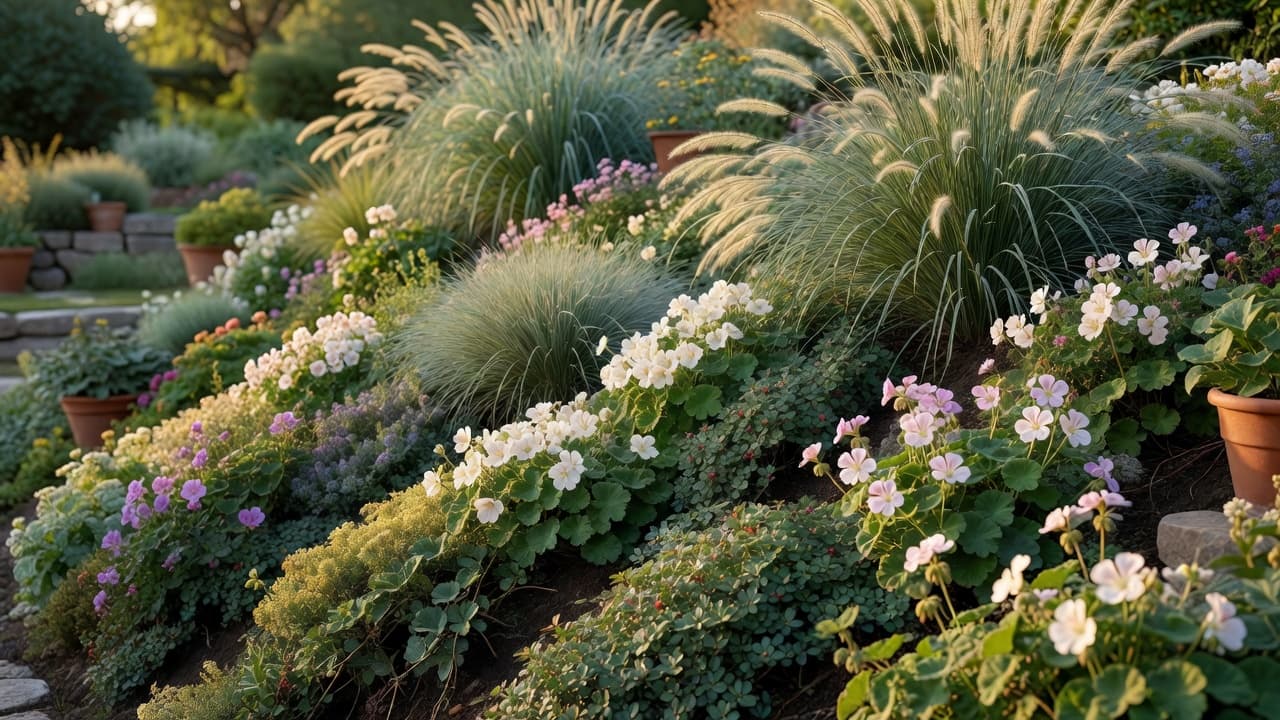
Between retaining walls, and on any bank left ungraded, planting does the real work of holding soil in place. The RHS guide to banks and slopes recommends strong-growing ground cover and climbers to stabilise soil quickly, alongside thorough soil preparation, since slope soils are often thin, poor and free-draining.
- Geranium macrorrhizum (bigroot cranesbill) — a tough, spreading perennial that forms a dense weed-suppressing mat and copes with poor, dry slope soil.
- Cotoneaster horizontalis — a low, wide-spreading shrub whose branching habit grips a bank and stabilises soil while offering autumn berries.
- Heuchera — reliable ground cover for a shadier section of slope, with foliage colour that works well layered below larger shrubs.
- Ornamental and native grasses with deep, fibrous root systems bind soil more effectively than shallow-rooted bedding plants on an open, sunny bank.
- Creeping junipers — evergreen, low-growing and well suited to a sunny, well-drained slope that needs year-round cover.
- Ferns, such as Matteuccia struthiopteris (ostrich fern), for a shaded, moist slope where little else will establish quickly.
Avoid reaching for very vigorous groundcovers like English ivy purely because they spread fast — several are now considered invasive in parts of the UK and US and can smother other planting or damage boundary structures once established, so check a plant's status locally before committing a whole bank to it. Our planting layers guide covers how to combine ground cover, mid-height shrubs and taller specimens down a slope so it reads as a designed border rather than a patch of erosion control. For the areas that need almost no upkeep once established, our low maintenance garden design guide is worth reading alongside this one.
Common mistakes in sloped garden design
- Guessing the gradient instead of measuring it, which usually leads to underbuilt steps or a retaining wall that is the wrong height for the drop.
- Backfilling a retaining wall with plain soil instead of gravel and a drainage pipe, storing up a wall failure a few seasons later.
- Using untreated wooden planks as a retaining structure, which rots far sooner than sleepers, stone or block.
- Trying to keep a close-mown lawn on a steep bank, which is genuinely unsafe to maintain and rarely stays looking good.
- Planting a thin, one-off selection instead of a repeated block of proven, deep-rooted ground cover.
- Skipping steps lighting, leaving a genuinely hazardous change of level unlit after dark.
What does a sloped garden redesign cost in 2026?
Retaining walls are usually the single biggest line item in a sloped garden budget, and the price depends heavily on material and height. In the UK, a timber sleeper retaining wall typically runs about £245 per square metre including labour, with a broader market range of roughly £120–£300 per square metre; concrete block retaining walls average closer to £260 per square metre, and overall UK retaining wall projects commonly land between £200 and £450 per square metre depending on material, height and access. In the US, retaining wall costs typically fall between $35 and $65 per square foot installed, with a wider range of roughly $15–$70+ per square foot depending on material — timber at the cheaper end, engineered concrete or natural stone at the top. Walls taller than about 1.2m (4ft) usually need engineering input and permits in both countries, which adds to the cost. Our full 2026 garden design cost guide breaks down full-garden budgets beyond the retaining structure itself, including planting, paving and lighting.
Frequently asked questions about sloped garden design
Do I need a retaining wall for a sloped garden?
Not always. A gentle slope of around 1:10 or shallower can often be managed with contoured planting and a couple of subtle level changes. Once a slope gets steeper than roughly 1:4, the RHS notes that retaining walls are usually necessary and recommends using a qualified builder or landscape contractor rather than a DIY approach.
What is the cheapest way to retain a sloped garden?
Timber sleepers are generally the most affordable structural option for a low wall, running roughly £120–£300 per square metre in the UK or towards the lower end of the $15–$70+ per square foot range in the US, though they have a shorter lifespan than stone, brick or engineered concrete block and are not suited to tall or highly loaded walls.
Why does a retaining wall need drainage?
Backfilling a wall with plain soil traps rainwater behind it, and the resulting hydrostatic pressure can push even a well-built wall out of position within a few wet seasons. A perforated pipe at the base, wrapped in clean gravel and separated from the retained soil with filter fabric, lets water escape safely instead of building up.
What plants are best for stabilising a slope?
Deep-rooted, spreading plants such as Geranium macrorrhizum, Cotoneaster horizontalis, ornamental grasses and creeping junipers for sun, and heucheras or ferns for shade, are consistently recommended for holding soil on a bank. Avoid very vigorous spreaders like English ivy where they are considered invasive locally.
Can I still have a lawn on a sloped garden?
On a gentle slope, yes, though mowing gets harder as the gradient increases. On a genuinely steep bank, close-mown grass is neither realistic nor safe to maintain long-term, and ground cover planting, gravel or terraced hard landscaping usually work better.
Can FlorAI redesign a sloped or hillside garden?
Yes. FlorAI works from a single photo of any garden, including a sloped or hillside plot, and generates a photorealistic redesign with terracing, retaining walls and slope-appropriate planting in seconds, so the layout can be tested before any structural work begins.
Last updated: August 2026. Written by the FlorAI garden team.