
Shade Gardens · 2026 guide
Shade Garden Design: A Practical 2026 Guide to Designing Under Trees
Shade garden design means matching the layout, materials and plant list to the shade a tree canopy actually casts, rather than fighting it with plants bred for open sun. The two things that make or break a shaded garden are recognising whether the shade is also dry (most canopy shade is, because tree roots pull moisture from the soil) and repeating a short list of genuinely shade-tolerant plants in blocks instead of buying one of everything. This guide covers how to read the shade under your own trees, the plants gardening authorities actually recommend for it, the hard landscaping choices that keep a shaded space usable, and the mistakes that waste a season of growing.
AI Garden Design GuidesPublished September 10, 2026Updated September 10, 202611 min read
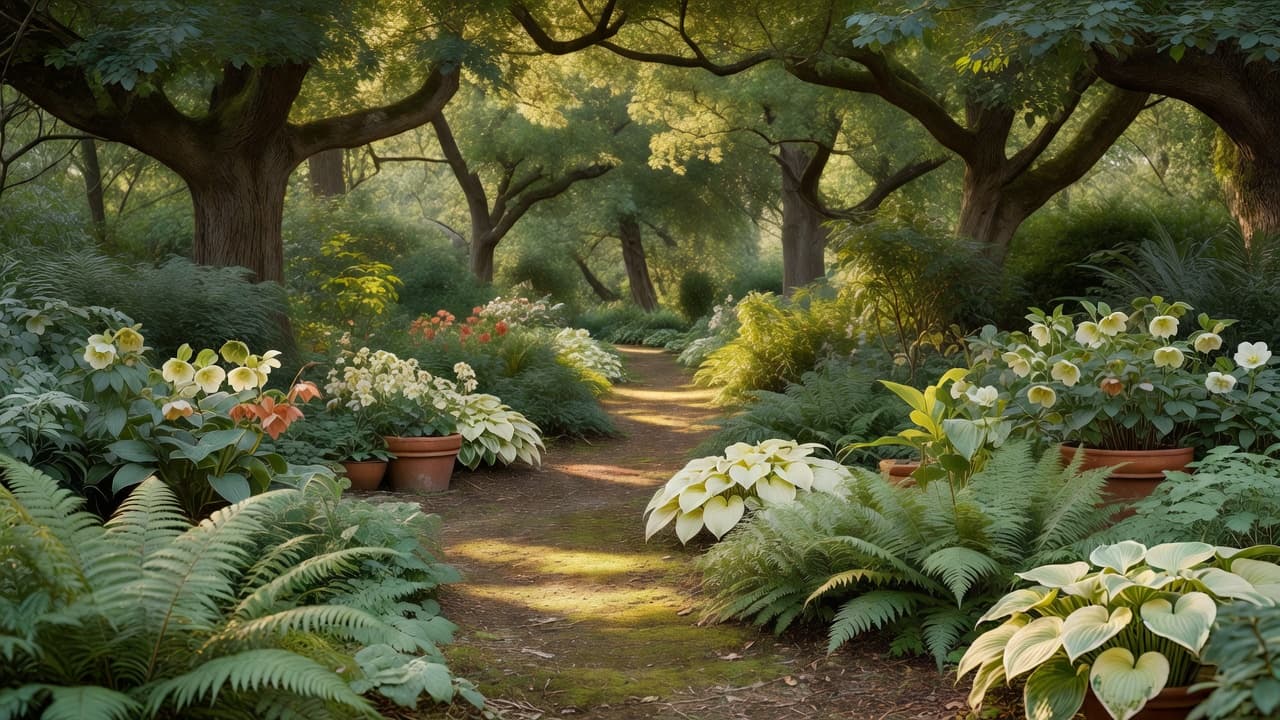
What is shade garden design?
Shade under trees behaves differently from the shade cast by a house wall. A building blocks light at a fixed angle that changes only with the seasons, but a tree canopy filters light unevenly, drops needles or leaf litter, and — critically — pulls moisture out of the soil through its root system. That combination of low light and dry soil is why so many otherwise shade-tolerant plants still fail under a mature tree. Getting a shaded garden right starts with treating "shade under trees" as its own design problem, not a smaller version of a north-facing garden. For the orientation-driven version of this problem, see our north-facing garden design guide; this guide focuses specifically on canopy shade.
How do you design a garden under trees?
The Royal Horticultural Society separates shade into practical categories that matter more once trees are involved, because a single tree can produce several of them within a few metres:
- Dappled or light shade — sunlight breaks through a thin or high canopy in moving patches; many woodland-edge plants thrive here.
- Partial shade — three to six hours of direct sun a day, often at the edge of a canopy rather than directly beneath it.
- Deep shade — dense, low canopy or evergreen cover that blocks almost all direct light; only a short list of true shade specialists will grow here.
- Dry shade — a separate axis from light level entirely: soil moisture pulled away by tree roots, common under mature deciduous trees and almost universal under conifers.
The RHS specifically recommends planting on the lighter, south-west side of a tree, where rain is more often driven in under the canopy by wind, rather than the drier, more sheltered north-east side. Mapping both light and moisture — not light alone — before choosing plants is the single biggest difference between a shaded garden that thrives and one that limps along.
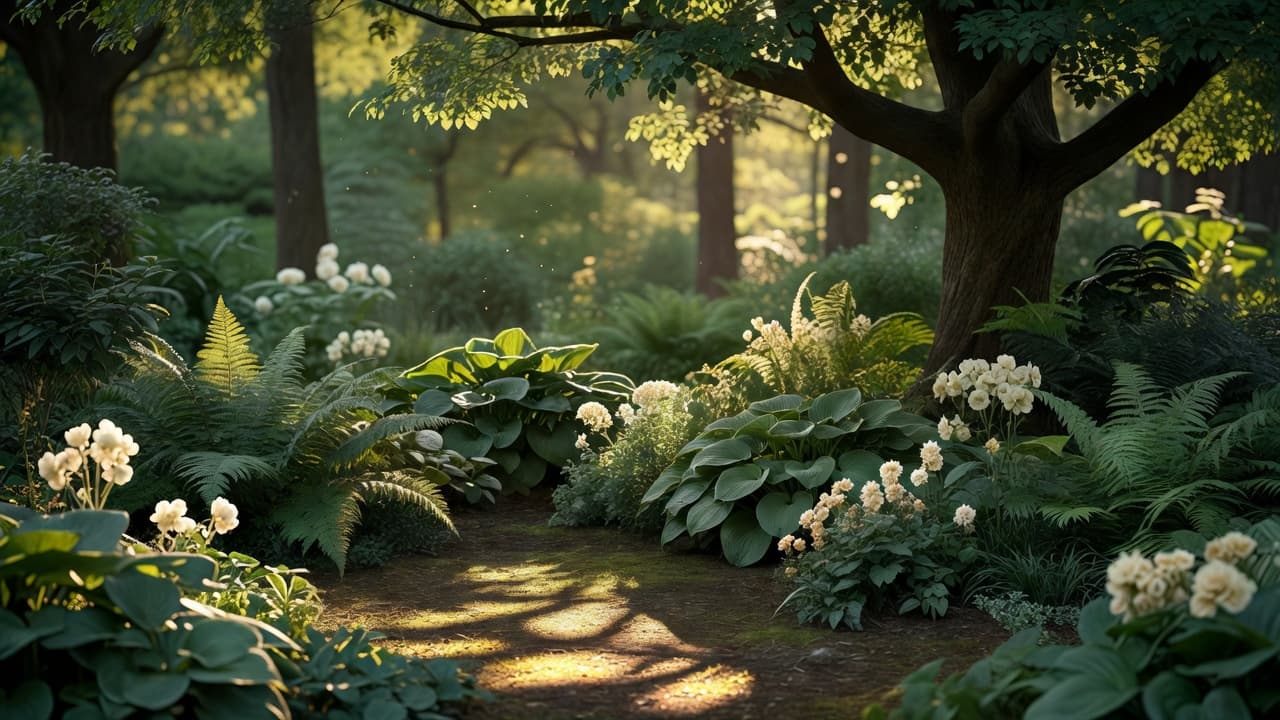
Design principles for a shade garden layout
Once the shade and moisture pattern is mapped, a handful of layout decisions do more for how usable a shaded garden feels than any individual plant:
- Put seating and paths where light actually reaches, even if that means curving a path away from the base of a tree rather than running it in a straight line.
- Keep the area within the root zone open and mulched rather than densely planted, since digging planting holes among tree roots damages both the tree and the new plants' chances of establishing.
- Use pale gravel or timber for paths under a canopy — light surfaces read as brighter and dry faster after rain than dark paving, which stays damp and slippery under trees.
- Layer planting by height — taller shade-tolerant shrubs at the drip line, then perennials, then a shade-tolerant ground cover closest to the trunk, mirroring how a real woodland edge is structured.
- Leave the canopy itself alone where possible and design around it; removing lower branches to "let in more light" can stress a mature tree and needs a qualified arborist's advice, not a DIY decision.
These principles hold regardless of garden size, and they matter more under trees than any single "best" plant choice — a well-considered layout makes a short plant list look intentional, while a poor layout makes even a good plant list look like an afterthought. Our colour theory for garden design guide goes further into using pale, reflective tones deliberately in a low-light space.
The best plants for a shade garden in 2026
Gardening authorities keep returning to a similar shortlist of genuinely shade- and dry-shade-tolerant plants, which is a good sign they actually perform rather than just photograph well. RHS dry-shade planting combinations and Gardeners' World's shade-loving plant picks both lean on the same reliable genera:
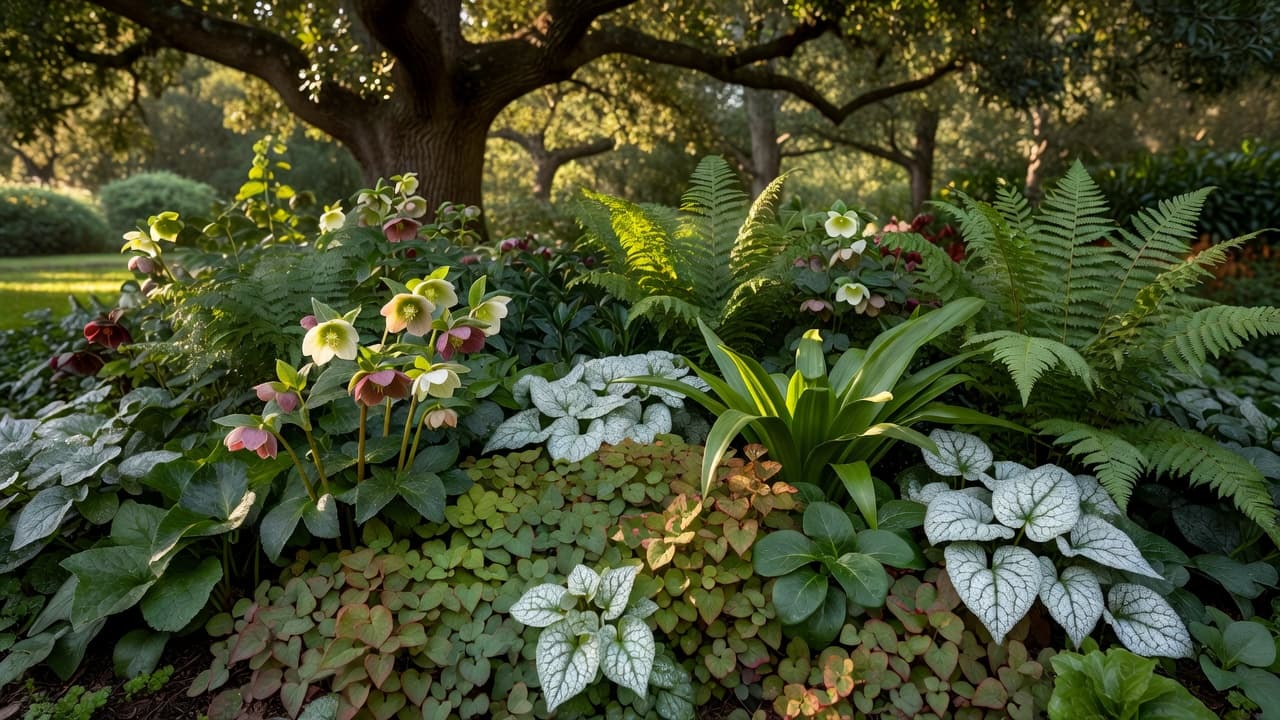
- Hellebore (Helleborus) — nodding winter and early-spring flowers that tolerate both shade and reasonably dry soil once established.
- Epimedium — a genuinely tough dry-shade ground cover with heart-shaped leaves and small spring flowers, one of the few plants that thrives right under a tree canopy.
- Brunnera — silver-veined or fully silver-leaved varieties lift a dark bed the way a variegated hosta does, with small blue spring flowers.
- Ferns, especially Dryopteris species and hart's tongue fern (Asplenium scolopendrium) — reliably tough in deep shade and largely evergreen.
- Hosta — best kept slightly away from the driest ground directly under a canopy, since it is thirstier than the true dry-shade specialists.
- Geranium macrorrhizum — one of the most drought-tolerant hardy geraniums, spreading as reliable ground cover in dry shade.
- Pulmonaria (lungwort) — early flowers for pollinators and spotted foliage that brightens shaded ground through summer.
- Japanese anemone (Anemone × hybrida) — recommended by Gardeners' World for light or dappled shade, flowering into autumn when much else has finished.
- Ivy and periwinkle (Vinca) — reliable evergreen ground cover for the driest, darkest ground close to a trunk, where little else will establish.
Always check a plant against your local hardiness zone before buying, particularly for evergreen ground cover on an exposed site; the free USDA Plant Hardiness Zone Map is the fastest way to check in the US, and most UK nurseries label stock with an RHS hardiness rating. Our flower bed planning guide covers how to lay these out in repeated blocks rather than one of each.
How do you fix dry shade under trees?
Dry shade is a soil problem as much as a light problem, and the RHS recommends treating it as such before planting:
- Dig in well-rotted organic matter across the planting area — garden compost or well-rotted manure — to improve the soil's ability to hold what moisture does reach it.
- Mulch every spring with a thick layer of organic mulch to slow evaporation and gradually improve the soil structure over several seasons.
- Water new plants generously for their first two seasons, even in a genuinely shaded spot — dry shade planting still needs a normal establishment period before it becomes properly self-sufficient.
- Avoid planting directly under conifers where possible; the RHS notes this is the hardest dry-shade condition of all, since the evergreen canopy blocks light and rain year-round and needle litter builds up on the soil surface.
- Choose the plants suited to the driest ground — epimedium, ivy, periwinkle and geranium macrorrhizum — for the area closest to a trunk, and reserve thirstier plants like hosta for slightly further out.
Seeing these choices applied to an actual photo of a real shaded garden makes the trade-offs easier to judge than imagining them. FlorAI can generate a photorealistic redesign from a single photo of a garden under trees, which is a useful, low-pressure way to compare a woodland-style planting scheme against what is there now before buying anything.
Hard landscaping for a shaded garden
Materials do real work in a shaded garden, because they set how quickly a path dries after rain and how much ambient light bounces back into the planting:
- Pale gravel or bark chip paths dry faster than dark, dense paving and reflect more light back up into surrounding foliage.
- Raised timber walkways or stepping stones keep foot traffic off compacted, root-filled soil, which matters more under a canopy than anywhere else in the garden.
- Avoid non-porous paving directly over a tree's root zone — it stops rain reaching the roots and can stress a mature tree over time.
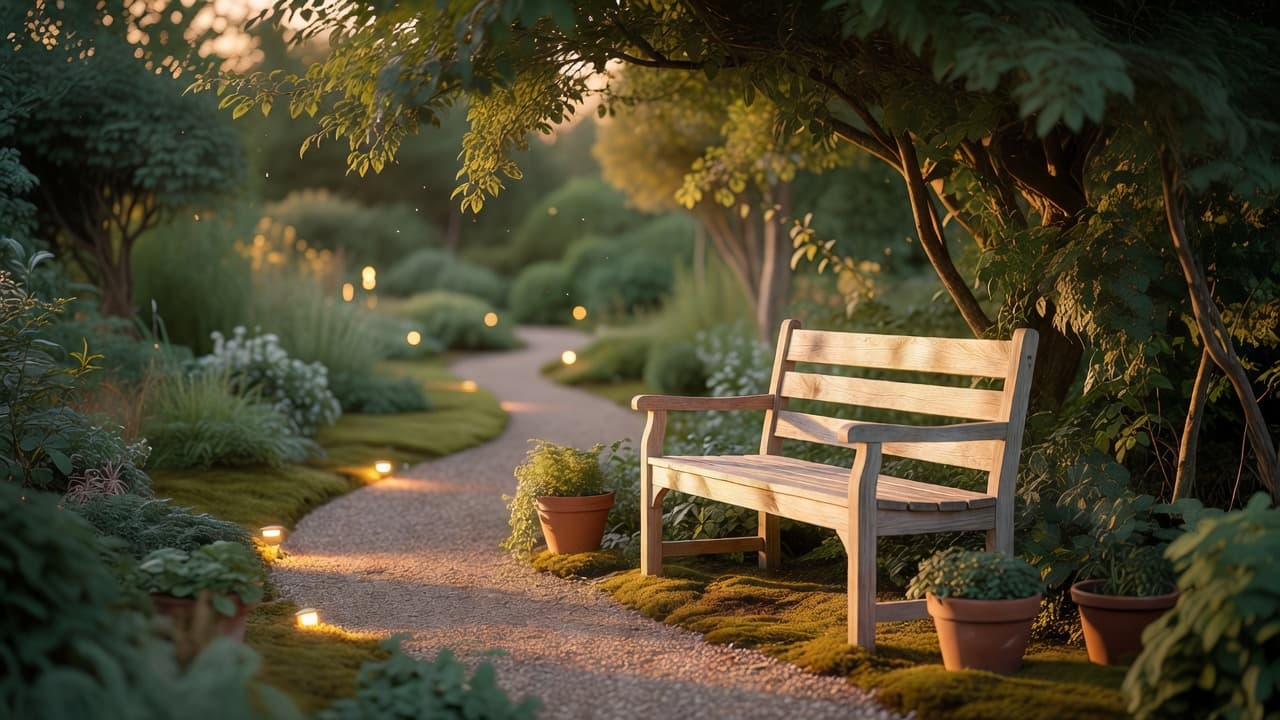
- A pale bench or seating area at the canopy edge, rather than hard against the trunk, gets more usable light and stays drier underfoot.
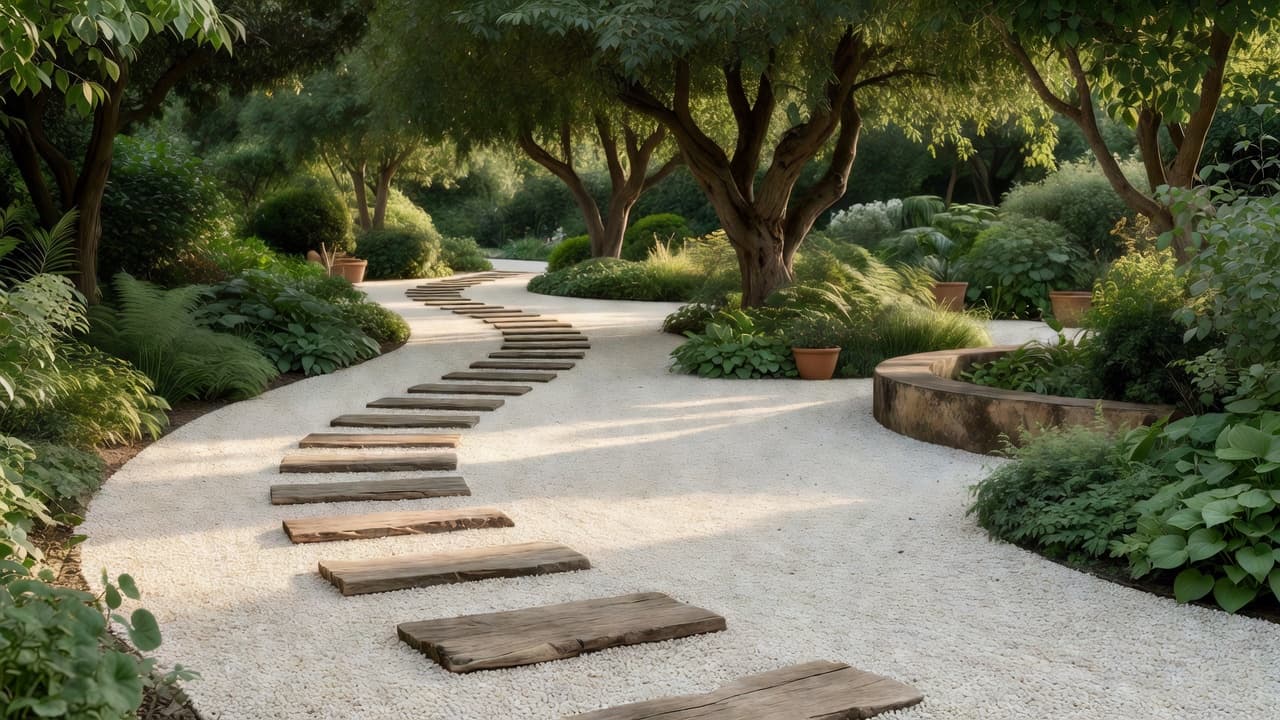
Seating and lighting for a garden under trees
A canopy-shaded garden loses useful daylight earlier than an open one, which makes both seating placement and lighting more functional decisions than purely decorative ones:
- Position seating at the canopy edge or in a clearing rather than directly under the densest branches, for both light and safety from falling deadwood.
- Warm, low-level path lighting extends usable evening hours without competing with the dappled daylight that remains.
- Uplighting a single specimen trunk or a fern creates a focal point that reads well once the canopy above goes fully dark.
- Avoid a single bright overhead light, which flattens the natural depth a tree canopy gives a garden rather than complementing it.
Our dedicated garden lighting design guide goes further into fixture types and realistic costs for a full evening scheme, and the low maintenance garden design guide is worth reading alongside this one, since shade-tolerant ground cover naturally reduces upkeep too.
Common mistakes in shade garden design
- Planting sun-loving species under a canopy — lavender, roses and most Mediterranean planting sulk and eventually fail in genuine tree shade, however appealing they look elsewhere.
- Treating all shade as the same, when dappled shade at a canopy edge and deep dry shade against a trunk need almost entirely different plant lists.
- Ignoring soil moisture and assuming any shade-tolerant plant will cope, when dry shade under a mature tree or conifer specifically calls for drought-tolerant shade specialists.
- Digging large planting holes among surface tree roots, which damages the tree and rarely gives a new plant enough root run to establish anyway.
- Choosing dark paving or mulch to look "tidy," which quietly removes reflected light a shaded bed badly needs.
- Skipping the establishment watering period for new dry-shade plants, assuming shade alone means they need no attention in year one.
What does a shade garden redesign cost in 2026?
A shade garden redesign typically costs a similar amount to any other garden of comparable size — canopy shade does not usually add cost on its own, though soil improvement (organic matter and mulch) adds a modest, worthwhile line item. As a realistic 2026 baseline, a compact UK project combining pale porous paths, a dry-shade planting scheme and basic lighting runs roughly £1,500–£5,500, with a small US project in the region of $2,000–$7,500. Our full 2026 garden design cost guide breaks larger projects down further.
Frequently asked questions about shade garden design
What grows well in a shade garden under trees?
Hellebores, epimedium, brunnera, ferns such as Dryopteris species, hardy geraniums like Geranium macrorrhizum, pulmonaria, Japanese anemone, ivy and periwinkle are all reliable in shade under trees, with epimedium, ivy and periwinkle the toughest choices for the driest ground closest to a trunk.
Is shade under trees the same as dry shade?
Not always, but they overlap heavily. Tree roots pull moisture from the soil, so most canopy shade is also dry shade, especially under mature deciduous trees and almost universally under conifers. Checking both light level and soil moisture before choosing plants gives far more reliable results than checking light alone.
How do you improve soil for a dry shade garden?
Dig in well-rotted organic matter before planting, mulch every spring to slow evaporation, and water new plants generously through their first two seasons even though the spot is shaded. This gradually improves both moisture retention and soil structure.
Can you have a path or seating area under a tree canopy?
Yes, though pale, porous surfaces such as gravel, bark chip or raised timber walkways work better than dense dark paving, which stays damp and can restrict water reaching the tree's roots. Position seating at the canopy edge rather than hard against the trunk for more usable light.
Does a shade garden cost more to redesign?
Not usually. A compact UK redesign combining pale porous paths, dry-shade planting and basic lighting typically runs £1,500–£5,500 in 2026; soil improvement is the main extra line item, not the shade itself.
Can FlorAI redesign a shaded garden under trees?
Yes. FlorAI works from a single photo of any garden, including one shaded by mature trees, and generates a photorealistic redesign with shade-appropriate planting and lighter materials in seconds, so the look can be tested before anything is bought or built.
Last updated: September 2026. Written by the FlorAI garden team.