
Comparison · 2026
3D Garden Design vs AI Photo Design: An Honest Comparison
3D garden design software builds a scaled model of your plot that you can rotate and walk through; an AI photo-based app turns a photograph of your actual garden into a photorealistic redesign. They solve different problems, and most homeowners only need one of them. This guide explains what each genuinely does well, where each falls short, and how to decide which one matches your project.
AI Garden Design GuidesPublished August 22, 2026Updated August 22, 20268 min read
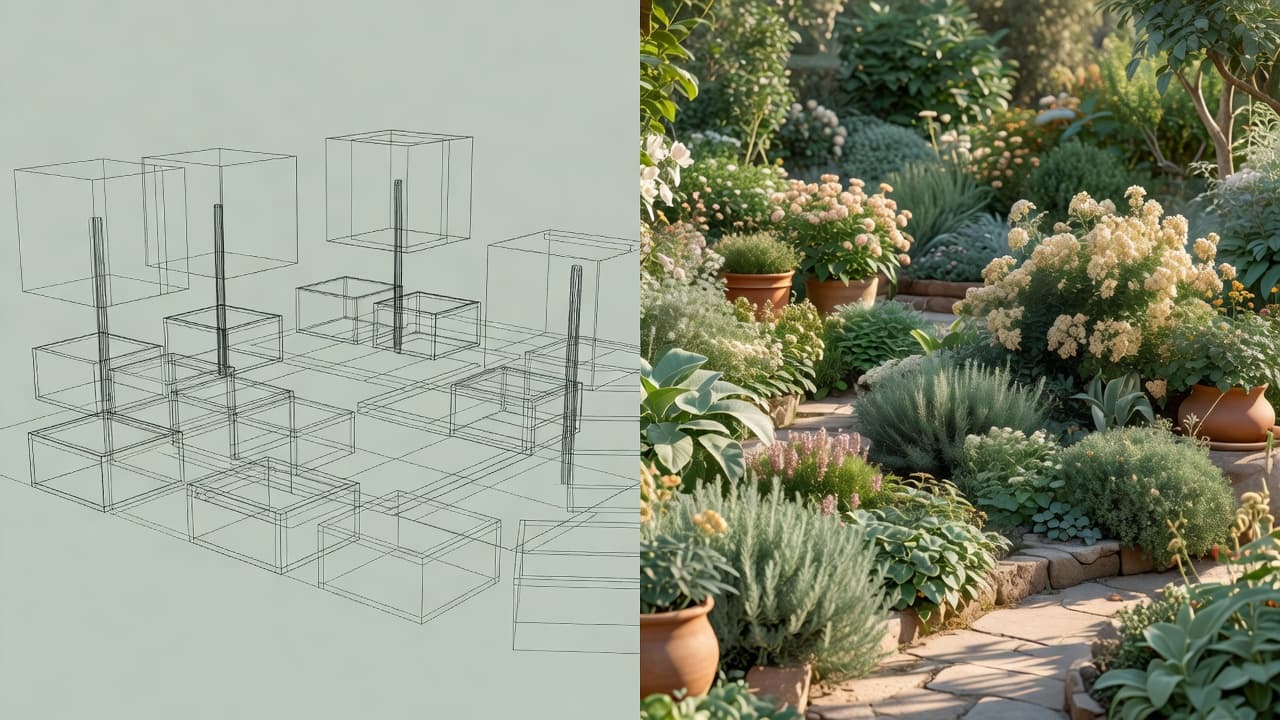
The one-line answer
Neither is objectively better. They are built for different stages of a project, and for different kinds of people.
What 3D garden design actually gives you
A 3D garden design tool asks you to build a model: set the boundary, mark the house and any fixed structures, then place beds, paths and features on a scaled plan. Once built, most tools let you rotate the view, walk through it in a simplified render, and adjust the layout with real dimensions attached to everything.
- Real measurements — useful for ordering materials or briefing a contractor.
- A rotatable view — you can check sightlines from multiple angles, including from inside the house.
- Structural planning — levels, retaining walls and drainage falls can be modelled, at least approximately.
- A plan a builder can work from, or at least start from, once it is refined.
The cost of all that is upfront effort. You are building a small piece of CAD before you see anything, and the render quality of most 3D garden tools is functional rather than beautiful — stylised trees, flat-shaded lawns, plastic-looking paving. It tells you the shape of the space, not what it will feel like to stand in.
What AI photo design actually gives you
An AI photo-based app like FlorAI works the opposite way. You photograph the garden you already have, choose a style, and the AI generates a photorealistic version of that same space — new planting, paving and lighting laid over your actual fence, house wall and boundaries.
- No modelling step — a result appears in about ten seconds from one photo.
- Photorealistic output — closer to seeing the finished garden than to reading a plan.
- Fast, cheap iteration — trying five styles costs a minute, not five sessions of redrawing.
- Your actual garden, not a stylised or generic version of it.
What it does not give you is a dimensioned plan. It cannot tell you how many square metres of paving to order, whether a retaining wall needs engineering, or how water will move across a slope. It is a decision-making tool, not a construction document.
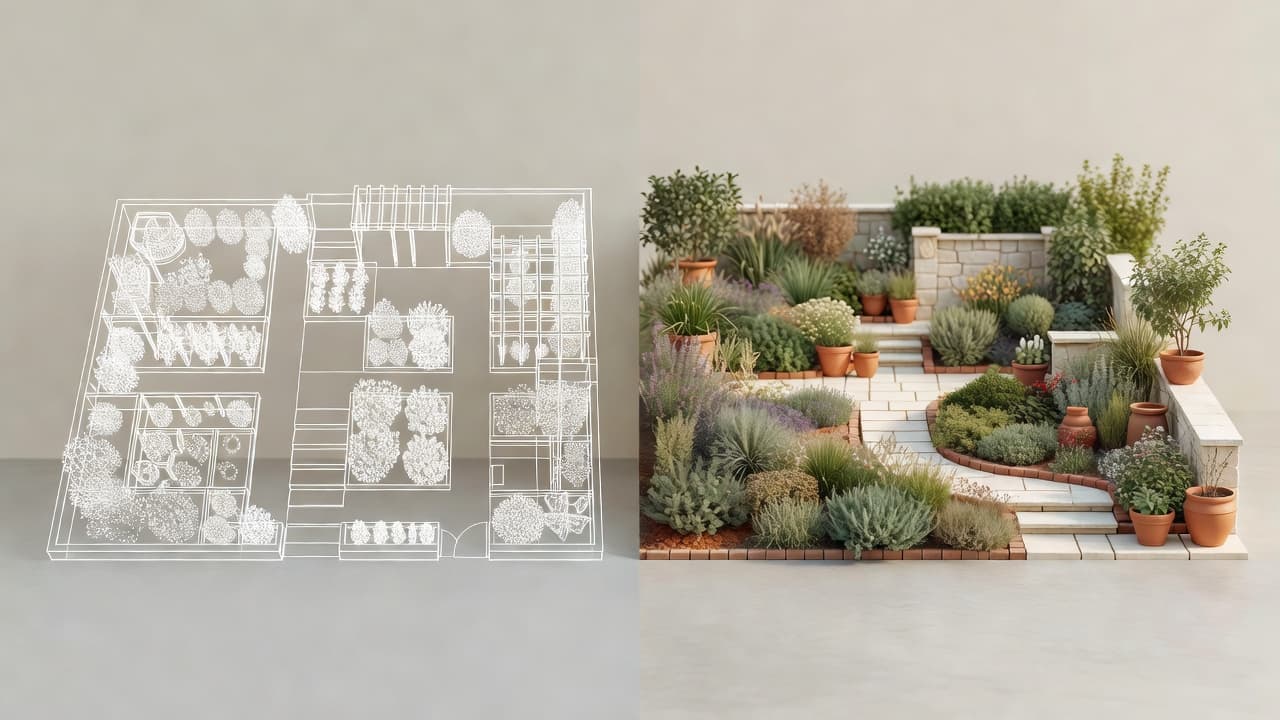
The comparison, feature by feature
- Setup time: 3D — measuring and modelling, often 30–90 minutes for a first plot. AI photo — one photograph, seconds.
- Realism: 3D — accurate shape, stylised finish. AI photo — photorealistic finish, approximate but faithful shape.
- Measurements: 3D — yes, built in. AI photo — no, it is a picture, not a plan.
- Iteration speed: 3D — slow, each change is manual. AI photo — near-instant, regenerate freely.
- Learning curve: 3D — real, closer to CAD software. AI photo — none — take a photo, pick a style.
- Best used for: 3D — structural planning and contractor documentation. AI photo — deciding what you actually want.
When 3D is genuinely the better choice
If your project involves changing levels, building a retaining wall, laying drainage, or you need to order a precise quantity of paving or turf, a 3D tool — or a professional using one — earns its complexity. Structural and dimensional accuracy is exactly what an image cannot give you, however realistic it looks.
It is also the right tool if you are already working with a landscape designer, since most professional workflows are built around measured plans. See our comparison of AI planning versus hiring a landscape designer for where that line usually sits.
When AI photo design is genuinely the better choice
If the honest question is "what should this garden look like?" rather than "how do I build it?", a photo-based AI tool answers faster and more usefully. Most home projects start exactly there — undecided on style, unsure whether the lawn should stay, not certain the fire pit belongs in that corner.
It is also the better choice if 3D modelling itself is the barrier. Plenty of people abandon a 3D garden planner at the measuring stage and never get to see a single design. A photo-first tool removes that barrier entirely — see our guide for beginners for more on why that matters.
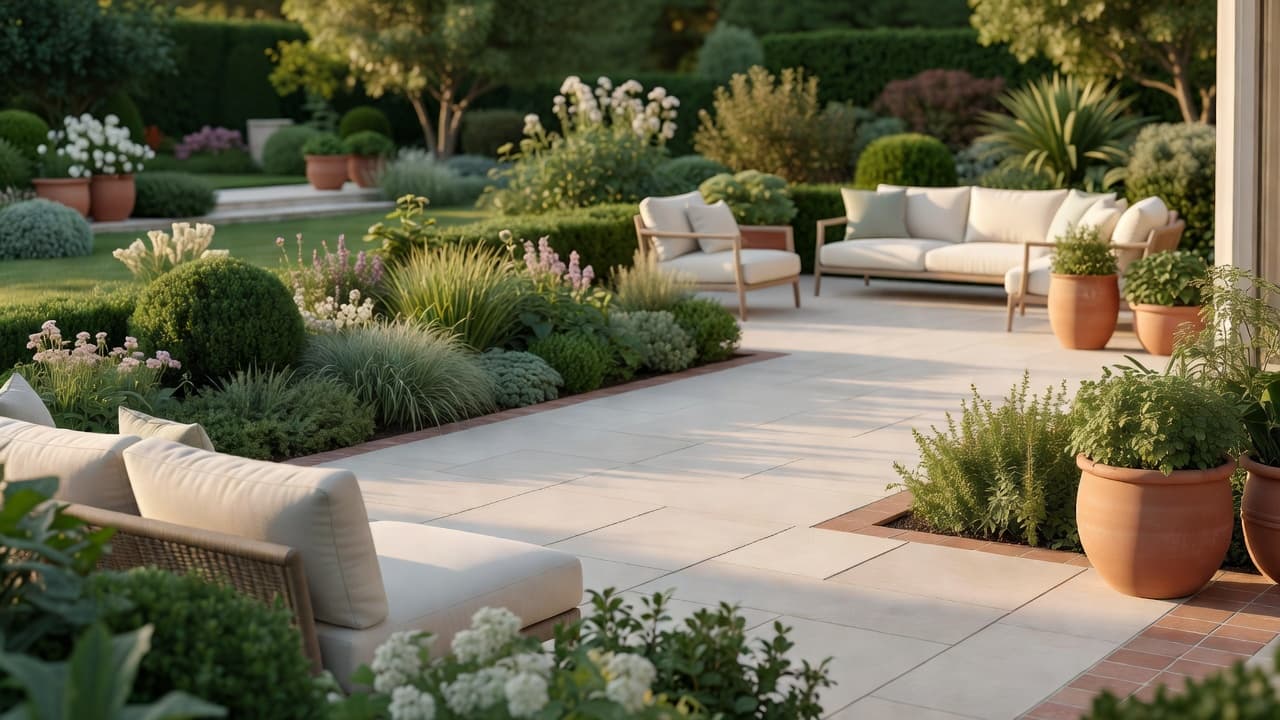
The workflow most homeowners actually want
In practice, the two are not really competitors — they are sequential. Use a photo-based AI tool first, cheaply and quickly, to settle on a style and a rough layout. Once you know what you want, a landscaper or a 3D tool takes that decision and turns it into something buildable, with real measurements and structural detail.
That order matters. Deciding first with a fast, photorealistic tool means you are not paying a professional an hourly rate to help you figure out your own taste — you arrive with a clear picture, and the measured planning that follows is shorter and cheaper as a result.
FlorAI is built for exactly that first step — free to try, from a single photo, with no modelling required.
Frequently asked questions
Is 3D garden design better than an AI photo app?
Neither is better in general — they answer different questions. 3D gives you a measured, buildable model at the cost of setup time. An AI photo app gives you a fast, realistic picture of your own garden but no dimensions.
Can an AI photo app replace 3D garden design software?
For deciding what you want, yes. For producing a dimensioned plan a contractor can build from, no — you still want a 3D tool or a professional for that step.
Which one is easier for a beginner?
A photo-based AI app, by a wide margin. There is no measuring, drawing or scale to set — you photograph the garden and choose a style.
Does FlorAI offer 3D garden design?
No. FlorAI works from a photograph and produces photorealistic redesigns, not a rotatable 3D model. That is a deliberate trade-off in favour of speed and realism over dimensional accuracy.
Can I use both tools on the same project?
Yes, and it is a sensible pattern — decide the look with a fast photo-based tool, then hand the direction to a professional or a 3D tool for the measured, buildable plan.
Which produces more realistic-looking results?
AI photo design, because it works from a real photograph and generates photorealistic imagery. Most 3D garden tools use stylised, simplified rendering rather than photorealism.
Last updated: August 2026. Written by the FlorAI garden team.