
Buyer’s guide · 2026
AI Water Garden Design: A 2026 App Guide
AI water garden design uses a photo of your existing yard to generate a photorealistic pond or water-feature redesign — liner shape, edging, planting and filtration — in seconds, so you can compare options before committing to a contractor quote. The best AI water garden design apps keep your actual layout, fence line and house in place and only change the water feature and its surroundings, rather than inventing a generic pond that looks nothing like your yard. This guide covers what a genuinely useful AI pond design app should do, how liner, pump and filtration choices compare, which plants actually thrive in a water garden, the safety considerations any pond design has to work around, and what a water garden realistically costs in 2026.
AI Garden Design GuidesPublished August 13, 2026Updated August 13, 202610 min read
What is AI water garden design?
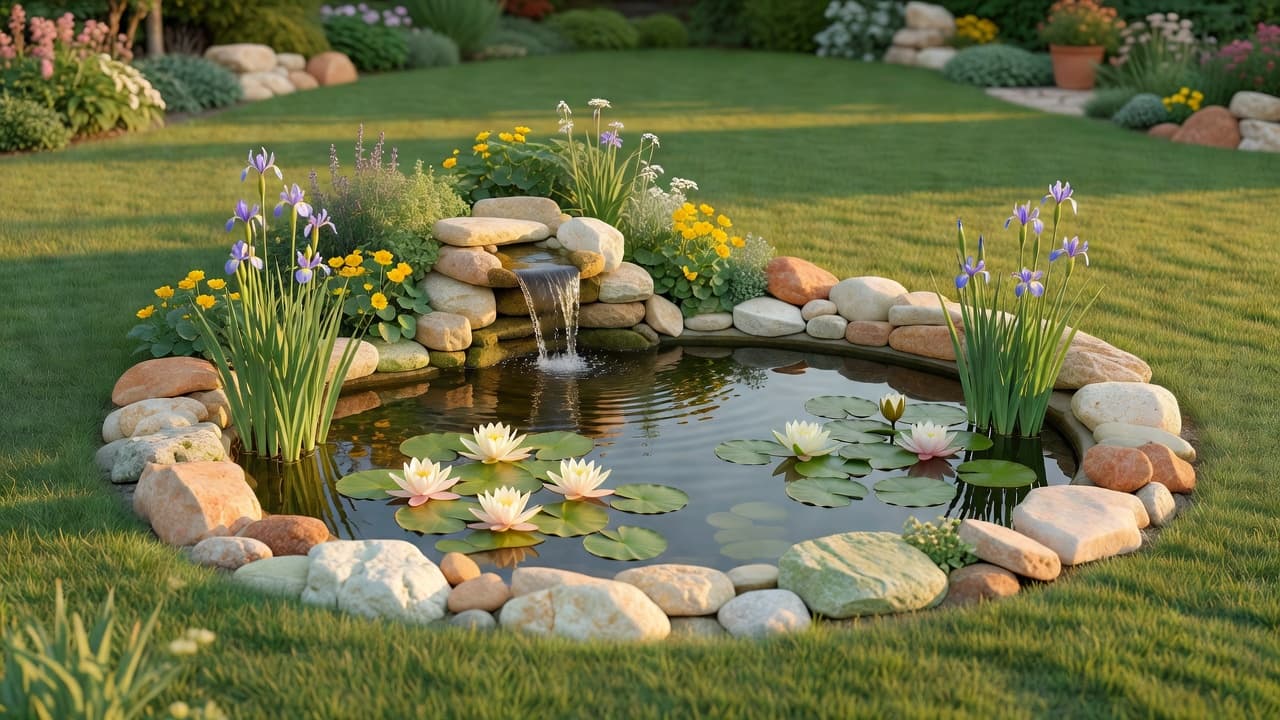
A water garden is one of the more technical spaces to redesign well, because liner shape, pump capacity, planting zones and drainage all have to work together around a feature that holds standing water year-round — you cannot simply sketch a pond onto a plan and know it will hold up. That is exactly where an AI tool earns its keep: instead of imagining how a kidney-shaped pond with a rock waterfall would look from a plan, an AI water garden design app renders it directly onto a photo of the yard you already have. Our broader AI garden design guide covers how this technology works across a whole garden; this guide focuses specifically on ponds and water features.
Most tools work the same basic way: upload one photo of the yard from a patio door or a corner of the garden, and the app returns several redesign options — different pond shapes, edging materials and planting schemes — rendered against the real geometry of your lawn, existing beds and house. It is a starting point for a conversation with a pond installer or landscaper, not a replacement for a structural, drainage or safety review.
What to look for in an AI water garden design app
Not every AI image tool is built for this job. A generic AI image generator will happily invent a pond that has no relationship to your actual yard; a genuine water garden design tool keeps your real lawn, boundaries and house in place and only changes the water feature and its surrounds. Look for:
- Photo-based, not prompt-only. The redesign should be generated from your own photo, keeping your real garden boundaries, sightlines from the house and existing planting intact — not a fresh AI-generated yard that happens to look similar.
- Multiple pond shapes and edging options in one run. A useful tool lets you compare a naturalistic rock-edged pond against a formal geometric one on the same photo, so you are judging style, not different angles.
- Planting suggestions matched to pond zones — marginal, deep-water and oxygenating — rather than a generic "add plants" pass that ignores which species actually need to sit in water versus at the pond edge.
- A rough cost range alongside the visual, even an approximate one, so a liner or filtration idea can be sanity-checked before you call a contractor.
- Fast turnaround. A useful redesign should render in well under a minute, so you can compare five or six pond concepts in one sitting rather than waiting on a single mockup.
FlorAI is built around exactly this brief for outdoor spaces: upload a photo of your yard and it generates a photorealistic redesign — pond shape, edging, planting and water features — from that same photo in seconds, free to try on iOS, Android and the web. If you are planning a water feature as part of a wider backyard project, it is worth reading our AI backyard design app guide alongside this one.
Pond liner and edging types compared
Liner choice determines how long a pond lasts and how much it costs to fix if something goes wrong, so it is worth understanding the trade-offs before a design gets finalised.
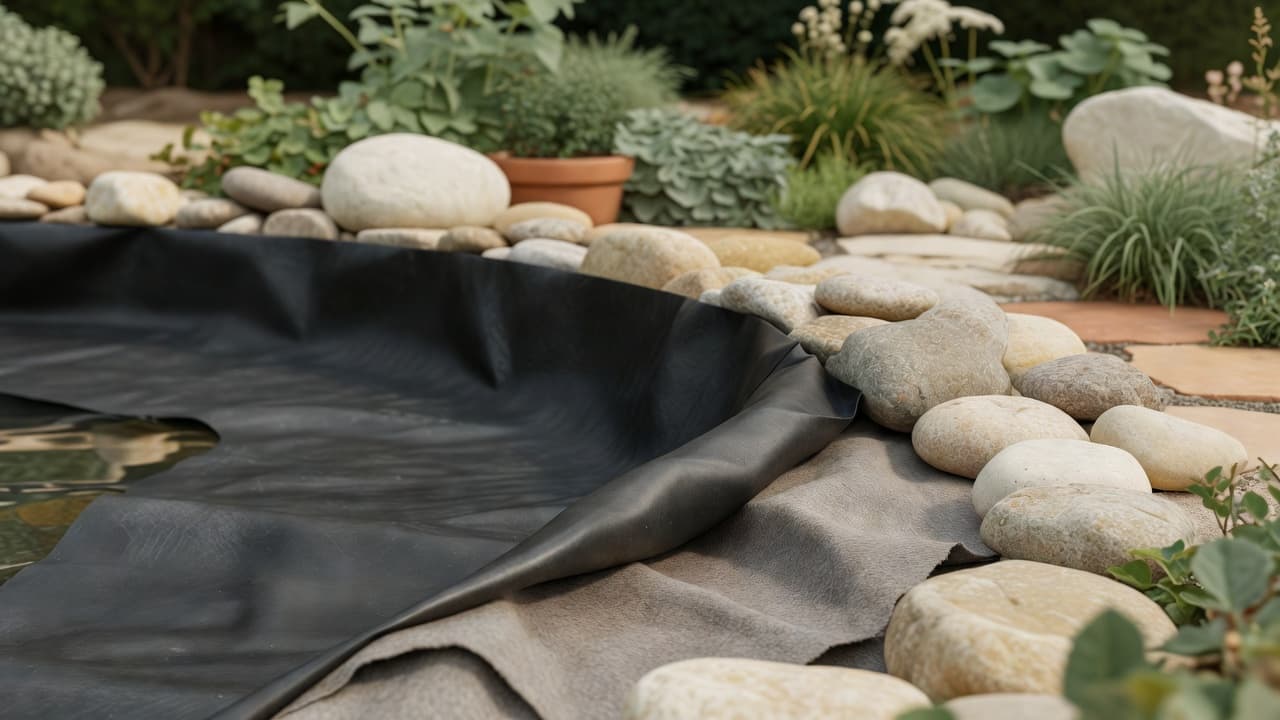
- Flexible EPDM rubber liner — the most common choice for naturalistic ponds because it stretches to fit irregular, curved shapes; typically runs $0.75–$2.00 per square foot for the liner alone and can last 20+ years if protected by underlayment.
- PVC liner — the most budget-friendly flexible option at roughly $0.35–$1.00 per square foot, but generally less UV- and puncture-resistant than EPDM over the long term.
- HDPE liner — a tougher, more chemical- and puncture-resistant flexible liner at roughly $0.50–$3.00 per square foot, often used for larger or wildlife ponds.
- Preformed rigid liner — a pre-molded fibreglass or polyethylene shell in a fixed shape, faster to install for a small formal pond but far less flexible on final shape and size.
- Concrete or reinforced pond — the most durable and most expensive option, typically only justified for larger, permanent water features or ones that need to bear weight nearby.
Whichever liner you choose, a $0.25–$0.40 per square foot underlayment beneath it is what actually prevents sharp stones and roots from puncturing the liner over time — skipping it to save money is the single most common cause of a leaking pond within the first few years.
Pumps, filtration and keeping water clear
Green, cloudy water is the single most common complaint from new pond owners, and it is almost always a sizing problem rather than a design one. A submersible pump should be sized to circulate the entire pond volume roughly once every one to two hours, with mechanical filtration to trap debris and biological filtration — beneficial bacteria colonising a media bed — to break down fish waste and excess nutrients before algae can use them.
- UVC clarifiers pass water past an ultraviolet bulb that clumps free-floating algae so the filter can remove it; as a rule of thumb, use roughly 10 watts of UV per 1,000 gallons for general clarity, and match the UV unit's rated flow to your pump so water is not moving through faster than the light can treat it.
- Mechanical and biological filtration together — most pressurised pond filters now combine both stages plus a UVC bulb in a single unit, which simplifies setup for a first-time water garden.
- Marginal and oxygenating plants act as a natural filter, competing with algae for the same nutrients — a well-planted pond typically needs a smaller mechanical filter than a bare one of the same size.
- A pump running noticeably louder or a filter clogging within days usually means it is undersized for the pond volume, not that something is broken.
Getting the plant balance right does most of the clarity work for free — the next section covers which species actually earn their place around and in the water.
The best plants for a water garden
Water garden planting works in zones, and matching the right plant to the right depth is what keeps a pond both clear and genuinely useful for wildlife. The RHS guide to aquatic planting recommends roughly four to five bunches of oxygenating plants per square metre of water surface — over-planting oxygenators can actually starve fish of oxygen overnight, so more is not always better.
- Oxygenating plants such as hornwort and water starwort — submerged species that release oxygen directly into the water and compete with algae for nutrients, usually sold in anchored bunches.
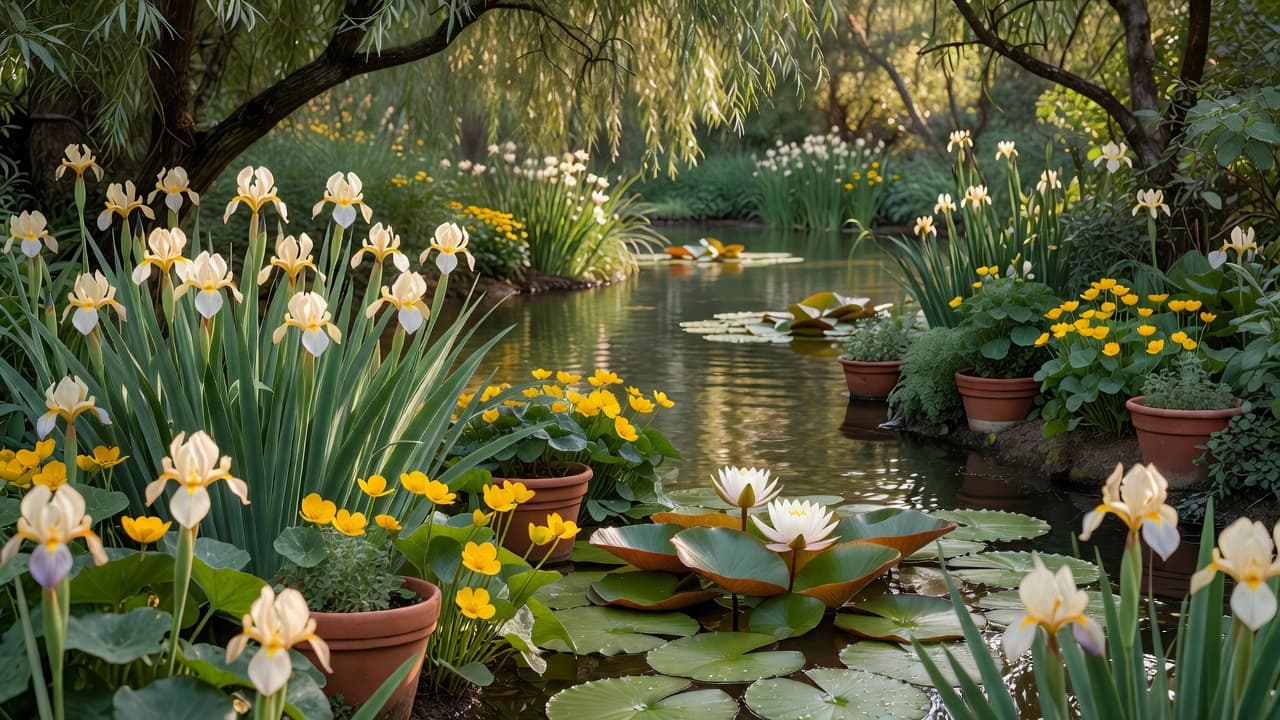
- Marginal plants like marsh marigold, water iris and flowering rush — planted in shallow water 0–45cm deep at the pond edge; tall-stemmed marginals also give emerging dragonfly and damselfly larvae something to climb.
- Deep-water plants such as hardy waterlilies — rooted in baskets at the pond floor with leaves floating on the surface, providing shade that helps suppress algae growth.
- Floating plants in moderation — but check local rules first, since several popular floaters are restricted or banned in parts of the US.
Species such as water hyacinth and water lettuce are widely sold but are now prohibited or regulated in a growing number of US states because they spread aggressively into natural waterways — Penn State Extension's guide to aquatic plants and algae is a good starting point for checking what is regulated in your region before buying. If attracting wildlife is the goal rather than just decoration, our guide to designing a wildlife garden covers pond placement and planting for pollinators, amphibians and birds in more depth.
Water garden safety rules to design around
Open water and young children are a serious combination — the CDC notes that drowning is the leading cause of death for children aged one to four, and it can happen silently in seconds, even in shallow water. A water garden design has to account for this from the layout stage, not as an afterthought.
- A shallow marginal shelf around the pond edge reduces the risk of a sudden drop-off underfoot, and doubles as the correct planting depth for marginal species — a genuine two-for-one in the design.
- Rigid mesh pond grilles, sold to sit just under the water surface, are a practical option for households with young children or pets, allowing the pond to function normally while removing open access to deep water.
- Self-latching gates and non-climbable fencing around a pond area follow the same logic recommended for pool barriers, even though most municipalities do not mandate a specific pond fence height the way they do for pools — check with your local building department, since rules vary widely by area.
- Active supervision within arm's reach of any water feature remains the most effective safety measure regardless of what barriers are in place.
If children regularly use the garden, it is worth planning the whole layout — not just the pond — with that in mind from the start; our family-friendly garden design ideas guide covers safety-first planning for the rest of the yard.
What a water garden costs in 2026
Liner and excavation are usually the largest line items in a new water garden, though a small container feature is a genuinely affordable way to start. Our garden design on a budget guide covers general ways to phase a larger outdoor project like this one.
- Flexible pond liner (material only): roughly $0.28–$5.00 per square foot depending on type (PVC, EPDM or HDPE), rising to $0.50–$6.50 per square foot once underlayment and basic installation are included.
- Full professional pond installation: typically $640–$3,980 for a small-to-mid-size residential pond, with the total project range running from roughly $300 up to $7,400+ depending on size, liner type and features like a waterfall.
- Pump and filtration system: a submersible pump with mechanical and UVC filtration for a small-to-mid pond commonly runs a few hundred dollars for the equipment alone, before installation.
- Preformed rigid liner (small formal pond): often faster and cheaper to install than a flexible liner for a small, fixed-shape feature, though less flexible on final size and design.
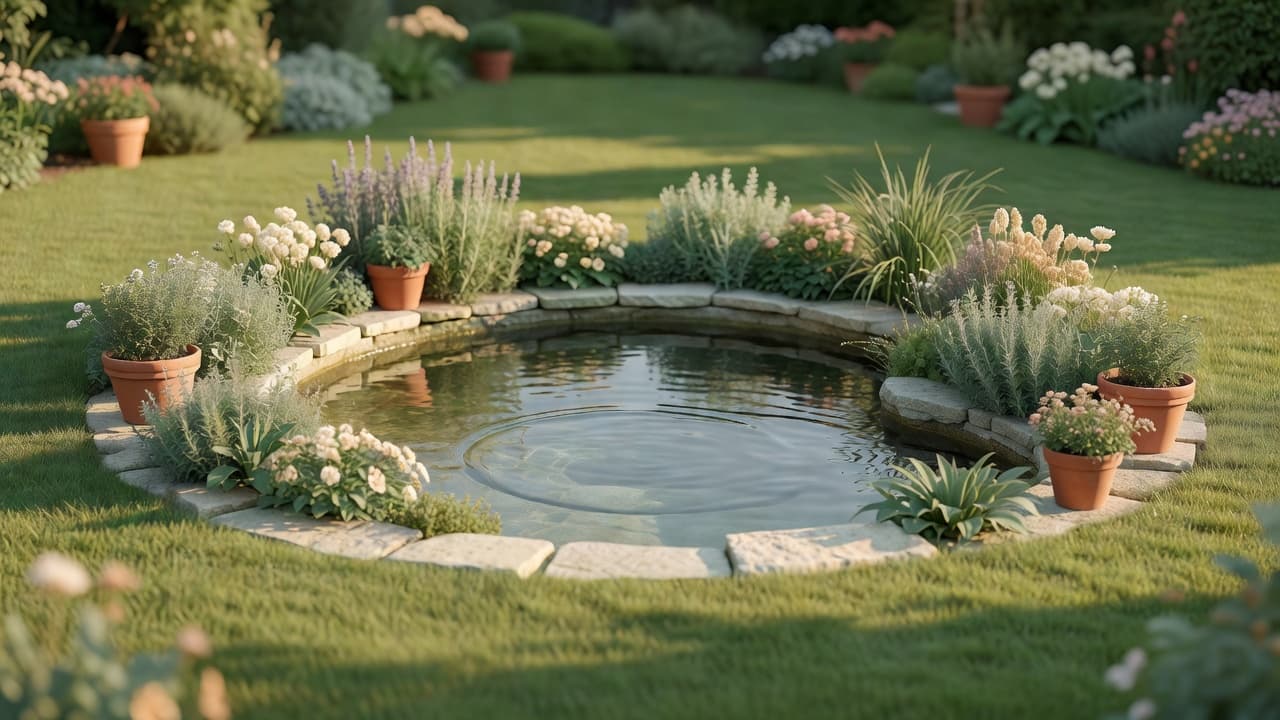
- A small container water garden — a half-barrel or large glazed pot with a miniature waterlily and a few oxygenators — is one of the most affordable ways to try a water feature, especially in a small garden; our small garden design app guide covers more compact-space ideas.
Mistakes that ruin a water garden design
- Undersizing the pump and filter for the actual pond volume. Green water within weeks is almost always a sizing problem, not a maintenance one — check the manufacturer's rated pond volume before buying.
- Skipping underlayment to save money. A puncture from a sharp stone or root a year or two after installation is one of the most common — and most avoidable — pond failures.
- Planting a restricted or invasive floating species without checking local rules first, risking both fines and ecological harm if it escapes into a natural waterway.
- Treating a pond grille or hedge as a full substitute for supervision. Physical barriers reduce risk; they do not replace active supervision around young children.
- Positioning a pond directly under deciduous trees. Falling leaves decompose in the water, feeding algae blooms and clogging filters far faster than an open-sky location.
- Skipping the shallow marginal shelf. Beyond the safety benefit, it is also the correct planting depth for marginal species — without it, marginal plants have nowhere appropriate to sit.
Seeing a pond shape, an edging material or a planting scheme applied to a real photo of your own yard makes these trade-offs far easier to judge than picturing them from a materials list. FlorAI can generate a photorealistic water garden redesign from a single photo, so you can compare pond styles and planting options before any contractor sets foot on site.
Frequently asked questions about AI water garden design
What is AI water garden design?
AI water garden design uses an app to turn a single photo of an existing yard into a photorealistic pond or water-feature redesign — liner shape, edging, planting and filtration — in seconds, keeping the real geometry of your garden rather than generating a generic image.
What is the best pond liner material?
Flexible EPDM rubber liner is the most common choice for naturalistic pond shapes and can last 20+ years with proper underlayment beneath it. PVC is more budget-friendly but less durable long-term, while HDPE offers strong puncture and chemical resistance for larger ponds.
What plants are best for a water garden?
A balanced water garden mixes oxygenating plants like hornwort, marginal plants like water iris and marsh marigold, and deep-water plants like hardy waterlilies. Always check that any floating species is not restricted in your state before buying.
Are backyard ponds safe for young children?
Open water is a serious risk for children under five, and drowning can happen silently in seconds. A shallow marginal shelf, a rigid pond grille and active supervision within arm's reach are the most effective safety measures; check local rules on fencing with your building department.
How much does a water garden cost in 2026?
A flexible liner alone runs roughly $0.28–$5.00 per square foot depending on material, with full professional pond installation typically costing $640–$3,980 for a small-to-mid-size residential pond, and more for larger or waterfall features.
Can AI help design a garden pond?
Yes. An AI garden design app like FlorAI can turn a single photo of your yard into a photorealistic pond redesign, making it much easier to compare liner shapes, edging and planting before committing to a contractor quote.
Last updated: August 2026. Written by the FlorAI garden team.